English Version
Mountains have appeared on Scary Japan before for good reason. Even though they are part of the same planet we live on, some places on Earth still feel almost unreachable: unclimbed peaks, Everest routes where bodies have become grim landmarks, and mountains such as Annapurna, often cited for its terrifying fatality rate.
The scale and force of nature can make human beings feel impossibly small.
And around the world, there are still mountains and rock walls that even top-class climbers, equipped with modern gear, struggle to climb. When people talk about the world’s most difficult peaks, many mountain fans might immediately think of K2 or Nanga Parbat.
Of course, K2 and Nanga Parbat are extremely serious mountains. They are not places where an ordinary beginner can train a little and safely try their luck. These are mountains for professionals. But there are other peaks said to be even harder to summit.
Latok: A Karakoram Nightmare
One of those names is Latok.
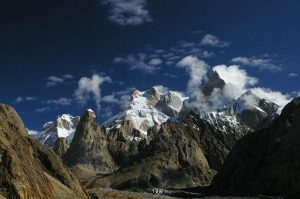
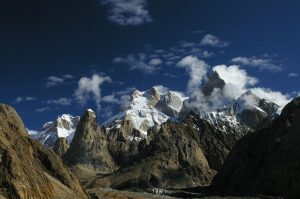
The Latok group is a set of steep, rocky mountains in the Karakoram Range. Latok I stands at 7,145 meters, which is far below the famous 8,000-meter giants. But height alone does not decide how frightening a mountain is.
Latok has four main peaks:
- Latok I: 7,145 meters
- Latok II: 7,108 meters
- Latok III: 6,949 meters
- Latok IV: 6,456 meters
All four are considered extremely difficult and hard to summit. Photographs of the mountains make the reason obvious: the ridges and faces are brutally steep.
Latok I was once attempted by Japanese climber Yasushi Yamanoi, who has many devoted fans among mountaineering enthusiasts. This was before the accident in which he lost fingers. Yamanoi is often described as one of Japan’s strongest climbers, and he even climbed K2 solo. Yet even he was unable to reach the summit of Latok I.
Latok I was first climbed in 1979, and the successful climbers were Japanese. According to the sources cited in the original article, no one had managed to repeat that summit afterward. Whether discussing old records, attempted routes, or changing conditions, Latok remains one of those mountains whose reputation is built not on height alone, but on the way it rejects climbers.
Gasherbrum IV: Lower Than 8,000 Meters, But Not Easier
Gasherbrum is also located in the Karakoram Range. Gasherbrum I and Gasherbrum II both rise above 8,000 meters, placing them among the world’s highest mountains.
But the peak often described as especially difficult is Gasherbrum IV, which stands at 7,925 meters.
Although it does not quite reach 8,000 meters, it is still one of the highest mountains on Earth, and technically it is said to be more difficult than Gasherbrum I or II. One Japanese woman climber, known as the first Japanese woman to successfully summit K2, reportedly looked out at Gasherbrum from the top of K2 and described it as “harder than K2.”
Yasushi Yamanoi also attempted Gasherbrum IV but gave up because of bad weather. After that, he climbed Gasherbrum II instead and reportedly said he had enough energy left that he could have gone back and forth.
That kind of comment says a lot. For most people, even imagining a single climb in that range is overwhelming. For an elite climber, Gasherbrum II could feel manageable compared with the menace of Gasherbrum IV.
From “Which Mountain?” to “Which Route?”
In modern mountaineering, the focus has shifted.
All fourteen of the 8,000-meter peaks have been climbed. Ascents without supplemental oxygen, once almost unthinkable, are no longer rare among elite climbers. Because of that, many of the world’s top climbers now focus less on simply asking “Which mountain can be climbed?” and more on asking “Which route can be climbed?”
Even on mountains that have already been summited, there are still untouched or unfinished routes. There are also enormous walls that remain among the great unsolved problems of alpinism.
The West Face of Makalu
Makalu is one of the fourteen 8,000-meter peaks. At 8,481 meters, it is the fifth-highest mountain in the world.
Its west face is especially feared. Just below the 8,000-meter zone, the mountain rises into a near-vertical wall, with sections that are said to overhang. This face has been called one of the great challenges of the Himalayas.
According to the original article’s sources, no climber had fully completed this wall at the time discussed. The idea of an overhanging, vertical wall at such an altitude is almost unreal. It is the kind of place where even the air itself becomes an enemy.
Nanga Parbat and the Rupal Face
Nanga Parbat stands at 8,125 meters and is one of the most difficult 8,000-meter peaks. It has long carried grim nicknames such as “the Killer Mountain” and “the Man-Eater Mountain.”
On Nanga Parbat is the Rupal Face.
The height difference of the Rupal Face is an astonishing 4,800 meters. In other words, the wall alone rises far higher than Mount Fuji. It is both an object of awe for climbers and one of the most dangerous places in the world of high-altitude mountaineering.
Until relatively recently, Nanga Parbat had not been climbed in winter. That means even the easiest route, avoiding the Rupal Face, was considered extremely difficult under winter conditions.
Now imagine the Rupal Face itself: a 4,800-meter wall rising on a mountain already known as the Killer Mountain. Just thinking about it is enough to send a chill through you.
There are also difficult variation routes on other peaks, including Cho Oyu and Manaslu. The west face of Makalu, the Rupal Face of Nanga Parbat, and winter attempts on these enormous walls remain the kind of challenges that make people wonder: will someone someday complete them?
The Rupal Face can reportedly be seen from trekking routes, even if climbing it is far beyond the reach of ordinary travelers. However, this is not a casual sightseeing spot. Nanga Parbat has also been the site of past terrorist attacks targeting climbers. Anyone considering travel in the region should check current government travel advisories, use reputable local operators, follow permit rules, and understand that even viewing the mountain from trekking areas can involve serious altitude, weather, and security risks.
The Terror of Scale
There are many mountains in the world rising above 7,000 or 8,000 meters. But among them are peaks and walls that remain especially difficult to climb: Latok, Gasherbrum IV, the west face of Makalu, and the Rupal Face of Nanga Parbat.
They remind us that Earth still has places where human ambition feels tiny. These are not haunted ruins or cursed tunnels, but they carry their own kind of fear: the cold, silent terror of nature on a scale the human body was never meant to challenge.
Japanese Language
オカルトオンラインでも何度か取り上げてきた「山」。同じ地球上の陸地なのにまだだれも登っていない未踏峰や、 遺体が目印になっているエベレスト 、死 亡率38%のアンナプルナ など、自然の力とスケールの大きさはな私たち人間のサイズ感をはるかに凌駕するもの…。実は世界には、世界トップクラスのクライマーが最新の装備を持ってもなお、なかなか登れない山や岩壁があるんです。世界屈指の難峰「ラトック」「ガッシャーブルムⅣ峰」。世界屈指の難峰…と言われると山に詳しい人ならK2やナンガ・パルバットなどをあげることでしょう。
もちろん、K2もナンガ・パルバットも難峰です。そんじょそこらの素人がちょっとトレーニングしたくらいでは登れないプロの山です。ですが、この山たちよりも登頂が困難だと言われている山があるんです。それが、ラトックと呼ばれる山々です。ラトックはカラコルム山脈にある急峻な岩山で1峰の標高は7145メートルと、8000メートルには遠く及ばない山です。ラトック峰。。。画像引用 Wikipedia 。ラトックには4つのピークがありそれぞれの標高は。ラトック Ⅰ峰 7,145m。
ラトック Ⅱ峰 7,108m。ラトック Ⅲ峰 6,949m。ラトック Ⅳ峰 6,456m。この 4つのピークすべてが極めて難易度が高く登頂が困難な難峰 です。Wikipediaのこちらの写真を見ても解るとおり、かなり切り立っていますよね。ラトックⅠ峰は日本人クライマーとしてファンが多い山野井泰史さんが、まだ指を失う前にトライしたことがあるのですが、最強クライマーとの呼び声が高くK2にソロで登ってしまう山野井泰史さんもラトックⅠ峰への登頂は叶いませんでした。
ラトック1峰は、初登頂1979年で登頂を果たしたのは日本人です。ですがそれ以降はまだだれも登頂できていない んです。参考資料 。Wikipedia 。「CHRONICLE ラトック1峰(7145m)」, 岩と雪 Vol7 山と渓谷社 。ガッシャーブルムⅣ峰。。画像 Wikipedia 。ガッシャーブルムはカラコルム山脈にある山で、Ⅰ峰とⅡ峰は8000メートルを越す標高をもつ山です。ですが難易度が高いとされているのは、標高7925メートルのⅣ峰です。
8000メートルには届かない物の世界で17番目に高い標高を誇る高山で、技術的には8000メートルを超えるⅠ峰やⅡ峰より難しいと言われています。。日本人女性で初のK2に登頂成功したクライマーはK2の頂上から見えたガッシャーブルムを「K2より難しい山」と語っています。また、日本人最強クライマーだと言われる山野井泰史さんはガッシャーブルムⅣ峰を天候不良で諦めたあとにⅡ峰に登頂し「往復できるくらい余裕があった」と言ったんだそう…。参考資料 wikipedia 。
登山はどこに登るか…からどう登るかに変化している。8000メートル峰がすべて登頂され、無酸素登頂も珍しくなくなった今、 世界のクライマーは「どのルートで登るか」 に注目しています。すでに登られている山でもまだ未開のルートがたくさんありますし、世界屈指の大岩壁もまだまだ残されています。マカルー西壁。マカルーは8000峰14座のひとつに数えられる山で標高は8481メートルで世界第4位です。そのマカルーの西壁は8000に達する少し前からオーバーハングしている垂直の岩壁があります。
。ヒマラヤの難題と言われるこの岩壁を登りきったクライマーはまだ誰もいません 。。参考資料 <日本一のアルパインクライマーが語る(3)> 山野井泰史 「経験したことと、記録されたもの」 。ナンガ・パルバット ルパール壁。。画像引用 Muhammad Ashar – 投稿者自身による作品 , CC 表示-継承 3.0, リンク による 。人喰い山という異名をもつ山ナンガ・パルバットは、標高8125メートルで8000メートル峰の中でも難易度が高い山と言われています。
そのナンガ・パルバットには ルパール壁 という岩壁あるんです。ルパール壁の 標高差はなんと4800メートル!壁の標高差だけでも富士山よりずっと高いということになります。死の山…人喰い山と呼ばれるナンガ・パルバット にそびえるルパール壁はクライマーの憧れでもあり、そして世界屈指の危険な場所でもあります。ナンガ・パルバットはつい最近まで冬季登頂がなされていない山でした。つまり、ルパール壁を登らない最も簡単なルートでも登頂が困難な山なのです。
その山にそびえる標高差4800メートルのルパール壁…考えただけでもぞっとします。他にもチョ・オユーやマナスルにも登頂が難しいバリエーションルートがあります。まだだれも登りきれていないマカルーの西壁やナンガ・パルバットにルパール壁の冬季登頂…いつか誰かがそのルートを制覇する日がくるのでしょうか。ちなみに標高差4800メートルのルパール壁はチャレンジは容易ではありませんが、トレッキングコースから見ることはできます。ただ、ナンガ・パルバットでは以前に、登山家を狙ったテロもありましたから、見るだけでもそれなりのリスクを覚悟しなくてはなりません。
参考資料 ラインホルト・メスナー『ナンガ・パルバート単独行』山と溪谷社、2000年7月1日 。まとめ。世界には、7000メートル8000メートルを超える山々がたくさんありますが、その中には「なかなか登れない難峰」があります。ラトックやガッシャーブルムⅣ峰、そして、マカルーの西壁、ナンガ・パルバットのルパール壁など自然の大きさを感じずにはいられません