English Version
When people think of haunted places in Japan, abandoned buildings and old tunnels often come to mind. But just as many ghost stories are tied to historical sites: battlefields, execution grounds, and places where many people died.
According to local belief, places where lives were taken can retain grudges, restless spirits, or earthbound ghosts. From the Sengoku period through the Edo period, many people were executed for political or religious reasons, including some who may have been innocent. Their regret, the stories say, did not simply disappear.
Ehime Prefecture was once known as Iyo Province. During the Edo period, it was divided into eight domains, often called the Eight Domains of Iyo. Many former execution sites connected to those domains are now discussed as haunted places.
Below are seven such sites in Ehime, introduced in historical order and with the legends kept as local rumor rather than confirmed fact. Many of these places are in residential areas, farmland, or near protected religious sites. If you visit, do not trespass, do not disturb offerings or monuments, avoid nighttime visits in neighborhoods, and be respectful of local residents.
1. Yoshida Domain Execution Ground Site
The first site is the former Yoshida Domain execution ground in Yoshida, Uwajima City.
Ehime is famous for mandarin oranges, and deep in the hills of Uwajima, among the orange groves, there is a solitary stone monument marking the old execution ground. The inscription identifies it as a designated cultural property of Yoshida Town and the site of the Yoshida Domain execution ground.
About 150 years ago, during the Edo period, this area was used for executions by the Yoshida Domain. The few surviving records mention two leaders of an uprising being hanged, as well as a woman being crucified. In Japan, detailed records of who was killed at execution grounds are often scarce.
There is also a tradition that once 1,000 people had been executed, a memorial stone would be erected. Whether that was truly the case here is unclear. The scenery today is calm enough that it is hard to imagine 1,000 spirits gathering there.
For locals, it is part of the everyday landscape. But according to rumor, outsiders who visit may be more likely to experience something strange.
2. Uwajima Domain Execution Ground Site: Maruho
In the Maruho area of Uwajima City, there was once a crematorium. Near its entrance stood an execution ground from the time of the Uwajima Domain, now remembered as the Maruho execution ground site.
The area still has an address connected to Maruho Village, Furukawa, Okubatake, and today it is a residential district. Beside a small concrete-lined stream and bridge, several small stone monuments are arranged together. These mark the former execution ground.
There are headless Jizo statues and stone towers at the site. In the past, executions by beheading, crucifixion, burning, and hanging are said to have taken place there.
After 1,000 people were allegedly executed, the Uwajima Domain is said to have moved its execution ground to Kuronose, the next site on this list.
Stories of floating spirits have been reported here. Because the site is now inside a residential area, many people who notice it do so at night while passing by.
3. Uwajima Domain Execution Ground Site: Kuronose
In a residential area of Uwajima City, there is a bridge known as Mikaeri Bridge, or the Bridge of Looking Back. The bridge is said to have existed since the Edo period, though it had a different name at the time.
According to local tradition, its current name comes from condemned prisoners being dragged toward the Kuronose execution ground and repeatedly looking back along the way.
Tokyo has a similar place name connected to executions: Namidabashi, or the Bridge of Tears. A story remains there of prisoners not being allowed even to stop, only to look back over their shoulders as they were led one way toward death.
From the roadside near Mikaeri Bridge, a mountain path leads upward to the area once called Kuronose, though the place name no longer survives locally in the same way. Some believe that a small Yakushi hall in the area was built as a memorial hall for the Kuronose execution ground.
This hall stands partway along a bend in the mountain path. Inside the small structure is a single charming stone Buddhist figure. The setting is quiet, but the story attached to it is grim.
4. Hiji Riverbank Execution Ground Site: Ozu Domain
The fourth haunted historical site is the former Hiji Riverbank execution ground, associated with the Ozu Domain.
In Ozu City, there is a grassy patch that looks as if it has been left behind among the fields. A single stone monument stands there. As the place name suggests, this whole area was once a riverbank.
The monument bears a Buddhist phrase commonly used in memorial contexts, and it is thought to be a memorial tower for the execution ground.
Was this another place where 1,000 people were killed? There is no clear confirmation. However, stories say that people who filmed videos there later found eerie voices or strange images recorded in the footage.
5. Dodan-san in Nishihara
The fifth site, known as Dodan-san, is difficult to find.
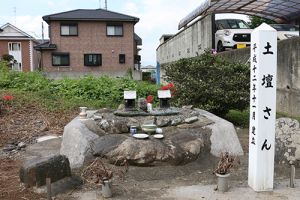
In the Nishihara district of Saijo City, a small stone shrine stands quietly in a residential area. The word dodan refers to an earthen platform. In modern Japanese, the related phrase dodanba means the final moment or last possible stage of a situation. Originally, it referred to the place where executions by beheading were carried out.
Dodan-san does not appear in official Ehime records as an execution ground. It survives mainly through local oral tradition.
The site is a small square space hardened with concrete and covered in gravel. Two small stone shrines stand side by side, and behind them is what appears to be the head of a stone Buddhist figure.
Its origin and history are unclear. Unlike many other former execution grounds, however, offerings are still left there today. That suggests the site remains carefully venerated by local people.
6. Matsuyama Domain Execution Ground Site: Furudera Jizo Hall
In Shinmachi, Onishi, Imabari City, there is a former execution ground connected to the Matsuyama Domain.
Today it is known as the Jizo Hall of Furudera, meaning old temple. In front of the modest hall stand several stone objects that appear to be memorial towers. The largest is inscribed with a Buddhist dedication meaning that each stone bears one character of a Mahayana sutra. On the back, it records that it was erected in July 1933 by a woman named Kamo Yoshi.
An explanatory sign behind it describes the history of the Furudera Jizo. In summary, there was originally a temple called Shinko-ji on this site. After the temple relocated, the Matsuyama Domain designated the former temple grounds as an execution site.
During the Jokyo era, heavy taxes and years of poor harvests left farmers in great hardship. Yagi Chuzaemon, the village headman of Engi Village, directly appealed to the lord of the domain for a reduction in taxes.
For that act, Chuzaemon was punished. In 1686, he and his son Kotaro were beheaded at the Furudera execution ground, and their heads were put on public display.
The farmers of Engi Village and surrounding areas are said to have secretly built a Jizo statue to mourn Chuzaemon and Kotaro. Over time, this Jizo came to be worshipped as a guardian against fire, illness, and misfortune.
Later, in 1869, a headman named Ide erected the Mahayana sutra memorial tower to console the spirits of those who had been executed.
In 1924, local volunteers, especially from the lower town area, collected donations and added contributions from residents to expand the grounds and build a new hall.
Inside the hall, which has a simple community-center-like feel, a Jizo statue is enshrined at the back. It wears a red bib and red cap, and its face has a somewhat childlike expression, as Jizo statues often do.
There is also a story that human bones were unearthed when the Jizo hall was built.
7. Matsuyama Prison Cemetery: Kinuyama Execution Ground Site
The six sites above are all connected to former execution grounds, but many of them inspire more historical sadness than immediate supernatural terror. The final site, the former Kinuyama execution ground, is different. It is often feared as one of Ehime Prefecture’s most terrifying haunted places.
The reason is that today it is a cemetery under the jurisdiction of Matsuyama Prison.
Many paranormal stories are told about this area. It is also not simply remembered as an execution ground. It is tied to the dark history of the persecution of Christians in Japan, which gives the place an even heavier atmosphere.
Because this is connected to a prison cemetery and sensitive historical ground, visitors should not enter restricted areas or treat it like an attraction. If you research it, do so respectfully and from legal public areas only.
What These Places Leave Behind
These seven haunted sites in Ehime show how easily execution grounds can vanish into ordinary scenery.
Today, most of them are buried within fields, neighborhoods, or quiet roadsides. In many cases, there is only a single stone monument, with little or no explanation of what happened there. Even local residents may grow up nearby without knowing the history.
Some people say that learning the origin of a haunted experience actually makes them feel calmer. A strange sound or uneasy feeling is more frightening when it has no explanation. Once the history is known, the fear gains a shape.
Still, a stone monument is almost a mercy. In some places, the past may be completely unmarked. A park where people casually play, for example, might stand on land once rumored to have been an execution ground.
There are stories from other parts of Japan as well, such as the rumor that Green Hill Miwakemori Park in Iwate Prefecture was built on a former execution site.
The places we pass through every day may be hiding older and darker histories than we realize. Once you notice that possibility, the familiar world can begin to feel very different.
Japanese Language
心霊スポットといえば、 廃墟 や トンネル が多いですよね。ですがそれと同じくらいに多いのが、 合戦場 や 処刑場跡地 といった歴史にまつわる心霊スポットです。多くの人の命が失われた場所には、今も怨念や地縛霊がすみついているといいます。。とくに戦国~江戸時代では、政治や宗教の理由から多くの 無実の人 が処刑に遭っています。彼らの無念はそうとうなものでしょう。愛媛県には、 処刑場跡地 にまつわる心霊スポットがたくさんあります。江戸時代、愛媛県は「伊予の国」と呼ばれ八つの藩にわかれていました。
「伊予八藩」と呼ばれたそれぞれの藩にあった処刑場は、今はどれも心霊スポットになっています。。今回はその中から7つを厳選して紹介します。またどうして心霊スポットになってしまったのか、歴史で読み解いていこうと思います。。歴史で読み解く愛媛県の心霊スポット①吉田藩処刑場跡。。1つ目の心霊スポットは、宇和島市吉田町の 「吉田藩処刑場跡」 です。愛媛県といえばみかんで有名ですが、宇和島市の山中のみかん畑に、ぽつんと処刑場跡の石碑があります。石碑には 「吉田町指定文化財 吉田藩刑場跡」 と刻まれています。
さかのぼること150年前の 江戸時代 。この辺りは吉田藩の処刑場でした。残された数少ない記録には、 「一揆の首謀者二名絞首刑」 、 「女の磔刑」 が残っています。処刑場で殺された人間の記録は、全国的に見てもほとんど残っていません。。「千人処刑すると供養碑を建てる」 という伝承がありますが、はたして本当なのでしょうか。1000人分の霊が渦巻いているというには、ずいぶんと穏やかな景観ではありますが……。地元民にとっては日常の景色なのですが、 地元民以外の人が行くと、心霊現象にあうと聞きます。
。歴史で読み解く愛媛県の心霊スポット②宇和島藩処刑場跡(丸穂処刑場跡)。。愛媛県宇和島市の丸穂には、かつて 火葬場 がありました。その入り口に宇和島藩時代の処刑場があり、それが 「丸穂処刑場跡」 として残っています。現在も丸穂村古川奥畑間という住所があり、そこは住宅街になっています。コンクリートに固められた小川の橋のたもとに、 小さな石碑 が折り重なるよう並んでいます。それが2つ目の心霊スポット、丸穂処刑場跡なのです。首のない地蔵 や石塔などが並ぶここでは、その昔、 斬首 、 磔(はりつけ) 、 火あぶり 、 絞首刑 などが行われていました。
その後 1000人 を処刑したのを機に、宇和島藩の処刑場は次に紹介する 「黒の瀬処刑場」 に移ったとされています。ここでは 浮遊霊 の目撃例があります。今は住宅地の中にあるので、夜に目にする人が多いのです。歴史で読み解く愛媛県の心霊スポット③宇和島藩処刑場跡(黒の瀬処刑場跡)。。愛媛県の宇和島市の住宅街に 「見返橋」 という橋があります。この橋は江戸時代からあったといわれていますが、当時の名前は今と違っていました。橋の名の由来は、 「黒の瀬処刑場」 へ引っ張られる罪人が何度も振り返ったという故事から来ているそうです。
東京都にも、処刑場に由来を持つ 「泪橋(なみだばし)」 があります。「立ち止まることさえ許されず、背中越しに振り返る一方通行の泪橋」という故事が残っています。この見返橋の道端から山道を上がると、今は地名の残っていない「黒の瀬」になります。そ の付近にある薬師堂こそが、黒の瀬処刑場の供養堂だという説があります。。その心霊スポットの薬師堂は、山道の曲がり途中にあります。小さなお堂の内には、かわいらしい石仏が一体安置されています。歴史で読み解く愛媛県の心霊スポット④肱川河原処刑場跡(大洲藩処刑場跡)。
。4つ目の愛媛県の心霊スポットは、 「肱川河原処刑場跡(大洲藩処刑場跡)」 です。大洲市の畑の中に取り残されたような草原があり、そこに 石碑 が1つ置かれています。地名の通り、ここ一帯はかつて河原でした。「南無妙法蓮華経」 と彫られたそれは、処刑場の供養塔だと思われます。ここでも1000人の人が斬り殺されたのでしょうか?。動画を撮ると不気味な声や映像が入っていた、という体験談が伝わっています。。歴史で読み解く愛媛県の心霊スポット⑤西原の土壇さん。
愛媛県 土壇さん 画像引用元:西条市公式ウェブサイト 。5つ目の心霊スポット 「土壇さん」 は、見つけるのが難しい心霊スポットです。西条市西原地区の住宅街に、石の祠がぽつんとあります。土壇は「どだん」と読みます。今でも物事が決定する最後の瞬間、場面のことを 「土壇場」 といいますね。これは元々、首を切る 処刑場 をあらわす言葉でした。
土壇さんは愛媛県の記録にはなく、言い伝えのみの処刑場跡です。四角くコンクリートに固められた狭いスペースに砂利が敷かれています。その上に小さな二基の石祠が並び、奥に頭だけの石仏らしきものがのぞきます。起源も来歴も不明ですが、他の処刑場跡地とは違って、今でもお供え物がしてあります。地元の方に大事に祀られているのがわかりますね。。歴史で読み解く愛媛県の心霊スポット⑥松山藩処刑場跡(古寺地蔵尊)。。愛媛県今治市大西町新町には、かつての 松山藩の処刑場跡 があります。
今では 「古寺の地蔵堂」 と呼ばれています。こじんまりとしたお堂の前に供養塔らしき石造物が並び、一番大きなものには「大乗妙典一石一字」とあります。裏には「昭和八年七月 鴨頭ヨシ子 建之」と刻銘があります。その後ろの説明版「古寺地蔵尊由緒沿革」には、地蔵尊の来歴が書かれています。以下はその要約になます。ここには元々 「真光寺」 という寺がありましたが、寺が移転したのを機に、松山藩はその跡地を 処刑場 に定めました。貞享年間、高い年貢と長引く凶作により百姓らは困窮しました。
そこで延喜村の庄屋だった八木忠左衛門は、藩主に年貢軽減の直訴をしました。しかし、忠左衛門は罪を問われ貞享3年(1686)息子の小太郎と共に、この古寺の処刑場で 斬首 され、 さらし首 になりました。延喜村を中心にした百姓らはひそかに 「地蔵尊」 を建て、忠左衛門と小太郎を弔いました。その後この地蔵尊は火難、悪病、厄除けにご利益のある地蔵として、人々の信仰を集めたといいます。その後明治2年(1869年)に、大庄屋である井出氏は処刑された人々の霊を慰めようと、 「大乗妙典一石一字」の供養塔 を建てました。
さらに下って大正13年(1924年)、下町を中心とした有志らが浄財を募り、地域の人らの寄付を加えて、境内を拡げ新しいお堂を建立したといいます。公民館のような中の奥に、お地蔵様が安置されています。赤い前掛けに赤い帽子、地蔵なので当たり前ではありますが、やや子供っぽい顔をしています。なお地蔵堂が建立された際には、 人骨 が発掘されたという話もあるそうです。歴史で読み解く愛媛県の心霊スポット⑦松山刑務所墓地(衣山処刑場跡)。。さてここまで6つの処刑場跡地にまつわる心霊スポットを紹介してきました。
といっても感じるのは 歴史の無常や人間の残酷 さで、あまり霊的な怖さはなかったと思います。しかし最後に紹介する 「衣山処刑場跡」 は、愛媛県の心霊スポットでも最恐と恐れられています。というのも、現在は 松山刑務所所管の墓地 になっているからです。ここではさまざまな心霊現象が語られていますし、しかも単なる処刑場ではなく、 キリシタン弾圧 という闇の歴史を持つ心霊スポットなんです。。衣山処刑場跡については、 の記事で詳しくまとめていますので、。
。今回は愛媛県の処刑場跡地にまつわる心霊スポットを紹介しました。見ていただくとわかるのは、 今ではほとんどが畑や住宅地に埋もれてしまっている 、ということです。石碑が1本あるだけで由来も書かれていないものがほとんどなので、 地元民でもなにも知らずに過ごしてきた ということが多いのです。ですから心霊体験をした者は、むしろ由来を知って安心するくらいだといいます。理屈が通っているほうが、人は落ち着ける生き物だからです。。しかし石碑などがあるのはまだマシで、 普段遊んでいた公園が、実は処刑場跡地に作られていた ……なんてこともあるんです。
そこでは今も、人が亡くなる事件や事故が起こっていたり……。岩手県の心霊スポット 「見分森公園」 は、処刑場跡地に作られた と噂されています。こちらも詳しくまとめていますので、興味のある方は。あなたが何気なくすごしてきた毎日にも、恐ろしい歴史的な心霊スポットがひそんでいるのかもしれません。このことに気づいてしまったあなたの日常は、きっと今までとは変わった恐ろしいものに変化してしまうでしょう。【愛媛県の心霊スポット】衣山処刑場跡(松山刑務所墓地)【歴史】 。
【岩手の心霊スポット】処刑場に作られた?グリーンヒル見分森公園 。【青森県の心霊スポット】久渡寺【お遍路とオシラサマ信仰】