English Version
Ehime Prefecture has an unusual number of former execution grounds. During the Edo period, the region was divided among eight domains known as the Iyo Hachihan, and each domain had its own place of execution. Today, many of these sites are spoken of as haunted places.
This article focuses on one of the most feared among them: the Kinuyama Execution Ground Site, also known as the Matsuyama Prison Cemetery. A cemetery built on a former execution ground would already be unsettling enough, but this site is also tied to the persecution of Christians in Japan. According to local history, many innocent people were beheaded here simply for being Christian.
A prison cemetery built on a former execution ground?
The Matsuyama Prison Cemetery in Matsuyama, Ehime, is often described as a haunted spot. Because it is managed by the prison, the entrance is barricaded and locked, and visitors are not allowed inside without permission. If you go to the area, do not trespass or climb barriers; view only from lawful public spaces and be respectful of the site.
Despite the restricted access, stories have been passed down by prisoners, their families, prison officers, and nearby residents. Some claim to have seen a large black shadow crossing the former execution ground. Others say a woman’s ghost appears there. There are also stories of something unidentifiable reflected in a car’s rearview mirror, sticky handprints appearing on window glass, and a man standing on the stairs beyond a closed door.
In one version of the rumor, people are warned never to speak to that man.
One person who was planning to move to the Kinuyama area was reportedly told by an elderly local: “Kinuyama used to be an execution ground. You’d be better off not living there.”
During the Edo period, Kinuyama was the execution ground of the Matsuyama Domain. It was also the place where the Urakami Christians were once buried.
Traces of execution and memorials
At the cemetery gate, a sign states that the site is a cemetery under the jurisdiction of Matsuyama Prison and that entry without permission is prohibited.
There are stone monuments near the fence. One in front appears to be a memorial to the souls of those who died while on the path to rehabilitation, though parts of the inscription are difficult to read because of the calligraphy. Another monument behind it is also partly unreadable.
Beyond the gate, stairs lead upward, and another stone monument stands at the top. Trees make it hard to see clearly, but the inscription appears to refer to a joint burial grave. It is thought to be a grave for prisoners with no surviving relatives or caretakers.
Behind the site, a memorial tower can be seen in an unusual position, and an old well is also visible deeper inside.
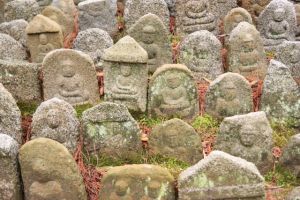
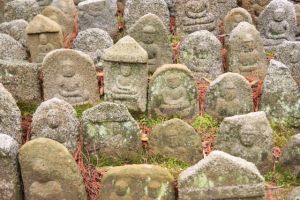
Not far from the former Kinuyama execution ground is the Kinuyama Jizo Hall. Inside the small hall are four Jizo statues on the right and a stone monument on the left. This hall is believed to serve as a memorial tower for the execution ground. Because of their shape, the Jizo statues are thought to be headless “beheading Jizo.”
Even more than 150 years after the Edo period, several traces of the old execution ground remain. But the darkest part of this site’s history is the persecution of Christians that once took place here.
Ehime and the persecution of Christians
When people think of Christian persecution in Japan, Nagasaki during the Edo period is often the first place that comes to mind. In 1622, the Great Martyrdom of Genna took place: 25 missionaries were burned to death, and 31 Christians were beheaded. Authorities also used methods such as the fumi-e, in which suspected Christians were forced to step on Christian images, and forms of torture involving hot water to expose believers.
In 1867, as persecution intensified, a major crackdown on hidden Christians occurred in Nagasaki. This event is known as the fourth Urakami crackdown. Among the Christians arrested by the government, some were exiled to Matsuyama in Ehime Prefecture. They became known as the Urakami Christians.
Later, under strong criticism from Western powers, the Meiji government ended the ban on Christianity. The Urakami Christians who had been isolated in Matsuyama were released. But when they spoke about their experience, they described roughly three and a half years of torture and life as prisoners.
Eight Christians died of dysentery. Their bodies were buried at Kinuyama, but the exact burial location has not been identified.
There is also a recorded martyrdom case in Ehime involving John Yanagiya Kyubei, who is said to have been executed at Kinuyama. With so much suffering connected to the site, it is easy to understand why ghost stories became attached to it, even if the reported phenomena remain local rumors.
Why was Christianity banned so harshly?
The first major persecution of Christians in Japan was carried out by Toyotomi Hideyoshi. In 1597, during the martyrdom of the Twenty-Six Saints of Japan, 26 Christians were executed.
Hideyoshi had already issued an edict expelling Christian missionaries and banning Christianity. One clause in that edict condemned the practice of selling Japanese people overseas to places such as China, Korea, and lands associated with European traders, and it also prohibited the buying and selling of people within Japan.
One interpretation of this history is that Hideyoshi was enraged by the overseas sale of Japanese people as slaves in connection with the Christian mission and foreign trade. In school, the usual explanation is that the shogunate feared the growing power of Christianity and the possibility of rebellion. That may have been one factor during the Edo period, but the overseas trafficking of Japanese people was also a real historical issue.
If Hideyoshi had not moved to restrict Christianity and foreign missionary activity, some historians argue that the situation could have become even more tragic.
A haunted place shaped by history
The Kinuyama Execution Ground Site, now associated with the Matsuyama Prison Cemetery, is not just a place of ghost stories. It is a site where execution, imprisonment, religious persecution, and forgotten burials overlap.
There were likely many reasons behind the persecution of Christians in Japan. But the people who died at Kinuyama were not guilty simply for their faith. Their regret and suffering are what give this place its heavy atmosphere—and why, even today, some people feel it is the kind of place where the dead might not rest easily.
Japanese Language
愛媛県には多くの処刑場跡が残されています。江戸時代の「伊予八藩」と呼ばれた8つの藩それぞれに処刑場あったからです。今ではすべて心霊スポットとなっており、 の記事 では7つの処刑場跡にまつわる心霊スポットを紹介しました。今回はその中でも最恐と噂される心霊スポット、 「衣山処刑場跡(松山刑務所墓地)」 についてお話します。処刑場跡に作られた墓地というだけでも恐ろしいのですが、ここではかつて キリシタン弾圧 が行われていました。キリスト教徒というだけで多くの無実の人が首を斬られた、闇の歴史をもつ心霊スポットなのです。
。今回は愛媛県の心霊スポット「衣山処刑場跡(松山刑務所墓地)」について紹介します。またその背景にあった日本のキリシタン弾圧に注目し、歴史的視点から心霊スポットを読み解いてみたいと思います。愛媛県の心霊スポット:松山刑務所の墓地は「衣山処刑場跡」に作られた?。。愛媛県松山市にある 松山刑務所の墓地 は、心霊スポットといわれています。刑務所所轄のため、バリケードに錠が下ろされ中に入ることはできません。ただし囚人やその家族、また刑務官や近くに住み人からは、さまざまな心霊現象が語られています。
処刑場跡で大きな黒い影がよぎるのを見た。処刑場跡には女の幽霊が出る。車のバックミラーに得体の知れない何かが映る。窓ガラスにベタベタ手形がつく 。閉じている扉の先の階段に男が立っている。しかし、決してそれに話しかけてはいけない。ある人がこの付近へ引越そうとしたら、年配の人からこう言われたそうです。「衣山はその昔処刑場だったから、住むのはよした方がいい」 と。江戸時代の衣山には、松山藩の処刑場が置かれていました。またそこは、かつて浦上キリシタンが葬られた地でもありました。
松山刑務所墓地に残された処刑の記憶。。墓地の門には 「当所は、松山刑務所所管の墓地につき許可なく立入りを禁止します」 と書いてあります。柵の前後に 石碑 があり、前のものには 「更生の途上むなしく仏れたる み魂よかめく懺悔 衣山…… (達筆により判読不明)」とあり、後ろのものには「 浄…… (達筆により判読不明)」とあります。心霊スポットの中には入れませんが、門の先に階段があり、その上にまた 石碑 が立っています。木々が邪魔してよく見えませんが 「~~合葬の墓」 と書いてあるようです。
無縁受刑者の墓と思われます。裏に回って見ると、 供養塔 が不思議なところに建っており、奥には古井戸も確認できます。衣山処刑場跡から近い所に、 「衣山地蔵堂」 があります。せまいお堂の中には、右にお地蔵さんが四体、左に石碑が置かれています。このお堂は、 衣山処刑場跡の供養塔 だとされています。地蔵はその形状から、 首のない首切り地蔵 だと思われます。江戸時代から150年が経った今でも、処刑場としての痕跡がいくつも確認できます。しかし本当に恐ろしいのは、かつてこの地で行われた キリシタンの弾圧 です。
。歴史で読み解く心霊現象スポット:愛媛県はキリシタン弾圧の地?。。キリシタン弾圧 ……キリスト教の禁止、及びキリスト教徒への迫害といえば、 江戸時代の長崎 が有名ですよね。1622年には 宣教師25人が火あぶりで殺され、キリシタン31人が斬首される という「元和の大殉教」があり、 踏み絵や熱湯を使った拷問 で、キリスト教徒をあぶりだしました。。キリシタン弾圧が加速した1867年、長崎で大規模な隠れキリシタン摘発事件「浦上四番崩れ」が起きました。
その時政府に捕らえられキリスト教徒の内、 愛媛県の松山 に流罪された人々がいました。彼らが 浦上キリシタン と呼ばれた人たちです。。その後明治政府は、欧米列強からの強い非難によりキリスト教禁教を終了。愛媛県松山に隔離されていた浦上キリシタンたちも 解放 されました。しかしこの時彼らの口から語られたのは、約3年半の 拷問と囚人としての生活 でした。8名のキリシタンは赤痢で 死亡 しました。彼らの遺体は衣山に葬られましたが、場所は特定されていません。
。また、愛媛県下で唯一記録のあるキリシタンの殉教事件、 「ヨハネ柳屋九兵衛」 もこの衣山で処刑されたといわれています。そんなキリスト教徒の無念が渦巻いている処刑場跡地ですから、心霊現象が起こるのも当然でしょう。しかし日本政府、及び江戸幕府はどうしてここまで残虐な手段を用いてまでして、キリスト教を禁止したのでしょうか。キリシタン弾圧のきっかけは、日本人が奴隷として売られるのを防ぐため?。。日本ではじめてキリスト教徒の弾圧を行ったのはあの 豊臣秀吉 です。
1597年に起こった 「日本二十六聖人殉教事件」 で26人のキリシタンを処刑しています。このとき 「バテレン追放令」 を出してキリスト教を禁止したのですが……そこに禁止の理由が書いてあります。「一、大唐・南蛮・高麗へ日本人を売り遣わし候こと、曲事たるべきこと。付けたり、日本において人の売り買い停止のこと。」 。バテレン追放令 第10条より 。なんとキリスト教宣教のイエズス会は、 「日本人奴隷は神の恩寵」 として外国へ売り飛ばていたのです。
これが 秀吉の逆鱗に触れました 。。学校で習うのは、 幕府がキリスト教の勢力やクーデターを恐れた こと。もちろん江戸時代にはそういった側面もあったのかもしれませんが、 日本人がアフリカの黒人奴隷と同様に白人たちのもとへ売り飛ばされていた のは歴史的事実です。秀吉がキリスト教を禁止していなければ、もっと悲惨なことになっていたのかもしれません。。キリシタン弾圧の真相については、 で詳しく紹介していますので、。今回は愛媛県の心霊スポット「衣山処刑場跡(松山刑務所墓地)」について紹介しました。
またその背景にあった日本のキリシタン弾圧に注目し、歴史で読み解いてみました。キリシタン弾圧の理由には色々あったのでしょうが、もちろん殺された人々に罪はありませんし、彼らの無念はやはりそうとうなものでしょう。化けて出たくなるのもわかる……というものです。【愛媛県の心霊スポット】7つの処刑場跡まとめ【歴史で読み解く】 。日本人を奴隷として売っていた?!キリスト教弾圧の理由 。【岩手の心霊スポット】処刑場に作られた?グリーンヒル見分森公園