English Version
Among the Seven Wonders of the Ancient World, one of the most mysterious is the giant statue of Helios that is said to have once stood on the island of Rhodes, in modern-day Greece.
Helios was the sun god of Greek mythology, and in the era when the statue is believed to have stood, he was widely worshiped by the people of Rhodes. Yet this enormous figure, said to have truly existed, reportedly collapsed in an earthquake after only about 60 years.
It is easy to imagine that later images of colossal stone kings, like the monumental statues seen in the film version of The Lord of the Rings, may echo this kind of ancient legend. Whether or not there is any direct connection, the Colossus of Rhodes remains one of history’s most haunting lost monuments.
Why Was the Colossus Built?
The reason the giant statue was built on Rhodes is said to trace back to the wars of power that followed the breakup of the vast Macedonian Empire.
After the death of Alexander III, better known as Alexander the Great, the ancient world entered the Wars of the Diadochi in 323 BC, as powerful successors struggled for control. During this period, Rhodes sided with Ptolemy I of Egypt.
In 305 BC, Antigonus, the king of Syria, sent his son Demetrius I with an army of 40,000 soldiers to capture Rhodes. This became the Siege of Rhodes. Although Rhodes was a strong fortified city surrounded by walls, its people were forced to hold out while waiting for reinforcements from Ptolemy I.
In 304 BC, those reinforcements finally arrived, and the siege by Demetrius I was lifted.
The people of Rhodes are said to have credited their deliverance to the gods. They sold the weapons abandoned by Demetrius I and decided to create a statue of Helios, the sun god worshiped as the guardian deity of Rhodes.
The Size of the Helios Statue
The Colossus of Rhodes is said to have stood more than 33 meters, or about 108 feet, tall. The project was reportedly taken on by a sculptor named Chares, who was said to be a student of the famous Greek sculptor Lysippus.
Pliny the Elder, the Roman statesman and writer of the 1st century AD, described the fallen statue in striking terms:
“Few people could clasp their arms around its thumb. Its fingers were larger than most statues.”
By Pliny’s time, however, the Colossus had already collapsed. His words are thought to refer to the remains of the statue, which may still have been visible as fragments of a once-great structure.
According to tradition, the statue stood on a huge marble base. Including that base, the total height may have reached around 50 meters, or about 164 feet. Some accounts compare its scale to that of the Statue of Liberty in the United States.
Construction and Collapse
Although the Colossus is one of the most veiled and mysterious of the Seven Wonders, some accounts of its construction are attributed to Philo, a writer associated with the ancient list of wonders.
The body of the statue is said to have been made of bronze. Because the statue was too enormous to cast in separate pieces and assemble in the usual way, Chares reportedly built it upward from the lower sections, starting from the massive marble base.
First, the feet were cast in bronze. Then earth was piled around the worksite to create a temporary platform. The next section was shaped and cast above it, and this process continued upward. According to this account, the full form of the statue would not have been visible until construction was complete.
Philo’s records place the beginning of construction around 294 BC, with completion around 282 BC. In other words, the Colossus reportedly took about 12 years to build.
But only 58 years after its completion, in 226 BC, an earthquake struck the area around Rhodes. The statue is said to have broken at the knees and collapsed.
Ptolemy III, a descendant of Ptolemy I, reportedly offered to fund the reconstruction. However, natural disasters were often interpreted as signs of divine anger, and the people of Rhodes declined the offer. With that, the Colossus of Helios began to disappear from history.
The fallen statue is said to have remained where it lay for about 800 years, becoming a kind of ancient sightseeing attraction. Pliny the Elder may have seen some of these broken fragments himself when he described their astonishing size.
Then, in AD 654, Rhodes was conquered by Mu’awiya from the Islamic world. The remaining bronze pieces of the Colossus are said to have been sold to a merchant as scrap. One reason given for this destruction is Islam’s prohibition against idol worship.
Mysteries of the Lost Colossus
Because the Colossus existed for only about 60 years as a standing monument, many mysteries remain.
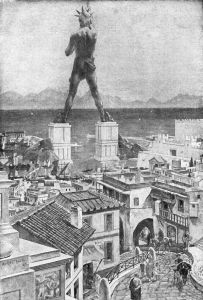
For example, the familiar illustrations of the statue were created by later artists and are based on imagination rather than direct evidence. Its actual appearance is still debated.
One old idea claimed that the statue stood at the entrance to the harbor, straddling two bases with ships passing beneath it. However, some researchers argue that a statue of that size could not have been built unless it stood vertically on a single stable foundation.
Other theories go even further. Some claim that the weapon held by the statue may have contained a mechanical device, possibly serving as a kind of defense against intruders. These claims remain speculative, but they add to the strange atmosphere surrounding the lost wonder.
Plans to Rebuild the Colossus
Since the 1970s, there have reportedly been several proposals to rebuild the lost giant statue of Helios. So far, those plans have not moved forward, partly because of funding problems.
If the Colossus were ever rebuilt on Rhodes, it would almost certainly attract visitors from around the world. However, given Greece’s financial difficulties in recent decades, such a project may be difficult to realize.
For travelers visiting Rhodes today, it is worth remembering that the original Colossus no longer stands, and its exact location and appearance remain uncertain. Enjoy the legends and historical sites responsibly, follow local signs and access rules, and avoid entering restricted or unsafe areas.
Japanese Language
世界の七不思議の中でも最もベールに包まれている存在とされているのが、現代のギリシャ領にあるロードス島にかつて存在したとされる巨大なヘリオス像です。ヘリオスとは、ギリシャ神話上の太陽神であり、ヘリオス像が立っていたとされる時代には多くの民衆に信仰されていたと言います。しかし、かつて実在したと言われる巨大なヘリオス像はわずか約60年ほどで地震によって倒壊した と伝わっています。指輪物語を実写化した映画【ロード・オブ・ザ・リング】に登場した巨大な王の石像などは、このヘリオス像の伝説を模したものではないのか?
と想像してしまうほどです。今回は 世界の七不思議の中でも多くの謎に包まれている【ロードス島の巨像ヘリオス】について紹介していきたい と思います。ロードス島にあったとされるヘリオスの巨像とは?。。画像引用元: ロドス島の巨像 。ロードス島に巨像が作られた理由は、巨大なマケドニア帝国が分裂した古代の権力戦争が発端となっていたと言われています。エジプトのファラオや古代マケドニア帝国の偉大な王であったアレクサンドロス3世の逝去を発端として、紀元前323年に各有力者のディアドコイ戦争という大きな戦争に突入しました。
この時、各地域が勢力を固めていく中、ロードス島はエジプトのプトレマイオス1世に協力しました。紀元前305年にシリアの王であったアンティゴノスは息子のデメトリオス1世に4万の兵を率いさせてロードス島を占領するために侵攻し、ロードス島包囲戦を行います。ロードス島は城壁に囲まれた強固な城塞都市であったものの、プトレマイオス1世の援軍を待つ状況が続きます。そして紀元前304年、ようやくプトレマイオス1世からの援軍がロードス島に到着し、デメトリオス1世によるロードス島包囲を解放することに成功します。
この解放を神のおかげとした当時の民衆は、デメトリオス1世が放棄した武器を売却し、 ロードス島の守護神として崇められていた太陽神ヘリオスを像にすることにしたそうです。。ヘリオスの巨像は、高さが33メートル以上あったとされており、ギリシャの著名な彫刻家であったリュシッポスの弟子と言われているカレスという彫刻家にが事業として引き受けたとも言われています。紀元1世紀頃の古代ローマの政治家であった大プリニウス曰く。「その親指に胸がまわる人はまずいないだろう。
これほど大きな指を持つ像は、ほかにほとんどないだろう。」 。と評されています。。※但し、大プリニウスの時代には既にヘリオス像は倒壊しています ※ 。おそらくは、崩壊した像の一部はまだ残っていたことから、過去の偉大な建築物を讃えた言葉だと考えられます。それもその筈、この ヘリオス像には足元に大理石で巨大な台座が築かれており、それを含めると約50メートルもの高さになっていた そうです。これは現在のアメリカ合衆国の「自由の女神像」に匹敵するほどの大きさであったとも言われています。
。ヘリオス像の建設と倒壊。。世界の七不思議の中では最もベールに包まれているものの、ヘリオス像の建設方法については、世界の七不思議を提唱したフィロンによっていくつかの方法が記録されているそうです。ヘリオス像の本体は青銅で作られていたと伝わっていますが、事業責任者であったカレスは巨大すぎるヘリオス像は部分別に鋳造して組み立てることは不可能だと判断し、巨大な大理石の台座から数回に分けて像の下側から建設していったそうです。まずは足元を青銅で鋳造し、周囲に土で土台を積み上げて次の部分に型枠を作り、像の全体像は完成まで見えない状態で建設されていったそうです。
フィロンの残した記録によれば、ヘリオス像の建設が始まったのが紀元前294年頃であり、完成したのは紀元前282年とされており、ヘリオス像の完成には約12年の歳月がかけられていました。しかし、この ヘリオス像が完成して僅か58年後の紀元前226年にロードス島を中心に地震が発生し、像は足元からあっさりと倒壊してしまった と言われています。この時、ロードス島の解放に協力したプトレマイオス1世の血を継いだプトレマイオス3世は像の再建に資金を提供すると申し出たということですが、当時の天災は神の怒りだと考えられていた為、ロードス島の人々はこの申し出を辞退し、ヘリオスの巨像は歴史から失われることになりました。
倒壊したヘリオス像は約800年の間、観光目的に放置されていたと言われており、前述した大プリニウスはこの倒壊して破片になったヘリオス像の一部を実際に目撃して大きさを例えたとも言われています。さらに西暦654年にはイスラム圏のムアーウィヤによってロードス島は征服され、ロードス島に残骸として残っていたヘリオス像の欠片も破壊された青銅として商人に売却されたと言われています。この背景にはイスラム教が偶像崇拝禁止を掲げていたという理由もあったそうです。
失われたヘリオス像の謎。歴史上にわずか約60年しか存在しなかったヘリオス像には多くの謎が残されています。。例えば、本記事に紹介しているイラストは後世の世に画家が想像したヘリオス像であり、実際の姿には多くの憶測がなされています。ヘリオス像の立っていたとされる位置は、当初港の入り口であり、さらに2つの土台を跨って作られたと言われていましたが、これだけの大きさの像であれば垂直に立っていなければ建設出来なかったのであないか?といった説や、ヘリオス像の手に持たされていた武器にはからくりの仕掛けが設置されており、侵入者に対しての兵器であったという説などもあります。
ヘリオス像の再建計画。この失われた巨大ヘリオス像は1970年代から、何度か再建計画が出されたものの、資金の問題などによって計画が白紙になっているそうです。仮に、このヘリオス像がロードス島に再建されれば、世界中の人々が観光に訪れそうな気もしますが…。知っている方も多いでしょうが、ギリシャは近年の金融恐慌などで財政的にも実現は難しいかもしれません