English Version
In ley-line lore, Britain’s St. Michael’s Line is often associated with ancient stone sites such as Stonehenge. Across the Channel, in Brittany in northwestern France, there is another vast megalithic landscape that some people regard as a kind of ley-line site: the Carnac Stones.
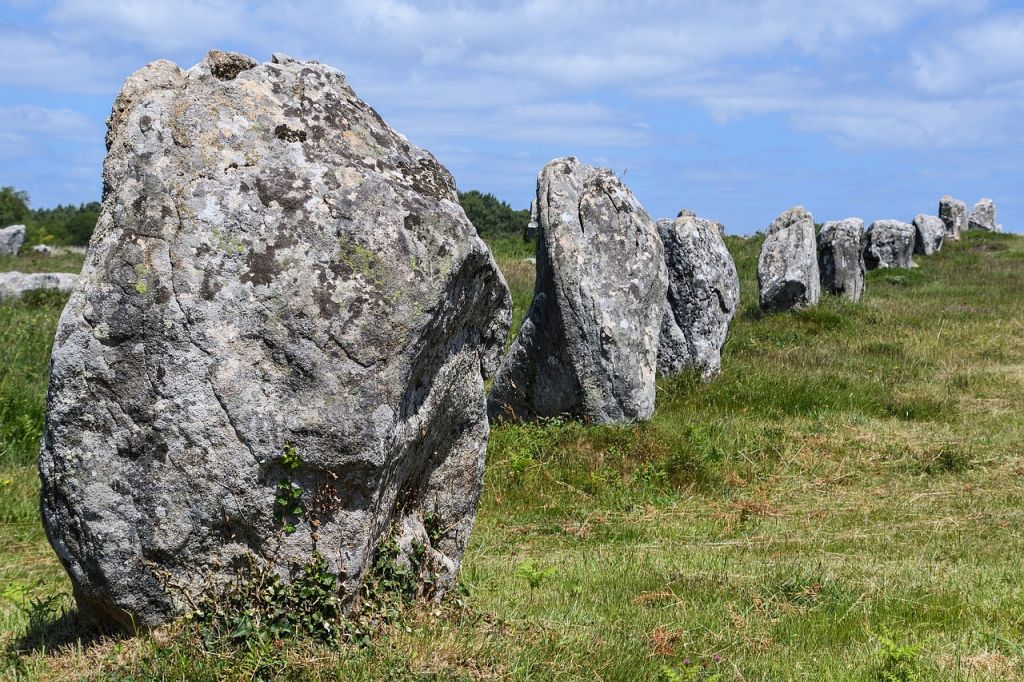
In a previous article, we noted that Saint Michael’s Mount in Britain and Mont-Saint-Michel in France share a connection through their dedication to the same archangel, Saint Michael. Strangely enough, this region also has massive stones arranged in long, deliberate-looking lines. Like Stonehenge and Avebury, the Carnac site features large stones placed with a certain sense of order. What makes Carnac especially distinctive is the presence of menhirs: upright monoliths standing like markers across the landscape.
Three Long Groups of Stones
The Carnac Stones are generally divided into three main groups, stretching for roughly 4 kilometers in total. These groups are known as Ménec, Kermario, and Kerlescan. In each area, huge monoliths are lined up for about a kilometer.
Researchers generally estimate that the stones began to be erected sometime between around 5000 and 3000 BCE. If that dating is roughly correct, Carnac may belong among the oldest surviving human-made monuments in the world, comparable in age to the Egyptian pyramids and possibly older than the periods usually associated with the world’s four great ancient civilizations.
Spirits, Giants, Tombs, or Astronomy?
There are many theories about the origin of the Carnac Stones. Some are fantastic, suggesting that spirits or giants created them. Others are more archaeological, proposing that the stones served as ancient tombs, grave markers, or monuments. There are also theories that they may have had some connection to astronomy.
As with many other megalithic sites, however, no single answer has been firmly established.
The largest surviving monolith at Carnac is about 6.5 meters tall. Elsewhere in Brittany, there is an even more extraordinary monolith that now measures about 9.5 meters. According to one theory, it may originally have stood around 20 meters tall.
Japan also has a history of building enormous burial mounds for rulers, such as keyhole-shaped kofun tombs. But those date mainly to around the 4th century CE, a completely different historical context. In Brittany, including around Carnac, some specific monoliths appear to have been clearly worked by human hands, with smoothed stone surfaces.
The Mystery Around Carnac
The Carnac Stones are not simply a case of large rocks placed in rows. Around the alignments, many burial mounds and other remains thought to be connected to the megalithic complex have also been found. One of them is said to be the Saint-Michel Tumulus.
If there are burial mounds nearby, it raises a question: were the monoliths themselves really tombs?
If they were not ancient graves, then what were they? If the scientific estimates of their age are more or less accurate, it seems natural to wonder whether the straight arrangement of these enormous stones had some specific meaning.
There are three major points that make the mystery so compelling.
First is technological ability. If people more than 4,000 years before the Common Era already had the skill to build such megalithic alignments, where did that knowledge come from? This does not have to mean a lost super-ancient civilization, but it does suggest a level of organization and technique that feels astonishing for such a remote era.
Second is necessity. Carnac contains three separate groups of monoliths, each stretching for about a kilometer. Why was such a vast project necessary in the first place?
Third is intention. Even if ancient people had the ability and a reason to build these lines of stones, what was their will behind it? Did they move and raise these massive stones by their own collective decision? Or were they following instructions from some authority, ritual system, or belief we no longer understand?
Will the day ever come when these mysteries are solved?
If you visit Carnac today, treat it as a protected archaeological site: follow posted rules, stay on marked paths, and do not climb on or damage the stones.
Japanese Language
イギリスのセント・マイケルズ・レイライン上にある巨大な石の遺跡地帯であるストーンヘンジ類と同じように、フランス北西部のブルターニュ地方には、 レイラインの1種であると思われる「カルナック列石」という巨石遺構が存在 します。イギリスの 「セント・マイケルズ・マウントの修道院」 とフランスの 「モン・サン・ミッシェル」 は同じ聖ミカエルを祀っているという共通点があることを以前紹介しましたが、同じような巨石群が不思議と並んでいます。ストーンヘンジやエイブベリーストーンに代表されるように大きな石が一定の規則性を持って配置されているのは同じですが、フランスの カルナック列石には「メンヒル」と呼ばれる、いわゆるモノリスが目印のように立っているのが特徴的 です。
カルナック列石は大きく3つのグループに分かれており、総延長は4キロにも及びます。カルナック列石に並ぶ巨大なモノリス。。カルナック列石には、「メネク」「ケルマリオ」「ケルレスカン」という3つのグループに分かれており、それぞれに巨大なモノリスが約1キロの長さに渡って並べられています。モノリスの起源は研究者の間では紀元前5000年から紀元前3000年頃に建て始められた とされていますが、この推定年代はエジプトのピラミッドなどに並んで、 現存する最古の人工物であるという説 もあり、世界四大文明が起こったとされる時期よりも更に古い可能性があるのです。
カルナック列石の起源には諸説が唱えられており、 精霊や巨人によって造られた というファンタジックなものや、 古代の墓、墓標、記念碑説などの考古学的な考え方 、また 天文学などに関連していた可能性 などが指摘されているものの、他の巨石群と同じようにはっきりとした答えは出ていません。現存しているカルナックのモノリスで最大の大きさのものは6.5メートルですが、同じブルターニュ地方には現在約9.5メートル、一説には 当初20メートルほどあったとされる規格外のモノリスも存在 しています。
日本の文化にも前方後円墳などが造られて、権力者の墓を大きくしてきた歴史はありますが、それは約4世紀頃のものであり時代背景が全く違います。また、カルナックを含めたブルターニュ地方の 特定のモノリスには、明らかに人工的に加工され、岩肌が滑らかになっているもの まであるのです。カルナック列石の謎。カルナック列石は数々の研究者によって様々な説が唱えられている巨石遺構ですが、単純に巨大な石が並べられているだけではありません。カルナック列石の周辺には、この巨石群に関係すると見られる古墳なども多数発見されており、中には聖ミシェル古墳なども存在するそうです。
これらの周辺にある古墳の存在を考えると、 モノリスそのものが墓だという説には疑問 が浮かんでこないでしょうか?。では、仮に古代の墓でなかった場合はどうでしょう。例えば、科学的に研究されている建てられた年代がおおよそ正確であれば、この巨大な石が直線的に配置されている事には何か意味があると考えるのが自然です。意味があると考えられる理由は大きく3つ。1つ目は文明力。。紀元前4000年以上昔の古代人がすでに巨石群を作れる技術持っていた可能性です。
超古代文明とまでは言わないですが、神話時代にあたる超古代に、こういった技術があったとすれば、どこからそれを持ってきたのか?という疑問が浮かびます。2つ目は必要性。。カルナック列石には約1キロに渡って3グループものモノリスが立ち並んでいますが、そもそもこの必要性についての疑問が残ります。3つ目は意思。。古代人達が仮にこれらの文明力と必要性があったとして、その意思は一体どうだったのでしょうか?。自分達の意思で巨大な石を運んで建てたのか?誰かの指示の元でこういった石の流れを築いたのか?
。こういった謎が解ける日は来るのでしょうか