English Version
Yokai, especially the yokai of Japan, were not always enemies of humankind. Sometimes they helped people, and sometimes they played tricks on them, but in many stories they lived in a separate world, keeping a kind of distance from human society.
But some yokai were different. Some were dangerous enough to upset the balance between humans and the supernatural. These terrifying beings were sometimes defeated by gods, and sometimes by human heroes. The frightening events surrounding them became legends, anecdotes, and tales passed down through the centuries.
The cultural anthropologist Kazuhiko Komatsu defined three especially powerful beings as Japan’s Three Great Yokai. What they have in common is simple: they are yokai that people of the medieval period likely would have considered the most terrifying.
1. Shuten Doji, the Mightiest Oni
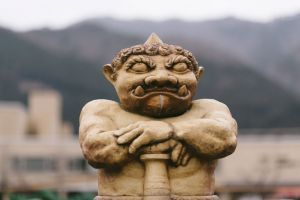
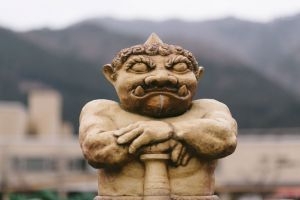
Shuten Doji was the leader of a band of oni who lived on Mount Oe. He would sometimes descend into town, stealing sake, abducting women, and doing whatever he pleased. As the chief of the demons who terrorized the capital of Kyoto, Shuten Doji is counted as one of the Three Great Yokai.
He was eventually defeated by samurai led by Minamoto no Yorimitsu. The warriors deceived him by presenting poisoned sake as a gift. After drinking it, Shuten Doji could no longer move, and he was struck down.
According to one version of the legend, Shuten Doji was originally human: a man of remarkable beauty. His personality, however, was said to be terrible. With his handsome face and clever words, he deceived and hurt many women.
One day, as he was about to burn the many love letters he had received, just as he usually did, the smoke was filled with the resentment and obsession of the women he had wronged. Wrapped in that smoke, he transformed into an oni.
Even so, after becoming an oni, Shuten Doji was said to be honest and straightforward. He did not lie. He loved sake and fighting, like a true oni. When Minamoto no Yorimitsu defeated him through what was essentially a trick, Shuten Doji’s final words were said to mean, “Oni do not take crooked paths.”
In other words, an oni would not use such a dirty method. The line gives a sense of Shuten Doji’s pride as a demon. Perhaps because of details like these, he remains a popular villain in modern fiction.
2. Tamamo-no-Mae, the Clever Fox Sorceress
Violence is not the only way to harm humans. Controlling those in power can be an even more efficient path to ruin. Tamamo-no-Mae is the kind of yokai who specialized in intrigue and manipulation.
She was said to be a beauty who brought nations to ruin, captivating rulers not only in Japan but across Asia. Her true form was a nine-tailed fox, a yokai that had lived for many years and learned the art of transformation.
After coming to Japan, this yokai entered the service of Retired Emperor Go-Toba, the ruler of the time, and became a court lady. While enjoying every luxury, she also tried to curse the retired emperor to death.
However, the onmyoji Abe no Yasunari saw through her disguise and realized she was a yokai. She fled, but was eventually hunted down by a punitive force and slain.
After her death, legend says she became a stone known as the Sessho-seki, or Killing Stone. Even today, the story claims, it gives off poison and kills living things that come near it. In that sense, it is something like a living fossil of the occult world.
Tamamo-no-Mae is also often identified with Daji, the fox spirit who appears in the Chinese novel Investiture of the Gods. Daji was said to have won the favor of the king and suggested cruel punishments, such as forcing people to embrace heated metal or dropping them into pits filled with poisonous snakes and other reptiles. According to the tale, innocent people were framed as criminals so these execution methods could be tested.
3. Otakemaru, the Demon Who Died for Love
Otakemaru was also known as the Demon God King, a title that makes him sound like an oni, a god, a demon, and a king all at once.
His power lived up to the name. Alone, he held back a great army for years. He could fly freely through the sky and even control the weather. His body was also protected by the power of the Three Bright Swords, and while that protection remained, he could not be defeated. Rather than a mere yokai, he seems closer to a divine being.
But there was one thing even Otakemaru could not obtain: Suzuka Gozen, a heavenly maiden who had descended to nearby Mount Suzuka. Captivated by her beauty, Otakemaru visited her every night in different forms, hoping to make her his own.
But Suzuka Gozen was, after all, a heavenly maiden. She never accepted his advances and continued to reject him.
One day, the warrior Tamuramaru, whose forces had been held back because of Otakemaru, met Suzuka Gozen. For some reason, the two quickly became lovers. Suzuka Gozen then offered to help Tamuramaru defeat Otakemaru.
With the heavenly maiden’s support, Otakemaru was finally slain by Tamuramaru’s sword, Sohaya no Tsurugi.
To be honest, this part of the story makes Otakemaru seem a little pitiful. The woman he loved suddenly becomes involved with another man, and then helps plot his destruction. Maybe it is just because the author is not especially popular with women, but it is hard not to sympathize with Otakemaru a bit, and difficult to fully like Suzuka Gozen.
A Thought on the Three Great Yokai
What the Three Great Yokai seem to have in common is that they became too involved with other beings.
One yokai kept taking from humans. One kept deceiving humans. One fell in love with a heavenly maiden. Even if each of them was simply following their own way of life, that contact distorted the relationship between them and others, eventually leading to conflict.
These stories remind us that yokai and humans, or even heavenly beings, are fundamentally different kinds of existence. What yokai do naturally may be far too extreme for human society.
Yokai should not invade the human world, and humans should not invade the world of yokai. In Europe, fairies are sometimes called “the little neighbors.” Perhaps the relationship between humans and yokai should be similar: living separate lives, occasionally hearing voices from the house next door.
For beings with such different ways of living, that may be the ideal distance.
If you visit real places associated with these legends, such as mountains, shrines, or historic sites, stay on public paths, follow posted rules, and avoid entering restricted or unsafe areas.
Next time, we plan to explore each of the Three Great Yokai in more depth.
Japanese Language
妖怪、特に日本の妖怪は、時に人間を救い、時に人間にちょっかいを出しながらも、基本的には人間と住み分けをして暮らしていました。ですが、妖怪の中には時に両者のバランスを崩してしまいかねない程に人間に危害を与える存在がいます。このような凶悪な妖怪は、時には神に、時には人間に征伐されるのですが、その恐ろしい出来事は、物語や逸話となり後世まで語り継がれていくのです。そうした大きな力を持った妖怪を、文化人類学者の小松和彦は 『日本三大妖怪』 と定義しました。
それらの共通項はただ一つ『中世の人々が、最も恐ろしいと思うだろう妖怪』です 。1.最強の鬼、酒呑童子。。大江山に住み、時折街に出ては酒を奪う、女性を攫うなどやりたい放題。京の都で暴威の限りを尽くした鬼たちの首領こそ、三大妖怪が一人である酒呑童子です。彼は、源頼光を始めとする侍達に差し入れと嘘を吐いて渡された毒入りの酒を飲まされ、動けなくなった所を討ち取られました。一説によると酒呑童子は元々人間、それも非常に顔立ちの整った男だったそうです。
しかし性格は超が付くほど酷い物で、その甘いマスクと巧みな話術で数々の女性を誑かし、傷つけました。ある時、彼が貰った大量の恋文をいつも通り燃やそうと火にくべた所、女性たちの執念がこもった煙に巻かれて鬼に変貌してしまったそうです。そんな経緯で鬼になった酒呑童子でしたが、鬼になってからは嘘を吐かず、実直で、酒と喧嘩が好きな鬼らしい鬼だったようです。だまし討ち同然のやり方で自らを討ち取った源頼光に対して『鬼に横道なきものを』という遺言を残しています。
。これは、鬼はそんな風な汚い事はしないという意味であり、鬼としての酒呑童子の矜持が感じられる発言です。こうした要素があり、近年の創作等でも愛される敵役となっています。2.妖狐の賢将 玉藻の前。。自ら暴力を振るうだけが人間に危害を加える方法ではありません。時の権力者を意のままに操る事もまた、効率よく人を破滅させる手段なのです。そういった権謀術数が得意な妖怪が玉藻の前です。日本だけでなく、アジア全土を股にかけて権力者を虜にしてきた傾国の美女……その正体は長い年月を経て変化の術を覚えた九尾の狐の妖怪です。
この妖怪は日本に渡来してきた後、時の権力者だった後鳥羽上皇に取り入って女官となり、贅の限りを尽くしながらも上皇を呪い殺そうとしました。しかし、陰陽師安倍泰成にその正体が妖怪である事を見破られ、逃げ出した先で征伐軍に討ち取られます。討ち取られた後、彼女は殺生石という石になり、なんと今でも毒素を放出し近くの生物を死に至らしめているのです。まさにオカルト界隈のシーラカンスといった所でしょうか。また、玉藻の前は中国の小説『封神演義』に登場する妖狐、妲己と同一視されています。
妲己は当時の王に取り入って、炮烙(焼けた巨大な鉄を抱かせる処刑)や蟇盆(毒蛇等の爬虫類がいる場所に落とす処刑)などの残虐な刑を提案し、罪のない人を罪人に仕立て上げてそれらの処刑方法を実験したと言われています。3.愛に殉じた鬼人 大嶽丸。。別名は鬼神魔王、鬼で神で魔で王です。。その誉名に負けない力を持っており、たった一人で大軍を数年にも渡って足止めし、空を自在に飛び回り天候まで操る。更にその身体は三明の剣という道具の加護を受けており、加護がある間は決して倒せないと言うのですから、妖怪というよりはむしろ神に近い存在だったと思われます。
ですが、そんな大嶽丸にも手に入らない物がありました。それは、近隣の鈴鹿山に天下った天女である鈴鹿御前。見目美しい彼女を自分の物にしたいと、大嶽丸は毎晩姿を変えて鈴鹿御前の元に訪れます……ですが、流石は天女。そんな誘いには一度も乗らず、大嶽丸を袖にし続けました。ある日、大嶽丸のせいで足止めを受けていた武将の田村丸は、鈴鹿御前と出会います。何故か田村丸とは出会ってすぐに男女の仲になってしまった鈴鹿御前は、大嶽丸を倒すために田村丸に協力をすると申し出ます。
そして、天女のサポートもあり、 大嶽丸は田村丸の刀『ソハヤノツルギ』によって討ち取られました。。……この話、ちょっと大嶽丸が可哀想に思えちゃうんですよね。好きだった女の人がポッと出の男と男女の仲になって自分を滅ぼそうと謀ってくる。筆者がモテないからでしょうか、大嶽丸側に感情移入してしまってどうも鈴鹿御前が好きになれません。4.考察。。三大妖怪の共通点は『他の生き物と関わりすぎた事』のように思います。人から奪い続けた妖怪、人を誑かし続けた妖怪、天女に恋してしまった妖怪 、彼らはただ己の生き方を貫いただけだとしても、それでお互いの関係性に歪みが起きてしまい、争い合う事になった。
これらのエピソードは妖怪と人間(天女)はやはり別の生き物であるという事を思い知らされます。彼らが常識的に行う行為は、人間にとってはピーキーすぎるのでしょう。妖怪は人間の領域を侵すべきではないし、逆もまた然り。ヨーロッパでは妖精の事を 「小さな隣人」 と呼称しますが、人間と妖怪の関係というのも本来はそのようにあるべきなのかもしれません。別の生活を送って、時に隣家の話し声が聞こえてくる。そんな関わり方が生き方の違う我々の理想の形態ではないでしょうか。
追記:次回からは3大妖怪それぞれについて、掘り下げた記事を執筆していこうと思います