English Version
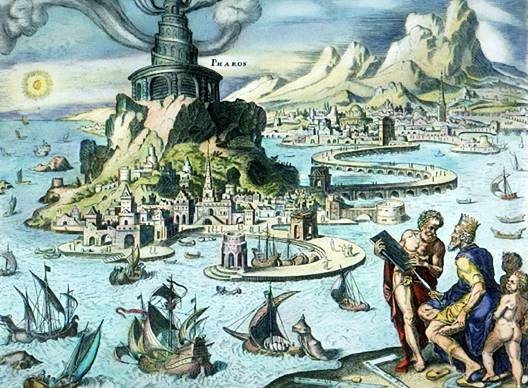
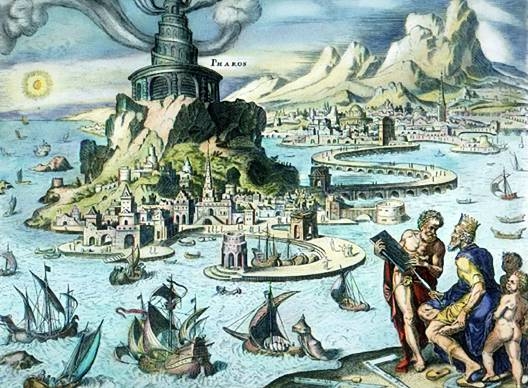
Among the structures known as the Seven Wonders of the Ancient World, the Lighthouse of Alexandria is often described as one of the largest, second only to the Great Pyramid of Giza. It once stood on Pharos Island in Egypt, and although one tradition says it was not included in Philo’s list because it had not yet been built, its scale and engineering were considered among the finest of its age.
Said to have been built in the era just before the Colossus of Rhodes, the lighthouse is connected with Ptolemy I, the ruler who governed Egypt after the death of Alexander the Great.
What was the Lighthouse of Alexandria?
In 332 BCE, Alexander III, the great king of ancient Greece, founded the city of Alexandria near the mouth of the Nile. Alexandria, still one of Egypt’s major cities today, came under the rule of Ptolemy I after Alexander’s death, beginning the Ptolemaic dynasty.
Ptolemy I chose Alexandria as his capital. But the surrounding landscape was flat, and ships entering and leaving the harbor had few clear landmarks to guide them. For that reason, he decided to build a lighthouse.
The person placed in charge of the project was Sostratus of Cnidus, a Greek sculptor. At first, his role in the design was apparently not widely known. According to later accounts, the plan Sostratus proposed to Ptolemy I was an ambitious 45-story octagonal tower. For a long time, the designer of the lighthouse was uncertain, but an inscription discovered later preserved the name of Sostratus, leading scholars to associate him with the great structure.
Building the great lighthouse
The Lighthouse of Alexandria rose to an estimated height of about 134 meters, though the original idea of a 45-story octagonal tower was never realized exactly as proposed.
Construction began around 305 BCE on Pharos Island, off the coast of Alexandria. The island was reportedly connected to the harbor by an artificial causeway. The lighthouse was built in three main tiers: a square lower section, an octagonal middle section, and a cylindrical upper section.
Traditionally, it was said to have been made of cut marble. At the top, a huge mirror was installed. Based on images found on Roman-era coins, it is believed that the mirror reflected sunlight during the day and firelight at night, turning the tower into a beacon for ships.
The lighthouse was not completed during the lifetime of Ptolemy I, nor during the lifetime of Sostratus. It is said to have finally been finished under Ptolemy II. Statues modeled after Triton, the sea god, were also reportedly placed around the lighthouse.
Collapse and disappearance
As the symbol of Alexandria, the capital of the Ptolemaic dynasty, the lighthouse survived longer than many of the other ancient wonders.
Records say that an earthquake in 796 CE caused major damage and left the structure partly collapsed. About 500 years later, earthquakes in 1303 and 1323 are said to have destroyed it completely.
A 14th-century account written by a Moroccan traveler noted that the damage was so severe that it was no longer possible to enter the structure. Around 1480, the Citadel of Qaitbay was built using material from the lighthouse ruins. That fortress still stands today and is open to visitors.
For travelers, the Citadel of Qaitbay is a real historical site, not an abandoned ruin. Follow local rules, check current access conditions, and do not attempt to enter restricted areas or dive near archaeological remains without proper permission and licensed guides.
Possible remains beneath the sea
In 1994, an Egyptian diver discovered massive stone blocks on the seabed near the Citadel of Qaitbay. These blocks are believed by some researchers to be remains of the Lighthouse of Alexandria.
Since then, investigations have reportedly been carried out mainly by French divers and archaeologists. Many of the discovered remains were made of strong materials such as limestone and granite, which has raised questions about the traditional image of the lighthouse as a marble structure.
One theory suggests that although the lighthouse was built in Egypt, its construction was strongly influenced by Hellenistic culture. A major reason for this idea is the engineering problem itself: stacking such heavy stone blocks to such a great height may have required advanced building methods, including early crane technology associated with Hellenistic architecture.
Coins minted during the reign of the Roman emperor Commodus also depict the lighthouse, offering important evidence that this enormous structure truly existed in the ancient world.
Like the Great Pyramid of Giza, the Lighthouse of Alexandria still leaves many questions about how it was built. Structures like these, created more than 2,000 years ago, continue to show us the culture, ambition, and architectural skill of the ancient world. Perhaps the knowledge and technology of ancient people were far more advanced than we usually imagine.
Japanese Language
世界の七不思議の建造物の中でもギザの大ピラミッドに次ぐ巨大さを誇ったと言われているのが、 エジプトのファロス島に存在したアレクサンドリアの大灯台 です。以前紹介した、 「ロードス島のヘリオス像」 や 「バビロンの空中庭園」 を選んだ、フィロンには建造されていなかったという理由から選ばれなかったものの。その 大きさと技術力は当時としても世界最高峰クラスの建造物であった と言われています。ロードス島のヘリオス像よりも少し前の時代、古代エジプトがその栄華を誇っていたエジプトにおいてヘリオス像の建造にも関わったプトレマイオス1世が建造したものだと言われています。
アレクサンドリアの大灯台とは?。。画像引用元: アレクサンドリアの大灯台 。紀元前332年、ファラオ、古代ギリシャの偉大な王であったアレクサンドロス3世によってエジプトのナイル河口にアレクサンドリアの都市を築かれました。現在でもエジプト第二の都市であるアレキサンドリアは、アレクサンドロス3世の死後、プトレマイオス1世によって統治されることになります。(プトレマイオス朝)。プトレマイオス1世によって当時の首都に選ばれたのはアレクサンドリアの都市でしたが、エジプトの土地柄から平坦な平地が拡がっており、船の出入りなどに指標になる目印がなかったことから灯台の建設を決定します。
アレクサンドリアの大灯台建造の責任者にはギリシャの彫刻家であったクニソスのソストラトスという人物であり、当初は設計に関わったことが知られていなかったそうです。プトレマイオス1世にソストラトスが進言した灯台の設計案は、 「八角形の45階建て」 という構想であったと言われています。当初、アレクサンドリア大灯台の設計者は不明でしたが、 後年に見つかった碑文にソストラトの名前が残っていたことから、この大灯台の設計者 であることが知られるようになりました。
アレクサンドリア大灯台の建設。アレクサンドリアの大灯台は全高約134メートルという巨大な規模であり、当初ソストラトスが進言した八角形の45階層というものは実現されませんでした。アレクサンドリアの湾岸に位置したファロス島に建設が決定された大灯台は、紀元前305年から建設が開始され、アレクサンドリアの港とは人工通路によって結ばれていたと言われています。大灯台の建材には切り出された大理石が使われており、3段の階層で建設が進められました。下から順番に四角形⇒中層部に八角形⇒上層部は円柱形が採用されたそうです。
最上階にあたる部分には、巨大な鏡が置かれており、日中は太陽光を反射させ、夜間は炎を反射させていたことが、ローマ時代に作られていたコインから伺えます。全高約134メートルに及んだこのアレクサンドリアの大灯台は、プトレマイオス1世の代には完成せず、同じく設計者であったソストラトスの生きた時代には完成せず、プトレマイオス2世の代になってようやく完成したと言われています。また、灯台の四方には海の神様であったトリトンを模した彫像も置かれていたそうです。
アレクサンドリアの大灯台の倒壊。プトレマイオス朝の首都、アレクサンドリアを象徴するこの大灯台は、世界の七不思議の中でも比較的長い期間、その姿を留めていたと言われています。記録によると西暦796年に起こった地震によって大灯台は半壊してしまい、さらに約500年が経過した1303年と1323年に起こった地震によって、アレクサンドリアの大灯台は完全に崩壊してしまったと伝わっています。14世紀に入ってモロッコ人の冒険家が記した記録には 「崩壊の影響で中に入ることも出来なかった」 ことが記されており、1480年頃には、アレクサンドリアの大灯台の遺跡を利用してカーイト・ベイの要塞が建設され、この要塞は現代にも残っており、一般開放されているため観光することも可能です。
。1994年、要塞近郊の海底で大灯台の残骸らしき遺跡が発見される。1994年、エジプトのダイバーによってカーイト・ベイの要塞付近の海底にアレクサンドリアの大灯台の残骸だと思われる巨大な石の塊が発見されます。この残骸を巡っては、フランスのダイバーや考古学者を中心にして研究と調査が進められているそうです。この発見された残骸の多くは石灰岩や花崗岩を中心とした頑丈な岩で出来たものが多かったことから、通説であった大理石造りという構造に疑問が持たれています。
一説によればエジプトの建設された大灯台ではあったものの、建設の仮定にはヘレニズム文化が大きく影響しているとも推測されています。これらの理由として 建材となる石材を高く重ねていくためには、ヘレニズム文化の建築技術である初期の「クレーン技術」などが必要だったのではないか?といったことが大きな原因になっています。紀元前の巨大建造物。ローマ皇帝であったコンモドゥスの時代に彫造されたコインには、大灯台が記されていることから紀元前300年という時代に、巨大な大灯台が実在していたことは確かな事実であったのです。
ギザの大ピラミッドも未だに建設行程に不明な点は多いですが、2000年以上も昔の技術によって造られたこれらの建造物は、当時の文化や建築技術を現代に伝える大事な役割を果たしていると思いませんか?。古代人の知恵と技術力は、現代の我々が思っているよりも遥かに高度な技術を持っていたのかも知れません