English Version
Around the world, there are enormous ancient structures known as the Seven Wonders of the World. Some still have physical evidence behind them, while others have never been fully proven. These wonders are said to have been selected around the 2nd century BCE by Philo, an ancient Greek mathematician, though there were also earlier writers who reportedly counted the grand monuments of foreign lands among the world’s greatest marvels.
According to one theory, from the age of Alexander the Great onward, Greek successors and intellectuals compared these wonders as a way of measuring how far their own civilization had advanced.
Among them are ruins that still retain much of their ancient form, such as the Great Pyramid of Giza in Egypt; sites where only fragments remain; and places like the Hanging Gardens of Babylon, which are said to have been completely destroyed. For that reason, the Seven Wonders are often discussed as structures that may have used the most advanced technology of their time.
The Great Pyramid of Giza has appeared on this site before in discussions of ley lines. Of the Seven Wonders said to have been chosen by Philo, the Hanging Gardens of Babylon are often considered the second oldest.
Babylon and the Age of Captivity
For readers familiar with this site, the word “Babylon” may already carry a certain weight. The period when the Hanging Gardens are said to have existed overlaps with the era around the Babylonian Captivity, after the ancient Israelites were divided into northern and southern kingdoms and conquered by Assyria.
In other words, the Hanging Gardens of Babylon are often described as a creation of the Mesopotamian world, linked in tradition to the rulers of Assyria and Babylon.
A Romantic Gift for a Homesick Queen?
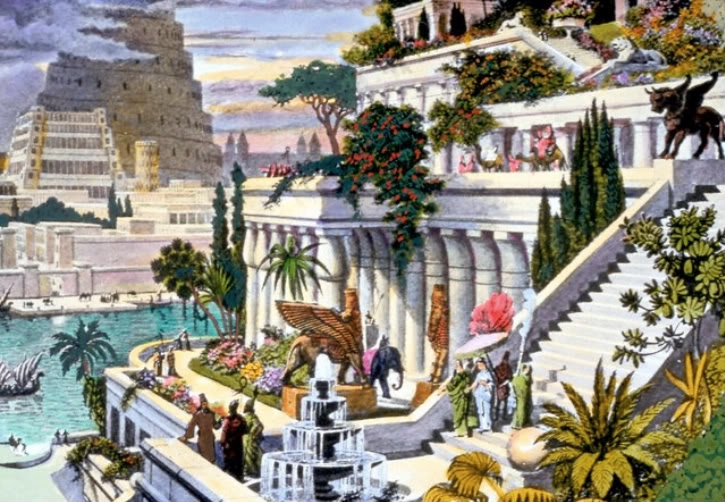
Many stories have been passed down about the Hanging Gardens of Babylon.
One says that Alexander the Great, who is believed to have died of illness in Babylon, tried to cool his fever in the gardens. Another famous tale claims that King Nebuchadnezzar married Amytis, a princess from Iran, and built the gardens for his queen because she missed the landscapes of her homeland. In that version, the gardens were a romantic gift—almost like an ancient Valentine’s present.
The first written record of the Hanging Gardens is said to come from Berossus, a historian writing around 270 BCE. He described a palace built by King Nebuchadnezzar, saying that it used stone foundations and was made in terraces resembling a mountain landscape, supposedly completed in only 15 days.
Berossus is also said to have identified this palace as the Hanging Gardens and recorded that the king built it to please his queen.
As for surviving evidence, one stone relief from around 645 BCE appears to show an Assyrian king relaxing in a place that may have been a garden. Other ancient accounts also survive, though their details differ slightly. Because of this, scholars and enthusiasts continue to debate whether the Hanging Gardens were a nostalgic legend or a real structure.
Still, if Greek travelers and explorers of the same broad era considered the structure impressive enough to rank among the Seven Wonders, it is not unreasonable to think that something extraordinary may once have existed.
Where Were the Hanging Gardens?
Although many ruins of Mesopotamian civilization survive, the exact location of the Hanging Gardens has never been identified.
The most common theory has long been that the gardens were part of the palace complex of Babylon. However, at Babylon’s height, many palaces and large buildings were constructed. After the fall of Babylon, the information needed to understand the exact layout of the ancient city was largely lost.
Another clue involves water. The gardens are thought to have used a mechanism similar to a screw-like water-lifting device, even before the Greek scientist Archimedes became associated with such technology. For that reason, some believe the most likely location would have been near the banks of the Euphrates River.
The gardens are also said to have contained “trees that never withered.” Today, this is usually interpreted less as a miracle and more as evidence of long-lived ornamental plants, carefully managed through the water technology of the period.
According to ancient Greek records, the Hanging Gardens may have included waterways, spiral water-lifting machines, and water towers. Their size was reportedly about 120 meters square.
In more recent scholarship, a different theory has attracted considerable attention. British archaeologist Stephanie Dalley has argued that the famous gardens were not in Babylon at all, but were built in Nineveh, the Assyrian capital, by King Sennacherib. This idea has gained support and remains one of the most discussed modern explanations.
The Ancient Romance of a Lost Garden
There is still no definitive proof that the Hanging Gardens of Babylon existed exactly as described. Even so, within the very real civilization of ancient Babylon, it seems entirely possible that a beautiful palace or garden complex once stood, remembered by later writers as the “Hanging Gardens.”
Unlike the Great Pyramid of Giza, the Assyrian and Babylonian structures connected to this legend have not survived in a form that clearly preserves their original appearance. But it is also difficult to imagine that ancient travelers and writers had no reason at all for preserving such a story. At the very least, it seems likely that a highly advanced building using remarkable water technology once existed somewhere in the region.
Considering the geography of Mesopotamia, it is also natural to think that the Babylonian world possessed especially advanced knowledge of water management compared with many other civilizations.
Today, academic progress in reading Akkadian texts continues. Depending on future research, the truth behind the Hanging Gardens may yet come closer to the surface.
For travelers interested in ancient Mesopotamian sites, remember that many related locations are in modern Iraq and surrounding regions. Always check current travel advisories, respect archaeological protections, and never enter restricted ruins or excavation areas without permission.
Japanese Language
世界各地にはその存在の根拠がいくつかは残っているものの、完全な立証がされていないものを含めて 世界の七不思議と呼ばれる巨大建造物 があります。これらは紀元前2世紀頃、古代ギリシャの数学者であったフィロンによって選ばれたものですが、それ以前にも他国の壮大な建造物を世界の七不思議に数えていたと言われている人物も存在しています。一説によると世界の七不思議は古代ギリシャにおけるアレクサンドロス大王の時代から、その後継者や知識人によって【自分達の文明がどこまで進んできたのか】を確かめる為に比較されてきたものであったそうです。
その中にはエジプトのギザの大ピラミッドなど、現在でも当時の姿をそのまま残している遺跡や、一部のみが遺跡として残っているもの、そしてバビロンの空中庭園のように現在では完全に破壊されてしまったと言われているものもありますが、その時代において 最も最新の技術が使われていた可能性が高い ことを上記の理由から語られることが多いのです。ギザの大ピラミッドは以前レイライン考察としても取り上げましたが、フィロンの選んだと言われている 世界の七不思議の中で2番目に古いとされているのが、バビロンの空中庭園 です。
「バビロン」 という言葉で、当サイトを何度かご覧頂いている方はピンと来るかもしれません。古代イスラエル民族が南北に分かれた後、アッシリアによって征服され、捕虜となったバビロン捕囚の時代前後が、この空中庭園が存在していたと言われている時期です。つまり、 バビロンの空中庭園はメソポタミア文明のアッシリア王によって作られたものだと言われている のです。バビロンの空中庭園はバレンタインのプレゼントだった?。。画像引用元: バビロンの空中庭園 。
バビロンの空中庭園に関するエピソードには様々なものが残されています。例えば、アレクサンドロス王はバビロンで病死したとされていますが、 その熱を空中庭園で鎮めようとした というものや、そもそもこの空中庭園は 当時アッシリアの王であったネブカドネザル王がイランの王女アミティスと結婚し、故郷を懐かしんだ王妃に対して庭園作ってバレンタインの贈り物とした というような逸話が語られています。バビロンの空中庭園が記録として記述されるのは紀元前270年頃の歴史家であった、ベロッソスという人物によってネブカドネザル王が作った宮殿について 「基礎に石を用いて山の風景に似せたテラス状の宮殿を15日間で作った」 というものが始まりだったそうです。
さらにベロッソスはこの宮殿を空中庭園だとし、王が王妃を喜ばせるために作ったものであるということも記録していたと言われています。現在に残っている空中庭園に関する遺跡としては、紀元前645年頃に庭園と見られる場所でくつろいでいるアッシリア王と見られる石版が残されている他、少しずつ記述の違う記録が残されてきたため、空中庭園が実在していたかどうかについては、懐古派と実在派によって議論が行われています。しかし、同時代のギリシャの冒険家や冒険家が実際に見た建造物の中から 「世界の七不思議」 と位置づけるほど高度な文明を感じたことを鑑みると、過去には実在していた可能性が高いようにも考えられるのです。
バビロンの空中庭園はどこにあったのか?。メソポタミア文明の遺跡は数多くあるものの、現在の広さからその場所までは特定されていません。元々はバビロン宮殿の1部だとされていた説が濃厚ですが、バビロンの最盛期には多くの宮殿群が建設された後があり、さらにバビロンが滅亡したことによって当時の位置関係を知り得る情報が残されていないのが現実です。しかし、ギリシャの科学者であるアルキメデスが螺旋構造によって水を組み上げる構造を考えた以前に、同じような構造を持っていたと考えられていることから、ユーフラテス川の川岸周辺が有力な空中庭園のあった場所だとも言われています。
バビロンの空中庭園には「枯れない木」があったとも言われていますが、現在ではこの「枯れない木」は観葉植物のように長寿かつ、当時の技術によって水の管理がされていたと考えられています。空中庭園には水路、螺旋揚水機、揚水塔なども完備されていたとされ、ギリシャに残された記録によれば、広さは約120メートル四方ほどあったことも残されています。また近年の学説上では、空中庭園はバビロンではなく アッシリア王のセンナケリブによって首都ニネヴェに建設されたものだというイギリスの考古学者ステファニー・ダリーの主張 が多くの支持と注目を集めています。
。バビロンの空中庭園という古代ロマン。。確かな実在の証拠はありませんが、古代バビロンという確かに存在した文明の中に、「空中庭園」と呼ばれた美しい宮殿が作られていた可能性は充分にあるのではないでしょうか。残念ながら、ギザの大ピラミッドのように当時の面影をそのまま残すことは出来なかったアッシリアですが、同時代の冒険家や探検家がわざわざ嘘を残す理由もないでしょうから、少なくともこういった高度な技術の使われた建造物は実在していた可能性が高いと考えられます。
また、地域の特色を考えても、水を扱う知識についてはバビロン王朝は他の文明よりも長けていたと考えるのでが自然だと言えるでしょう。現在、アッカド語の解読が学会上でかなり進んで来ていることもありますので、今後の研究次第では空中庭園の真相も発見される日が来るのかも知れません