
English Version
Kyoto is famous as Japan’s elegant ancient capital, but its long history also has a darker side: bloodshed, legends, yokai, and places said to be haunted. Naturally, Kyoto Prefecture has many so-called ghost spots. One of them was the abandoned site in Yawata City known as the “Military Hospital,” also called the “Burma Monastery Ruins.”
The site stood quietly on Mount Otokoyama, the hill where Iwashimizu Hachimangu Shrine, the head shrine of Hachiman shrines across Japan, is located. Some said it had been a wartime military hospital. Others pointed to records suggesting it was connected to a new religious movement, which is why it became known as the Burma Monastery Ruins.
The place became especially notorious after a boy who had gone there for a test of courage died in a way that made some people whisper about a curse. So what was it really: a hospital, a religious facility, or something else? And was there ever any truth to the stories of a haunting?
A Ghost Spot on Mount Otokoyama
The former site was in Yawata Nishitakabo, Yawata City, Kyoto Prefecture, on Hatogamine, part of Mount Otokoyama, where Iwashimizu Hachimangu Shrine stands.
Over the years, it was known by many names: the Burma Monastery Ruins, the field hospital, the blood hospital, and the Yawata ruins. It was once one of Kyoto’s better-known haunted places.
At the foot of Mount Otokoyama, beside the Otokoyama Cable Line that climbs toward the summit, there is said to have been a quiet stairway leading into thick grass and brush. The so-called Military Hospital was beyond that point. Today, however, it is said to have been demolished, and access is blocked by a gate and fencing. Signs reportedly prohibit entry, and surveillance cameras are present.
For travelers and urban explorers: do not attempt to enter restricted areas. Trespassing can lead to arrest, and abandoned or overgrown sites can be dangerous even without any supernatural element.
Whether anything still remains beyond the fence, or whether it has truly been removed, is something only those connected to the site can know for certain now.
Why Was It Called a Military Hospital?
In the past, there were no fences on the stairs, and the area was reportedly covered in weeds and dense undergrowth. Most people had no reason to climb up there. But ruin enthusiasts and ghost spot hunters have always had a way of sniffing out suspicious places.
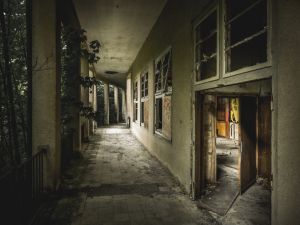
Those who pushed through the brush reportedly found two abandoned concrete buildings. Rumors spread that medical instruments and patient charts were scattered inside. Nearby, there was also said to be a stone monument bearing a World War II-era slogan, along with a cemetery. Over time, people began calling the place a “military hospital,” and its reputation as a haunted site grew.
But according to the records, the abandoned buildings were not actually a hospital at all.
They were the remains of a planned temple facility for a religious corporation called Nihon Shakuson Shobokai. Construction began in 1957 as a “Burmese Buddhist Mission Center,” intended to promote Burmese Buddhism in Japan. Plans reportedly included a believers’ hall, a temple building, and even a 30-meter-tall monastery structure, which is why the place came to be called the Burma Monastery.
However, the project was abandoned because of financial difficulties and unresolved negotiations with Iwashimizu Hachimangu Shrine and the landowners on Mount Otokoyama. Only the unfinished remains were left behind.
The nearby wartime slogan monument was unrelated to the Burma Monastery, and if the site was not a hospital, there should not have been patient charts or medical equipment there. That said, during reporting on the 2010 incident described below, an 82-year-old man living in Yawata City reportedly said he remembered a tuberculosis isolation ward being in the area during the war. This was cited in the Osaka edition of Sports Hochi.
In other words, there may have been rumors of a wartime medical facility somewhere around Mount Otokoyama. Combined with the World War II monument and the abandoned buildings’ hospital-like appearance, that may be how the Burma Monastery Ruins became known as the “Military Hospital.”
People who visited believing it was a hospital may have mistaken religious materials, tools, or documents for medical instruments and patient records.
Was the 2010 Accident a Curse?
If the place was merely the remains of a religious facility, with no hospital dead and no wartime patients, does that mean it was never a ghost spot? Not necessarily.
The surrounding area had already been known for unsettling stories involving suspicious deaths and fatal accidents. For example, at the foot of Mount Otokoyama there was also an abandoned inn rumored to have been the site of a hanging suicide and even a family murder-suicide. That ruin became known by names such as “the Yawata abandoned building,” “the abandoned house along the Keihan Line,” and “the family suicide ruin.”
There were also reports of a hanging suicide on Mount Otokoyama around New Year’s in 2020, which led some people to say that someone had died by suicide at Iwashimizu Hachimangu Shrine. In addition, fatal accidents have reportedly occurred repeatedly at railroad crossings on the Keihan Main Line in Yawata City. Locals were said to react with a sense of “it happened again.” One practical explanation is that a curve before the crossing makes visibility poor, but some people still wondered whether the Military Hospital, or Burma Monastery Ruins, had some connection.
The event that most fueled those rumors happened on August 24, 2010.
A 16-year-old boy from Osaka Prefecture, identified here as Y., had gone with a group of five boys and girls to look for the haunted spot known as the Military Hospital. They searched but could not find it. Just as the group was about to give up and go home, Y. suddenly said he was going to look one more time, then disappeared alone into the darkness.
One of the girls who was with him later described his behavior as if he had been “called by something.”
Y. never returned to his friends. He was struck and killed in a traffic accident.
What made the case especially strange to many people was that Y. had entered the tracks from a railroad crossing and was hit there. It was not described as a simple accident at the crossing.
The incident was widely discussed in the Kansai region at the time as “the curse of the Military Hospital.” As a result, the site drew renewed attention from ghost spot enthusiasts. To prevent trouble for nearby residents, fencing was installed, and the area is now off-limits.
No one can prove a causal link between the accident and the former Military Hospital site. What is known is that Y. had been searching for the place when the fatal incident occurred.
The Real Danger of Haunted Places
Stories of people getting into accidents or becoming involved in incidents on the way to or from haunted places are not rare in Japan.
There were fatal accidents in 1992 and 2001 involving people returning from tests of courage at the old Inunaki Tunnel in Fukuoka Prefecture. More recently, two women who had gone to the haunted Tsubono Kosen site in Toyama Prefecture disappeared; more than 25 years later, in March 2020, their remains were found.
Before talking about ghosts, curses, or grudges, it may be worth remembering that many haunted spots are simply hard to reach, poorly lit, unstable, and easy places to get hurt. Ruins, rail crossings, mountainsides, and restricted areas are dangerous in very ordinary ways.
The Military Hospital of Yawata may have begun as a misunderstanding surrounding the unfinished Burma Monastery. But the rumors, the accidents, and the atmosphere of Mount Otokoyama turned it into one of Kyoto’s most talked-about ghost spots.
If you visit the Iwashimizu Hachimangu area, go for the shrine, the history, and the views. Respect all posted signs, avoid restricted paths, and do not enter abandoned or fenced-off property.
Japanese Language
京都といえば華々しい日本の都。しかし過去には多くの人の血が流れ、今でも妖怪変化がはびこっているという裏の顔ももっています。そんな京都府には、当然数多くの心霊スポットが存在します。今回はその中でも八幡市の心霊スポット 「軍人病院(ビルマ僧院跡)」 についてお話したいと思います。。全国の八幡社の総本社である「石清水八幡宮」がある「男山」にひっそりとたたずむ廃墟です。戦時中は軍人病院だったともいわれますが、新興宗教の施設だったという記録も残っていることから 「ビルマ僧院跡」 とも呼ばれます。
数年前、軍人病院へ肝試しに行った少年が 祟りを思わせる亡くなり方 をして、有名になった心霊スポットです。。はたして病院だったのか?宗教施設なのか?祟りは本当にあったのか?詳しく追及していきます。▶本気の霊視を体験してみたい方はここをクリック 。京都府八幡市の心霊スポット:軍人病院?ビルマ僧院跡?。京都府八幡市八幡西高坊。軍人病院は、 石清水八幡宮 (いわしみずはちまんぐう)が鎮座する 男山の鳩ヶ峰 にあります。ビルマ僧院跡 、 野戦病院 、 血の病院 、 八幡の廃墟 などとさまざまな呼ばれ方をした、京都の有名な心霊スポットでした。
男山のふもとの、山頂へ向かう男山ケーブルカーの脇に、草ヤブへ続く 階段 がひっそりとのびています。軍人病院はこの先にあったのですが、今ではもう 取り壊された ともいわれています。というのも階段の先が柵の扉で通行止めになっており、「立入禁止」の看板があるように探訪はかないません。監視カメラもあり、むやみに入っては不法侵入で捕まりかねないのでやめましょう。。現存しているのか本当に取り壊されたのか、今となっては関係者にしかわかりません。。では、かつてこの先にあった軍人病院とは、どんな心霊スポットだったのでしょうか。
。かつては階段に柵もなく、とにかく雑草やら草ヤブやらに覆われていたといいます。そのため誰もこの階段を登る者はいませんでした。しかしいつの時代も廃墟マニアや心霊スポットマニアは怪しい匂いを嗅ぎつけるのでしょう。草ヤブをかきわけ上へ登ると、 コンクリートでできた2棟の廃墟 を発見しました。医療道具やカルテが散乱している という噂や、近くに 「天業恢弘八紘一宇」の石碑 (第二次世界大戦時のスローガンの1つ)や 墓地 があったことから、いつのまにか 「軍人病院」 と呼ばれるようになり、心霊スポットとして知名度を集めます。
しかしこの廃墟、実は病院とはまったく関係のない建物でした。。日本釈尊正法会という宗教法人の寺院……が作られる予定だったモノの跡地です。。。1957年、ビルマ仏教を布教するための 「ビルマ仏教布教センター」 として、1957年に建設が開始されました。信者会館やお堂などのほか、高さ30メートルの僧院も作られる予定だったため、 「ビルマ僧院」 とも呼ばれます。しかし資金難と、石清水八幡宮側や男山の土地所有者との話し合いがまとまらず、計画は断念。
施設跡だけが残ることになりました。近くにある「天業恢弘八紘一宇」の石碑もビルマ僧院とは 無関係 のもので、 当然カルテや医療器具があるはずもありません 。ただし2010年の事件(後述)時に、八幡市在住の82歳の男性から 「戦時中、結核の隔離病棟があったと記憶している」 と証言があったように、男山のあたりに戦時中病院が建っていたという噂はあったようです。出典: スポーツ報知大阪版 。この噂や第二次世界大戦時の石碑、そして廃墟の外観が病院に似ていたことから「軍人病院」と呼ばれるようになったのでしょう。
軍人病院だと認識して廃墟に訪れた者は、宗教施設の道具や紙資料を、医療器具やカルテと見間違えたと思われます。。2010年の交通事故は軍人病院(ビルマ僧院跡)の祟りなのか。。では軍人病院はただの宗教施設跡で、病死者の霊もいない。ならば心霊スポットではないのか……というと、そういうわけでもありません。もともとこの辺りでは、不審死や事故死が多いと有名でした。。たとえばこれも男山のふもとにある旅館跡なのですが、 首つり自殺者 が出た、 一家心中があった など奇怪な噂が多く、こちらも廃墟と化しています。
「八幡市の廃墟」、「京阪沿線の廃屋」、「一家心中の廃屋」などと呼ばれています。首つりといえば、今年 2020年のお正月 にも男山で首つり自殺があり、 「石清水八幡宮で自殺者がでた」 と騒がれました。また八幡市京都本線の踏切では 死亡事故 が昔から多発しており、地元民のあいだでは「また起こってしまったか」と認識されているほどでした。踏切の前にカーブがあり見えにくいため……と考えられていますが、もしかしたら、軍人病院(ビルマ僧院跡)と関係があるのかもしれません。
そう思わせるのが、2010年8月24日に起こった16歳の少年の死亡事故です。。。大阪府在住のYさんは、男女5人で心霊スポット(軍人病院)を探索していましたが、いよいよ見つけることができませんでした。あきらめてもう帰ろうとしたとき、Yさんが突然 「もう一度探しに行ってくる」 と言いだし、1人で夜の闇へ消えました。友達の少女は当時のYさんの様子を、 「まるで何かに呼ばれているようだった」 と話しています。その後、Yさんは友達のもとへ戻ることなく 交通事故 に遭い、命を落としました。
奇妙だったのは、Yさんが踏切から線路に入り、そこで事故に遭ったという点です。単なる踏切事故ではないのです。。この怪しい事故は、 「軍人病院の祟り」 と騒がれ、当時関西では大きく取り上げられました。▼本当の恐怖動画はこちら▼ 。。そのため軍人病院が再び心霊スポットとして脚光を浴び、マニアがつめよることとなり、近隣住民への迷惑防止のためにも柵が設置され、今や立ち入り禁止となったのです。。事故と軍人病院の因果関係はわかりませんが、軍人病院を探して事故にあったのは事実です。
心霊スポットへの行き帰りに事故に遭った、事件に巻き込まれたという話はよく聞きます。。福岡県の 旧犬鳴トンネル への肝試しの帰りに死亡した事故 が1992年と2001年に起こっていますし、 富山県の心霊スポット 「坪野鉱泉」 を訪ねた女性2人組が行方不明となり、25年以上を過ぎた2020年3月に遺体で発見された ことは記憶に新しいでしょう。どちらもオカルトオンラインで詳しくまとめていますので、興味のある方は。霊とか怨念とかいう以前に、心霊スポットへ行くことはやめておいた方が良いのかも知れません。
。心霊スポットはたいてい行きづらい、事故に遭いやすい場所にあります。。自戒を込めて。京都府の最恐心霊スポットランキングは→ 【闇が深い】京都府の最恐心霊スポットランキング!。【心霊スポット】犬鳴峠(旧犬鳴トンネル)の事件や事故、行き方まとめ 。肝試しが神隠しになった?富山県の坪野鉱泉女性失踪事件