English Version
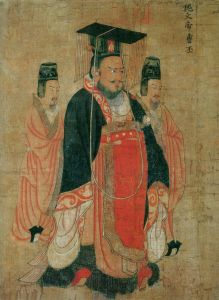
In Romance of the Three Kingdoms, Cao Cao is often set against Liu Bei and portrayed as a ruthless schemer who manipulated the realm for his own ambitions. One of the most famous episodes used to brand him as a villain comes after his failed attempt to assassinate Dong Zhuo. While fleeing, Cao Cao mistakenly kills the entire household of an old acquaintance.
At the time, he was traveling with Chen Gong, who would later serve as a strategist under Lü Bu. When Chen Gong rebuked him for what he had done, Cao Cao is said to have replied with the chilling line:
> “I would rather betray others than allow others to betray me.”
It is a selfish, unforgettable statement—and many people know Cao Cao through this image.
However, this episode does not appear in the historical text Records of the Three Kingdoms. Some scholars and readers point out that it may have been a creation of the later novel Romance of the Three Kingdoms. Of course, historical records do describe Cao Cao carrying out massacres during the struggle for power. Even so, when it came to winning people over and holding them together, there are also signs that he possessed a kind of personal virtue comparable to Liu Bei’s.
Cao Cao as a Young Official
By around the age of 20, Cao Cao had already entered government service. His first post was in Luoyang, where he served as Northern Commandant, a position somewhat like a gatekeeper responsible for maintaining order.
One famous story from this period concerns the law banning nighttime travel. A man connected to the powerful eunuchs of the court—an uncle of one of the eunuchs close to Emperor Ling—attempted to pass through as if the rules did not apply to him. Cao Cao treated him as a lawbreaker and had him beaten to death.
At the time, eunuchs held enormous influence in the government. Cao Cao also knew this world well, since his own grandfather had been a eunuch. Even so, he did not simply bend to corruption. It is even said that eunuchs who disliked him arranged for his “promotion” in order to send him away from the capital, Luoyang.
Later, after gaining military merit during the Yellow Turban Rebellion, Cao Cao was appointed Chancellor of Jinan. There as well, he cracked down on corruption and banned dangerous or heterodox religious activity, bringing a measure of stability to local politics. Because of these achievements, he was appointed Administrator of Dong Commandery—but he refused the post and returned to his hometown.
While he was back home, Cao Cao was also asked to support what was essentially a military coup to remove Emperor Ling. He refused.
Some time later, the general-in-chief He Jin called on regional lords across the country to help eliminate the Ten Attendants, the powerful eunuch faction at court. Cao Cao opposed this call as well.
He Jin was the brother of one of Emperor Ling’s empresses and therefore a relative of the imperial household by marriage. Some researchers interpret Cao Cao’s position this way: he believed that truly reforming a corrupt government required more fundamental change. Simply moving power from the Ten Attendants to He Jin would not solve the problem.
In fact, during the coup set in motion by He Jin’s call, He Jin himself was killed. After that, Yuan Shao and Yuan Shu slaughtered the eunuchs—but the result was not a restored and healthy court. Instead, the infamous Dong Zhuo seized power.
Against Dong Zhuo
After raising troops, Cao Cao answered the call to join the anti-Dong Zhuo coalition and took part in the fighting, including the campaign around Hangu Pass. Dong Zhuo had committed an outrageous act: he burned the capital of Luoyang, then moved to Chang’an with the imperial treasures and the emperor himself.
Many of the assembled warlords knew Dong Zhuo’s strength and hesitated to act. Cao Cao declared that this very violence and chaos was the one chance to strike Dong Zhuo down. In the end, however, most of the other lords merely watched Dong Zhuo’s tyranny unfold.
Cao Cao, by contrast, marched out with only about 5,000 troops—and suffered a crushing defeat.
The anti-Dong Zhuo coalition was also blocked by fierce commanders under Dong Zhuo, including Lü Bu, and it eventually dissolved for a time. Dong Zhuo’s misrule finally ended only after Lü Bu betrayed him.
Meanwhile, the warlords had to face a renewed wave of Yellow Turban uprisings in various regions. In some areas, the remaining Yellow Turban forces reportedly numbered as many as one million. When they invaded Yan Province, the provincial governor Liu Dai was easily defeated.
Cao Cao was the one who took over after him.
The Qingzhou Yellow Turbans, as they were called, were tough fighters and vastly outnumbered Cao Cao’s forces. He struggled against them, but through strategy he defeated them and ultimately forced their surrender.
At this moment, Cao Cao made a crucial decision. The Qingzhou Yellow Turbans were followers of a Daoist faith, and Cao Cao allowed them freedom of belief. By doing so, he succeeded in bringing their powerful military strength under his own command.
They later became known as the Qingzhou Army. Even after Cao Cao expanded his power and won victories across many regions, this force was remembered as one of the most distinctive corps within his army.
Born into a family connected to the eunuch establishment, yet unwilling to submit blindly to power, Cao Cao built a formidable military base through law, strategy, and political judgment. In this way, his name spread across China as a brilliant and dangerous hero of a chaotic age.
More Than a Simple Villain
The episodes introduced here only cover the period up to when Cao Cao had finally become Governor of Yan Province and Administrator of Dong Commandery—when he was just emerging as one of the major warlords of the Three Kingdoms era.
Still, looking at his actions and decisions, it becomes difficult to see him as nothing more than a simple villain. That image owes much to later storytelling and popular reputation.
Of course, these stories alone are not enough to judge his entire life. But at the very least, they suggest that Cao Cao was a man who valued law over personal power, possessed sharp political intelligence, and was far more complex than the dark legend that later surrounded his name.
Japanese Language
三国志の中で劉備と対比され、 天下を思うがままに操った悪役として描かれているのが曹操 です。曹操が悪役の代名詞として語られるエピソードの1つには董卓暗殺に失敗して逃亡する際に、旧知の知人一家を手違いから全員殺害してしまった事件が挙げられます。この時に行動を共にしていたのが、後に呂布の軍師として命を全うする陳宮でした。曹操の行動を見て戒めた陳宮に対して曹操が言ったとされる言葉が 「俺が他人に背こうとも、他人が俺に背くのはならぬ」 という利己的な発言であったことは聞いたことがあるかも知れません。
しかし、実は歴史書の三国志にはこのエピソードは記載されておらず、三国志演義での創作である可能性も指摘されています。もちろん、覇権争いの中において、いくつかの虐殺を行なった記録などはありますが、人心掌握という点では 劉備に勝るとも劣らない人徳を持ち合わせていた ことも伺わせるのです。曹操が悪とは言えないエピソードの数々。。曹操は20歳の頃になると既に官職についていました。はじめは洛陽の 北部尉という門番のような仕事に就きます。。この時の有名なエピソードとしては夜間の通行禁止が法によって定められていたことから、霊帝(当時の皇帝)の側近である宦官の叔父にあたる人物が、当たり前のように通ろうとしたのを受けて。
毅然とした態度で違反者として打ち殺したというものがあります。。当時の官職はいわば宦官が絶対的な権威であり、自身の祖父も宦官であったことからその事実は知っていた上で 汚職に走ることはなかった のです。この行動がきっかけで曹操を嫌った宦官によって首都であった洛陽から遠ざけるために昇進させたとまで言われています。そして黄巾の乱によって武功を挙げると済南の相に任命され、ここでも汚職の取締や邪教の禁止を施行して政治に安定をもたらしています。これらの功績から東群の太守に任命されますが、これを断って故郷へ戻るのです。
また、故郷に戻っている間に、霊帝の撤廃、いわゆる軍事クーデターへの協力を求められた時にもこれを断っています。。少し時間が経った頃、 大将軍であった何進が十常侍を完全に排除する為に全国の諸侯に呼びかけますが、曹操はこの檄文にも反対の意思 を見せています。大将軍何進は、実は霊帝の皇后の1人の兄であり、朝廷の外戚にあたる人物でした。曹操は既に腐敗した政治を改革するには、もっと抜本的な改革が必要であり、単純に十常侍から何進に権力が移っただけでは解決しないと考えたとも研究されています。
事実、何進の号令によって起こったクーデターで何進自身は亡くなるものの、その後袁紹と袁術によって皆殺しにされた宦官の後には、悪名高き董卓が権力を掌握してしまうのです。その後、兵を集めた曹操は反董卓連合の呼びかけに応じて参戦(函谷関の戦い)董卓は都の洛陽を焼き、財宝と皇帝を連れて長安へと移るという暴挙をおこなっていました。そんな中、董卓の強さを知っていた諸侯は集まるだけで中々行動に移さず、曹操は「この横暴と混乱こそ董卓を打ち取る唯一の好機である」ということを宣言しますが、結局は曹操以外の殆どの諸侯は董卓の横暴を見ていただけで終わったのです。
一方、曹操はこの時軍勢わずか5000を連れて出撃し、大敗してしまいます。曹操軍の核となった黄巾賊の残党。半董卓連合は董卓配下の猛将であった呂布などにも阻まれ、ついに一旦解散することになりますが、呂布が董卓を裏切ったため、董卓の悪政は終焉を迎えました。一方、諸侯は一旦収まりつつあった黄巾賊の反乱が各地で再加熱しており、それらの対応に追われます。黄巾賊の残党は一部で100万にもなり、これが兗州に攻め入ると、兗州牧の劉岱はあっけなく破れます。
その後釜を引き受けたのが曹操でした。数では圧倒的に多かった青州黄巾賊と呼ばれた屈強な兵士を見た曹操は苦戦しながらも計略によってこれらを撃破し、ついには降伏させることに成功します。この時、 曹操は道教の信者であった青州黄巾賊の信仰の自由を許し、その強力な軍事力を自身のものとすることに成功 したのです。彼らは後に青州兵と呼ばれ、曹操が各地で戦果を挙げて強大になったあとでも曹操の軍において突出した軍団として語られる存在になっていきます。宦官の家に生まれながら、権力に屈せず、また知略と法によって強大な軍事力を築いた曹操は、こうして乱世の奸雄としてその名を全中華に響かせることになるのでした。
曹操が単純な悪だというのはイメージによるもの。ここまで紹介したエピソードは、まだ曹操自身がようやく兗州牧と東郡太守の肩書を得て、三国志における群雄の1人になった頃までのものですが。曹操の行動や判断を見る限り、単純な悪人としての人物像はイメージによる所が多いと感じないでしょうか?。もちろん、これだけをもって判断するのは難しいですが、少なくとも曹操という人間は権力よりも法を重視し、知略にも長けた人物であったことはお分かり頂けると思います