English Version
A ley line said to run from Heitate Jingu in Kumamoto Prefecture, through Shikoku and Ise Jingu, is believed by some to continue all the way to Tokyo. And according to this theory, the sites on that line are not only ancient shrines and sacred places.
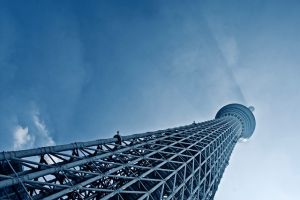
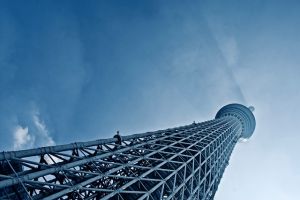
Tokyo Skytree, the modern symbol of Tokyo that opened in 2012, is also said to stand on this same line.
When you look at Tokyo Skytree together with the idea of ley lines and the old directional taboo known as the kimon, several details appear that make some people wonder whether it was all really coincidence.
A design concept that “transcends time and space”
Tokyo Skytree’s design concept has been described as the creation of an urban landscape that “transcends time and space,” combining traditional Japanese beauty with a futuristic design.
Other stated ideas behind the tower include acting as a catalyst for neighborhood revitalization, creating lively and welcoming spaces through three gates and two observation decks, and contributing to urban disaster prevention through a structural system inspired by Japan’s traditional five-story pagodas.
The phrase “transcending time and space” may sound vague at first, but in design terms it refers partly to the use of traditional Japanese architectural forms, such as gentle swelling curves and elegant inward curves.
In other words, Tokyo Skytree is a new landmark that incorporates older Japanese architectural techniques and aesthetics. But if a Tokyo landmark built around a concept of time, space, and tradition stands on a supposed ley line, it is easy to see why some people suspect intention behind it.
Is Tokyo Skytree a power spot?
Many of the places mentioned in ley line stories, including Heitate Jingu, Shikoku, and Ise Jingu, are also famous as so-called “power spots.” Sites along the Median Tectonic Line are sometimes said to hold powerful energy, and some are even rumored to have unusual magnetic qualities.
So what about Tokyo Skytree?
In this theory, Tokyo Skytree stands on the same line created by connecting Mount Fuji and the Imperial Palace. In fact, on a clear day, visitors can see Mount Fuji from the observation decks, and the Imperial Palace can also be seen from the tower.
A ley line is often described as a path for some kind of sacred or invisible energy. From that viewpoint, some people imagine that the land beneath Tokyo Skytree may also hold an unseen force that cannot be proven scientifically.
Officially, the site was chosen in part because a broadcasting tower needs an area without taller buildings nearby. Still, for people who follow ley line theories, the question remains: was that the only reason?
Of course, there is no way to prove whether the location was deliberately chosen for spiritual reasons, or whether any special energy exists there. What can be said is that, within this ley line interpretation, Tokyo Skytree is positioned on that line.
Tokyo Skytree is a major public attraction, so if you visit, use official routes, follow facility rules, and avoid entering restricted areas for photos or “power spot” hunting.
The height of Tokyo Skytree and Nikko Toshogu
Tokyo Skytree’s height is famously 634 meters. It is so tall that even from far away, it is instantly recognizable.
There is another curious detail: this height is said to be close to the elevation of the five-story pagoda at Nikko Toshogu.
Skytree’s visible height gets most of the attention, but the foundation also extends deep underground. The deepest piles are said to reach about 50 meters, and the deeper underground spaces are said to be around 32 meters below ground level.
If you add 32 meters to the tower’s 634 meters, the number becomes 666, a number often treated as ominous in Christian tradition. Is that simply coincidence? There is no public evidence proving otherwise, but it is one of the details that keeps the rumor alive.
Tokyo Skytree and the kimon
Tokyo Skytree also stands to the northeast of the Imperial Palace. In traditional Japanese cosmology influenced by Onmyodo, the northeast is known as the kimon, often translated as the “demon gate.”
Tokyo Tower, meanwhile, is located in the opposite direction, the ura-kimon, or “back demon gate.”
The idea of the kimon comes from old East Asian directional beliefs. One explanation is connected to the Chinese classic often known in English as the Classic of Mountains and Seas, which describes a legendary place with a giant peach tree and a gate in the northeast where demons were said to emerge. Stories also tell of a tiger placed at the gate to drive away those demons.
Were Tokyo Tower and Tokyo Skytree accidentally built in the kimon and ura-kimon directions when viewed from the Imperial Palace? Or did old directional ideas quietly influence part of Tokyo’s urban planning? Nothing official confirms such a theory.
However, the area around Tokyo Skytree has historically suffered damage in disasters such as the Great Kanto Earthquake. Since Tokyo Skytree also has a role as part of the city’s disaster-prevention infrastructure, some people feel it may not be entirely natural to think the site was chosen by chance alone.
Closing thoughts
Tokyo Skytree is one of Tokyo’s most popular tourist landmarks and a modern symbol of the city. Yet in ley line lore, it is said to stand on a straight line stretching from Heitate Jingu in Kumamoto toward Kashima Jingu, and it is also aligned with Mount Fuji in some interpretations.
It is positioned northeast of the Imperial Palace, in the direction traditionally called the kimon, while Tokyo Tower sits in the opposite ura-kimon direction. Its 634-meter height is also said to be close to the elevation of the five-story pagoda at Nikko Toshogu.
None of this proves that Tokyo Skytree was built for occult or spiritual reasons. But for travelers interested in haunted Japan, sacred geography, and urban legends, it adds another strange layer to one of Tokyo’s most familiar sights.
Japanese Language
熊本県の幣立神宮から四国を通って、伊勢神宮を通るレイラインはそのまま東京にまで伸びています。そしてそのレイライン上にあるものは、昔作られたものだけではありません。2012年に開業した東京の新しいシンボルの東京スカイツリーも、実はこのレイライン上に位置しています。東京スカイツリーとレイライン、そして、鬼門を考えると偶然こうなったわけてけはではないんじゃないかと思ってしまう、様々な条件が見えてきます。東京スカイツリーのデザインのコンセプトに”時空を超えた”がある。
画像:Pixaboy 。東京スカイツリーのデザインコンセプトは 時空を超えた都市景観の創造:日本の伝統美と近未来的デザインの融合 まちの活性化への起爆剤:賑わいと親しみを感じる3つのゲートと2つの展望台 都市防災「安全と安心」への貢献:日本古来の建築「五重塔」に通じる新たな構造システム 引用: Wikipedia 。です。時空を超えた都市景観がコンセプト・・・あまりピンときませんが、これは伝統的なデザイン「むくり」「そり」などを取り入れたデザインのことを差しています。
伝統的な建築技術やデザインを取り入れた新しい東北のシンボルというわけですが、時空を超えたデザインの東京のランドマークがレイライン上にあるということは…やはり誰かの意図がそこに介在しているのでしょうか。参考資料:東京スカイツリー 。レイライン上にある東京スカイツリーはパワースポット?。。画像:Pixaboy 。これまで紹介してきたレイライン上にある場所…幣立神宮や四国、伊勢神宮などはすべて「パワースポット」としても有名な場所です。膨大なエネルギーが秘められている中央構造線沿いにあるスポットは、0地場の場所も多いわけですが東京スカイツリーはどうなのでしょうか。
東京スカイツリーは同じレイライン上・・・つまり、富士山と皇居を一直線上で結んだときにできるライン上に作られているという事です。実際に、東京スカイツリーの展望台に上ると天気がよければ富士山が見えますし、皇居も見ることができます。レイラインとは、もともと「何かの神聖なエネルギーの通り道」ですから、東京スカイツリーがある場所もまた、何か目には見えない、化学では証明することができないエネルギーがある場所だと考えることもできます。東京スカイツリーの建設に当たって、電波塔という性質から「高くに高いビルがない」場所を基準として選ばれたとは言われていますが、実際のところはどうなのでしょうか…。
もちろん、この場所にエネルギーがあるのか、誰かが意図的にに選んだのかを調べるすべはありません。ですが、レイライン上に位置していることだけは事実なのです。参考資料 :2−4.東京スカイツリー – J-Stage 。東京スカイツリーの高さと日光東照宮の標高がほぼ同じ。東京スカイツリーの高さはみなんもご存知「634m」です。かなり高さで、遠くから見てもひときわ高いので一目で「スカイツリーだ」と解る高さですが、実はこの高さは日光東照宮にある五重塔の標高とほぼ同じ高さです。
そして、高さが注目されることが多いスカイツリーですが、地下にうち込まれた杭は最も深いもので50メートルになもります。地下空間の深い部分は地下約32メートル程度といわれています・・・これ高さと足すと、キリスト教で不吉な数字とされている666になります。これは、単なる偶然なのでしょうか。参考資料:もっとスカイツリー | Q&A – 東京スカイツリー建設プロジェクト 。東京スカイツリーと鬼門の関係。画像:Pixaboy 東京スカイツリーは、皇居から見たときの北東・・・つまり鬼門の方角に建てられています。
そして、東京タワーはその反対の裏鬼門にあたる位置になるのです。鬼門とは、陰陽道の考え方のひとつなのですが、山海經という書物に出で来る度朔山という大きな桃の木がある場所からみて、「北東にある鬼が出る門」のことでした。この門の鬼を退治する為に虎が門におかれていた…という伝説的な話が元になっているといわれています。皇居から見たときの鬼門と裏鬼門に当たる位置にたまたま東京タワーとスカイツリーが作られたのか…それとも時空を超えた都市計画の一部に、鬼門や裏鬼門という考え方も含まれているのかは、公にはされていません。
ですが、東京スカイツリーが位置する場所は歴史的に見たときに、関東大震災などで被害を受けた地域でもあります。そして、東京スカイツリーは、防災の拠点という役割もあることを考えると、たまたまこの場所に作られたのではないのではないかと考えるほうが自然な気もしてきます。参考資料:中国の神獣・悪鬼たち―山海経の世界 (東方選書) 。まとめ。東京の新しいシンボルとして、観光地として大人気の東京スカイツリーですが、熊本県の幣立神宮から鹿島神宮に伸びる一直線上のレイライン上にあり、そして、東京スカイツリーと富士山も同じライン上に並んでいます。
東京スカイツリーは皇居から見たときに鬼門に当たる位置に作られており、東京タワーは裏鬼門に当たります。また、高さが日光東照宮の五重塔とほぼ同じ高さにされているのも単なる偶然ではないのかもしれません