English Version
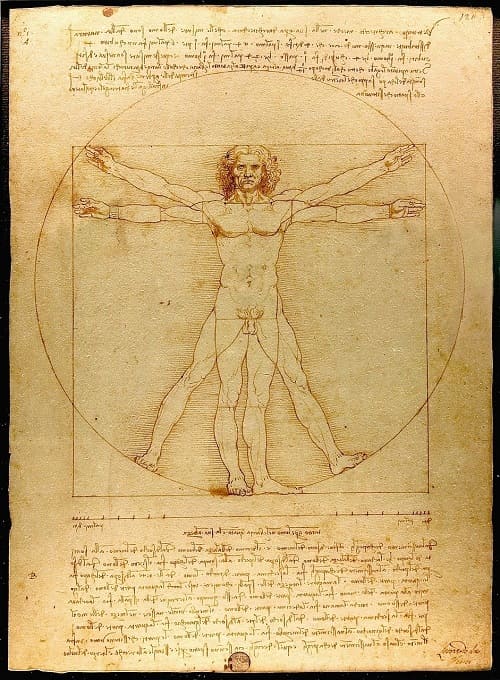
If the name Vitruvian Man instantly brings an image to mind, you know your art history. But even if the title sounds unfamiliar, you would probably recognize the picture the moment you saw it: a man with his arms and legs spread inside a circle and a square.
Many artists have drawn versions of the Vitruvian Man, but the most famous is the one by Leonardo da Vinci. It is so iconic that, even today, it remains one of the clearest visual symbols of the human body.
So what exactly makes it so remarkable? Why does a man inside a circle matter so much?
To understand that, we have to go back to the world Leonardo lived in.
A Diagram of Human Proportion
The Vitruvian Man is a drawing meant to show that the human body follows mathematical proportions.
For example, it expresses ideas such as:
- The distance from the top of the head to the chin is equal to one-eighth of a person’s height.
- The length of the hand is equal to one-eighth of a person’s height.
- The length of the foot is equal to one-sixth of a person’s height.
In other words, the drawing presents the body as something harmonious, measurable, and mathematically balanced.
Of course, today we know not every body follows these exact rules. Modern fashion models, for example, are often described as having especially small faces, so the proportions would not always match neatly. But in Leonardo’s time, this way of visualizing the body was revolutionary.
The Circle, the Square, and the Universe
The article’s central idea is this: the Vitruvian Man suggests that humanity stands at the center of the universe.
That sounds abstract at first, but the symbolism makes it easier to understand.
In Leonardo da Vinci’s era, a perfect circle was often associated with heaven or spirit. A square was associated with earth or matter. When the two forms were brought together, they could be read as a symbol of the universe itself.
In the Vitruvian Man, the human figure fits into both the circle and the square with carefully calculated proportions. The body appears as the point where heaven and earth, spirit and matter, meet.
That is why this single sheet of paper can be interpreted as a visual argument: human beings are not just part of the universe. They occupy its center.
Why That Idea Was So Shocking
The idea of human proportion had existed since ancient Rome. Painters used it for portraits. Sculptors used it for statues. Architects used it for buildings. It had practical value because it helped artists and builders create forms that looked beautiful and balanced.
But according to this interpretation, Leonardo did something different. He did not treat human proportion as only a technical tool. He treated it as philosophy.
In the world Leonardo lived in, the common belief was that God stood at the center of the universe. That assumption was so deeply accepted that most people would not question it.
So for someone to suggest that the center of the world was humanity, not God, would have sounded almost impossible to accept.
That is one reason Leonardo’s Vitruvian Man was not widely presented to the public in his own time. It remained in his manuscripts, preserved as a note and a study, until the surrounding ideas became easier for later generations to receive.
Why Leonardo’s Version Is Special
The idea that humanity might be central to the world had been discussed before Leonardo. But before him, it was mostly expressed in essays, philosophical arguments, or abstract claims.
Leonardo turned that idea into a single image.
Anyone could look at it and understand the message immediately: the human body, measured and balanced, is placed within the symbolic structure of the universe.
That was the power of the drawing. It took an idea that had been vague and philosophical and made it visible.
The Endpoint of Leonardo’s Study of the Human Body
Leonardo da Vinci is best known for paintings such as the Mona Lisa, The Last Supper, and Virgin of the Rocks. One reason those works remain so famous is that Leonardo observed human beings with extraordinary intensity.
To draw or paint a person convincingly, an artist has to understand bones, muscles, skin, expression, movement, and the structure beneath the surface. Leonardo studied the body from the outside and the inside, even performing human dissections and recording what he found.
The Vitruvian Man can be seen as one result of that lifelong investigation.
It brings together the golden proportions of the body and the philosophical idea that humanity belongs at the center of the cosmos.
Leonardo was not only a painter. He was an artist capable of challenging the common sense of his age. And few works express that more clearly than the Vitruvian Man.
Japanese Language
「 ウィトルウィウス的人体図 」。と聞いてパッと図が思いつく人は、なかなかの知識をお持ちですね。そうでない人も、絵を見れば一発でそれと分かります。ウィトルウィウス的人体図は様々な芸術家が描いていますが、最も有名なものが、レオナルド・ダ・ヴィンチが描いたもの。それが、こちら。。既視感ありますよね。「 円と正方形の中に両手両足を広げた人が入っている絵 」といえば、まず誰もがこれを思い浮かべるでしょう。それくらい、未だに人体を象徴する絵であり続けています。
さて、このウィトルウィウス的人体図について、。「一体何が凄いの?」。というお話。「円の中に人がいるから、何なの?」。という感じですよね(笑)。この絵の凄さを知るには、ダ・ヴィンチが生きた時代にまで遡る必要があります。ウィトルウィウス的人体図について、。何が凄いのか?何が革新的なのか?何を表現しているのか?この疑問にお答えしていきます。ウィトルウィウス的人体図は、「宇宙の中心は人間である」と証明している。。いきなり結論です。ウィトルウィウス的人体図は、 「宇宙の中心は人間である」ことを証明しています。
。はい。わけが分かりませんね(笑)。実際の人体図から、この「宇宙の中心は人間である」を見ていきましょう。ウィトルウィウス的人体図とは?。ウィトルウィウス的人体図とは、「人体は数学的に比例している」ことを説明する図です。ウィトルウィウス的人体図が表す「人体の調和」 頭頂から顎の先までの長さは、身長の1/8と等しい 手の長さは、身長の1/8と等しい 足の長さは、身長の1/6と等しい このように、体にはいろんな比例が見つかることを示しています。
今では「モデルは皆顔が小さい」と分かってますから、この法則が当てはまらないと誰もが分かりますけどね(笑)。しかし当時、 これをもとに作られたウィトルウィウス的人体図は、 天地がひっくり返るほど革新的だったのです。。「宇宙の中心が人間である」というダ・ヴィンチの主張は、こう。。レオナルド・ダ・ヴィンチが生きた時代、。真円は、「 天 」あるいは「 精神 」 正方形は、「 地 」あるいは「 物質 」 を示す象徴であり、これら2つが合わさることで「 宇宙 」を表していました。
。そして、ウィトルウィウス的人体図に描かれる人間は、 真円にも正方形にも完璧に内接し、2つの象徴の中心に完璧な比率で存在しています。。つまり「宇宙の中心に人間がいる」ということを、この人体図たった一枚が証明しているのです。実は、この考えは古代ローマ時代からあり、。画家は肖像画を 彫刻家は彫像を 建築家は建造物を 素早く美しく作るため、実用的に使われていました。人体の比率を哲学的に捉える人は、 ダ・ヴィンチを除いて誰一人いなかったのです。
。ウィトルウィウス的人体図は、当時の常識を覆すものだった。。レオナルド・ダ・ヴィンチが生きた時代は、「 宇宙の中心には神がいる 」という考えが常識でした。それこそ「地球は丸い」ということくらい、誰もが信じて疑わないことでした。地球は本当に丸いのか、実際に見た人はほとんどいないのに…。。この地球と同じように、。「神は見たこと無いけど、宇宙の中心は神でしょ」。という考えも、常識中の常識だったのです。今の時代に、。「地球は平らで、端っこに行くと落ちちゃうんだよ」。
って言っても、誰も信じませんよね(笑)。同じく、 ダ・ヴィンチの時代に「世界の中心は人間なんだよ」って言っても、誰も信じてくれません。。だから、ダ・ヴィンチが描いたウィトルウィウス的人体図は公に出ず、この考えが受け入れられるまで「 手稿 」というメモにずっと描き残されたままでした。なぜ、ダ・ヴィンチのウィトルウィウス的人体図が特別なのか?。実はこの「人間が世界の中心説」は、ダ・ヴィンチ以前から囁かれていました。しかしそれまでは、論文やら哲学者の主張やらで主観的に語られ、誰もが認められる説ではありませんでした。
その説を、 ダ・ヴィンチは誰が見ても「宇宙の中心は人間である」と一発で分かるよう、 たった一枚の絵に表現してしまったのです。。それまでの空想的な説を具体化して、誰もが認める形にしてしまったのです。「地球は丸い」と主張する人を宇宙に連れて行って、本当は平らだった地球を見せつけるようなものです。これほどに、この人体図は天地がひっくり返るほど強烈なものだったのです。ウィトルウィウス的人体図は、ダ・ヴィンチの哲学的な到達点を表している。。ダ・ヴィンチといえば、。
モナ・リザ 最後の晩餐 岩窟の聖母 のような「絵画」が有名ですよね。この絵画がこれほど有名である理由の1つは、ダ・ヴィンチが人間を徹底的に観察していたから。人間を完璧に描くには、骨格、筋肉、皮膚、表情、その他人体のすべてを知る必要がありますよね。ダ・ヴィンチは、自身で人体解剖まで行い、人間について外からも中からも徹底的に観察し、記録していました。そしてたどり着いた到達点が 「人体の黄金比率」であり、「宇宙の中心は人間である」という概念 です。
。画家でありながら、常識を覆す哲学をも生み出してしまうのが、レオナルド・ダ・ヴィンチの凄さ。そしてその凄さを端的に表している絵が、ウィトルウィウス的人体図なのです