English Version
When you hear “the boundary between this world and the next,” what kind of place do you imagine?
A glittering river like the Sanzu River from a near-death-experience TV reenactment? A deep, endless cave, like the underworld Orpheus entered in search of Eurydice?
If your image is that dramatic, Rokudo no Tsuji may surprise you. This “border with the afterlife” is less than 30 minutes by bus from Kyoto Station.
What Is Rokudo no Tsuji?
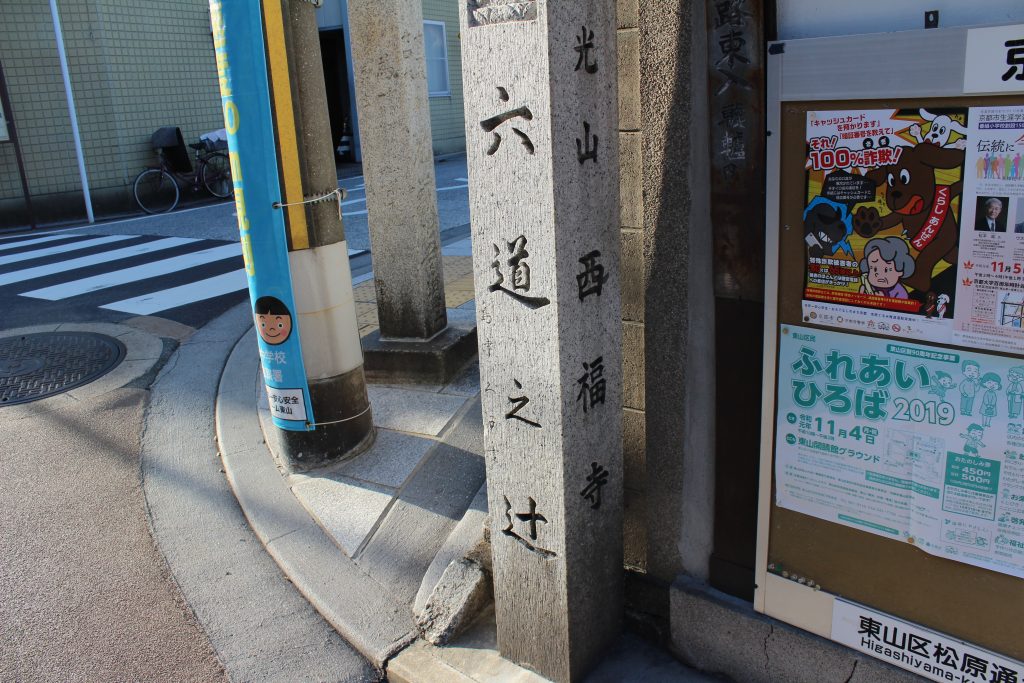
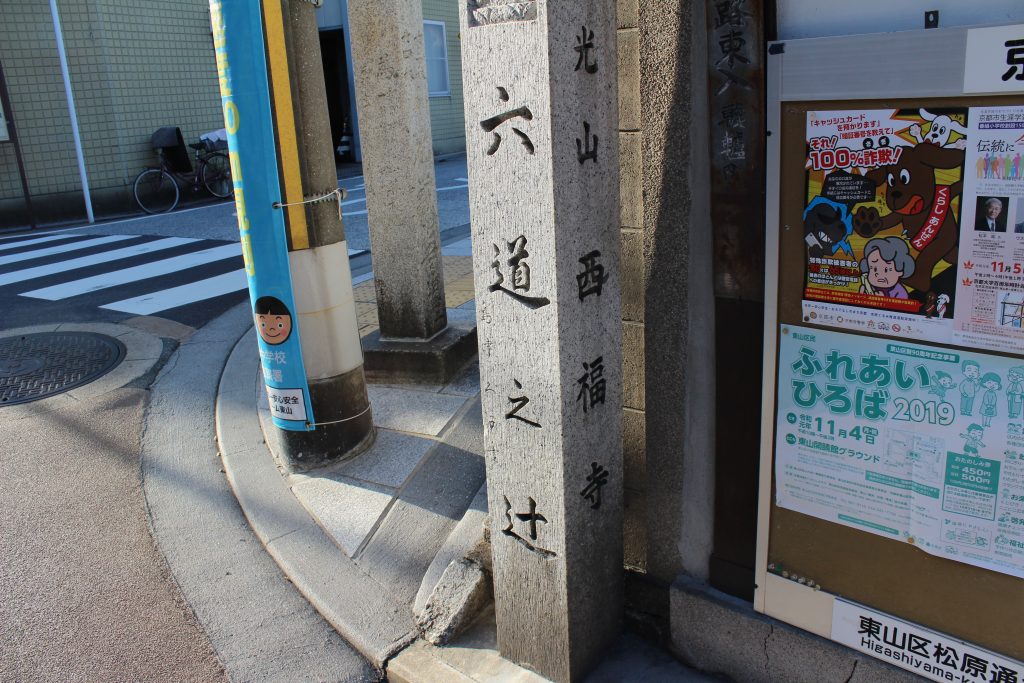
From Kyoto Station, take Kyoto City Bus No. 206 for about 20 minutes. Near the Kiyomizu-michi bus stop, you’ll find a street known as Rokudo no Tsuji.
At first glance, it looks like an ordinary road. But for centuries, this area has been regarded as one of Kyoto’s borders between the living world and the realm of the dead.
In Buddhism, “rokudo” refers to the six realms through which beings are reborn: Hell, Hungry Ghosts, Animals, Asuras, Humans, and Heaven. According to this belief, the realm of one’s next life is determined by the deeds of previous lives. Beings cycle through these six worlds, accumulating virtue in the hope of eventually escaping the cycle.
As its name suggests, Rokudo no Tsuji is said to mark a crossroads of these six realms. In more folk-based belief, it also came to be thought of as an entrance to the underworld.
The name appears in the Kojidan, a collection of tales from the Nara to Heian periods, which suggests that the area had already been called Rokudo no Tsuji by at least the medieval period.
Ono no Takamura: A Man Who Worked in Two Worlds?
Rokudo no Tsuji, and the nearby temple Rokudo Chinno-ji, are also tied to another famous legend: the story of Ono no Takamura, a man said to have worked in both this world and the next.
Although the tale is legendary, Ono no Takamura himself was real. He was a literary figure of the early Heian period, and one of his poems appears in the Hyakunin Isshu anthology under the name Sangi Takamura.
His poem is often translated in spirit as:
“Tell the people of the capital, O fishing boat, that I have rowed out across the wide sea toward the countless islands.”
Takamura composed this poem when he was exiled to the Oki Islands. His exile was not the result of a violent crime. Rather, it is said to have followed a dispute with the imperial court over problems that arose when he was meant to travel to Tang China as part of a diplomatic mission. He later wrote a Chinese poem criticizing Emperor Saga, which is believed to have worsened his situation.
In fact, Takamura was called back to Kyoto only a few years after his exile, because his talent was too valuable to waste.
Even so, the episode suggests that he was an unusually bold and unruly figure. His rebellious spirit was so strong that he earned the nickname Yakyo, meaning something like “wild eccentric.”
According to legend, every night Takamura descended into the underworld through a well behind Rokudo Chinno-ji and assisted King Enma, the judge of the dead. By day, he served the imperial court. By night, he worked as an official in the realm of the dead.
If true, he must have had an astonishingly demanding schedule.
At Rokudo Chinno-ji, the well that Takamura is said to have used to travel to the underworld still remains. No one knows exactly why this legend formed, but it may have grown from Takamura’s larger-than-life personality: a man exiled for defying authority, then summoned back because of his exceptional ability.
To people of the Heian period, Ono no Takamura may have seemed like a kind of dark hero, active in both the imperial court and the underworld.
The Other World Was Close
So why did Rokudo no Tsuji come to be called an entrance to the underworld in the first place?
The answer likely lies in its location. Rokudo no Tsuji stood at the entrance to an area once known as Toribeno. In earlier times, Toribeno was a place for open-air burial.
“Open-air burial” may sound poetic, but in practice it meant that bodies from the capital were carried outside the city and left exposed. Japan was already deeply influenced by Buddhism at the time, and high-ranking people were often cremated. But for commoners who could not afford the wood needed for cremation, the more common practice was to leave the body to weather and decay naturally.
When someone died, their family placed the body in a coffin, held funeral rites at Rokudo Chinno-ji near Rokudo no Tsuji, and then carried the coffin on to Toribeno.
Toribeno was not the only such site. Along with Adashino and Rendaino, it was known as one of Kyoto’s three major funerary grounds. The other two also have legends describing them as entrances to the underworld, making it easier to understand why Rokudo no Tsuji came to be seen as a boundary between life and death.
In old Japan, death was much closer to everyday life than it is for many people today.
When epidemics spread, many people lost loved ones. Injuries, malnutrition, and accidents must also have been common. The dead were carried out of the capital, but until they literally became dust and were taken by the wind, they remained nearby, visible if one only turned one’s eyes in that direction.
Surely some people returned again and again to the burial grounds, watching the bodies of those they loved decay and merge with the earth.
Rokudo no Tsuji is an entrance to the underworld that can be reached from Kyoto Station in about 30 minutes. It is not a glamorous sightseeing spot, but for travelers interested in Kyoto’s darker folklore and the history of how people faced death, it is a place worth visiting with quiet respect.
If you go, remember that this is a real neighborhood and a religious site. Stay on public paths, follow posted rules at the temple, and be considerate of residents and worshippers.
Japanese Language
あの世とこの世の境目 、と聞いて、あなたはどんな場所を思い浮かべるだろうか。臨死体験の再現VTRに出てくるような、きらきらと水面が輝く三途の川?それともオルフェウスがエウリュディケを求めて降りていったような、深く長い洞穴?。そんなドラマティックなイメージをお持ちの方は少しがっかりしてしまうかもしれない。何しろ、今回紹介する「あの世とこの世の境目」は京都駅からバスで30分足らずの場所にあるのだ。冥府への入り口「六道の辻」って?。。京都駅から市バス206番に乗ること20分。
バス停「 清水道 」のすぐそばに、 六道の辻 と呼ばれる道がある。一見すると何の変哲もないただの通りなのだが、何を隠そう、ここが古くから「あの世とこの世の境目」とされてきた場所のひとつなのだ。六道 とは、仏教において人が 輪廻転生 する6つの世界のこと。地獄道・餓鬼道・畜生道・修羅道・人間道・天道がある。我々は前世の行いによって次の生をどの世界で過ごすかを定められ、これら6つの世界をめぐりながら徳を積み、やがて離脱することを目指す。「六道の辻」はその名の通り、これら6つの世界の分岐点にあたると言われており、もっと素朴な信仰においては「 冥府への入り口 」とも信じられてきた。
奈良〜平安時代の様々な説話を収めた書物『 古事談 』にも、この地域を六道の辻と呼ぶ、と記載があることから、少なくとも中世以前から六道の辻という名称が使われてきたようだ。あの世とこの世のダブルワーカー?小野篁伝説。。六道の辻及び、そこにそびえ立つ六道珍皇寺には、もうひとつ有名な逸話がある。それが、あの世とこの世、2つの世界で仕事をしていたとされる 「小野篁」伝説 だ。伝説といっても、小野篁は実在する人物である。平安時代初期の文人で、百人一首にも「 参議篁 」という名前で和歌が残っている。
以下に、その和歌を紹介しておこう。「わたの原八十島(やそしま)かけて漕(こ)ぎ出でぬと 人には告げよ海人(あま)の釣り舟」。簡単に訳すと、「大海原へ、たくさんの島々を目指して漕ぎ出して行ったよ、と都の人々に伝えてくれ、漁師の船よ」という意味合いになる。これは小野篁が隠岐に 島流し に遭った時に詠んだ歌だ。島流しといっても大罪を犯したわけではなく、遣唐使として唐へ向かう際のトラブルで朝廷と対立し、その後作った漢詩で当時の天皇、嵯峨天皇を批判したことが原因とされる。
実際、小野篁は、島流しからわずか数年で、才能を惜しまれ、京に呼び戻されている。ともあれ、この小野篁、朝廷を批判する漢詩を作って島流しに遭ったというエピソードから見てもわかるように、かなり破天荒な人物だったようだ。あまりに旺盛すぎる反骨精神から「 野狂 」という異名まで取っていた。そんな彼は、夜な夜な、この六道珍皇寺の裏にある井戸からあの世に出かけ、なんと 閻魔大王 の仕事を手伝っていたという。昼は朝廷で、夜は冥府で役人をしていたというのだから、これが本当ならかなりタフな人物だ。
六道の辻にある 六道珍皇寺 には、小野篁が冥府に行くのに使っていたとされる井戸が、今でも残っている。一体なぜこのような伝説が囁かれるようになったのかはわからないが、おそらくは小野篁の破天荒な人となり、そして一旦は島流しにされたものの、その才を惜しまれて都に呼び戻された、という常人離れした逸話によるものだろう。朝廷と冥府、2つの世界で華々しく活躍する小野篁は、平安時代の人々にとってダークヒーロー的存在だったのかもしれない。「あの世」はすぐそばにある。
京都各地に残る冥府への入り口。そもそも、一体なぜ六道の辻が 冥府への入り口 と称されるようになったのだろうか?。実は、六道の辻は 鳥辺野 と呼ばれる地域の入り口にあたる。この鳥辺野は、かつて 風葬の地 だった。風葬と言えば聞こえはよいが、要するに、都で出た遺体を洛外に運び、 野ざらし にしていたのだ。当時、既に仏教の影響下にあった日本。身分の高い人々は火葬によって葬られていたが、木材を買うことのできない庶民にとって最も一般的なのが、遺体を 野ざらし にし風化を待つ「 風葬 」だった。
人々は身内が亡くなると、その遺体を棺におさめ、六道の辻にある 六道珍皇寺 で葬儀を行ったのち、棺を鳥辺野まで運んでいったという。こうした風葬の地は鳥辺野以外にも存在し、 化野 、 蓮台野 と並んで「 京都三大葬送地 」と呼ばれている。残る二箇所もまた「 冥府への入り口 」とする伝説があることから、一体なぜ六道の辻があの世とこの世の境目と呼ばれるようになったのか、その理由は明白だろう。かつての日本において、「死」は現代よりもよほど身近な存在だった。
疫病が流行れば身近な人が大量に死ぬし、怪我や栄養失調、不慮の事故もかなりの数あったはずだ。そして、彼ら死者は一度は都から外へと運び出されるものの、文字通り塵となり風に乗るまで、ふと目をやればすぐ見える場所に留まっていたのだ。中にはきっと、何度も風葬の地へ足を運び、愛した人の遺体が腐り果て、土と同化していくさまを見守った人もいたに違いない。京都駅からわずか30分ほどで足を運べる冥府への入り口。華やかな観光スポットとは言い難いが、京都に訪れた際には是非足を向け、人々の生死に思いを馳せてみてほしい