English Version
Among the figures of the Three Kingdoms, Lu Bu is remembered as a warrior of extraordinary strength. Ancient Chinese tales are full of powerful generals, but Lu Bu has often been treated as something special.
He was said to be highly skilled in horseback riding and archery, and his beloved horse, Red Hare, was considered a superb steed. This led to the famous praise: “Among men, Lu Bu; among horses, Red Hare.”
At the same time, because he changed masters several times, Lu Bu also became a byword for betrayal. Later generations often described him as a man of unmatched martial ability but shallow judgment and little political talent. Yet historical accounts also suggest that Lu Bu’s rule was not always viewed negatively.
Here, we look at both Lu Bu’s legendary strength and the often-overlooked question of his political ability.
How Lu Bu Became Known as the Strongest Warrior
Much of the image of Lu Bu as the strongest warrior in the Three Kingdoms comes from Romance of the Three Kingdoms. In particular, modern games and pop culture often highlight the Battle of Hulao Gate, where Lu Bu is shown defending Dong Zhuo’s forces.
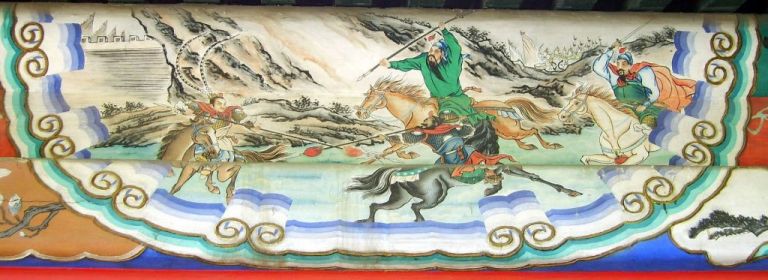
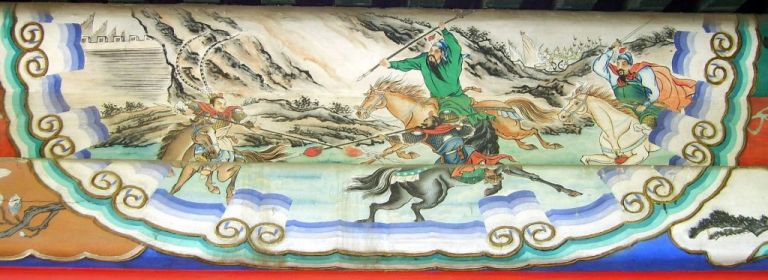
In that famous story, the anti-Dong Zhuo coalition—led by Yuan Shao and including figures such as Cao Cao and Sun Jian—struggles against Lu Bu’s overwhelming strength. Zhang Fei, who at the time serves under Liu Bei, begins a duel with him. Only after Guan Yu and Liu Bei join the fight is Lu Bu finally forced to retreat.
However, in the historical Records of the Three Kingdoms, the Battle of Hulao Gate itself does not appear in that form. This episode is generally considered a fictional creation rather than a documented historical event.
The battle where Lu Bu truly showed terrifying force in historical accounts came after he betrayed Dong Zhuo and fled the capital, eventually taking shelter with Yuan Shao.
At that time, Yuan Shao was fighting Zhang Yan, the leader of a criminal and rebel force known as the Black Mountain Bandits. Not much detailed information about Zhang Yan survives, but one account claims he commanded as many as one million followers. He later became a general under the state of Wei.
Zhang Yan’s army, which was giving Yuan Shao serious trouble, is said to have numbered around 10,000 soldiers. Lu Bu was the one sent to deal with them.
With only a few dozen mounted men, Lu Bu launched repeated attacks against this much larger force several times a day. Over the course of several dozen days, he scattered Zhang Yan’s troops.
In effect, this battle helped break apart the power known as the Black Mountain Bandits. It was this feat that led to the praise: “Among men, Lu Bu; among horses, Red Hare.”
Lu Bu, Wang Yun, and an Unexpected Reputation for Governance
Lu Bu’s military strength continued to appear in later episodes, but his political side is also worth noting.
After entering Dong Zhuo’s service, Lu Bu joined forces with Wang Yun and assassinated Dong Zhuo. In Romance of the Three Kingdoms, Wang Yun’s daughter is Diao Chan, whose beauty is used to drive a wedge between Dong Zhuo and Lu Bu.
In the historical record, however, the reason Lu Bu betrayed Dong Zhuo is uncertain, and several theories exist. Some say he had grown disgusted with Dong Zhuo’s tyrannical behavior. Others say he feared being exposed for having a relationship with one of Dong Zhuo’s concubines.
As an aside, that latter theory is sometimes said to have inspired the character of Diao Chan in Romance of the Three Kingdoms.
Whatever the reason, Wang Yun and Lu Bu briefly came to control the imperial court. Interestingly, their governance during this period was generally regarded as favorable. For that reason, it is difficult to say simply that Lu Bu had no political ability at all.
This rule did not last long. Li Jue and Guo Si, former subordinates of Dong Zhuo, attacked the capital, throwing the court into chaos once again.
During this conflict, Lu Bu defeated Guo Si—who was known as a brave and powerful warrior—in single combat. Guo Si himself withdrew, but in terms of overall military strength, the difference between the armies was overwhelming. Lu Bu and Wang Yun were ultimately defeated.
Lu Bu’s strategist Chen Gong also reportedly praised him, saying that if Lord Lu Bu fought in the proper way, no enemy could stand against him. This suggests that Lu Bu may have been a man of considerable potential, not merely a brute-force warrior.
Japanese Language
三国志の登場人物の中でも、 ずば抜けた強さを語られているのが呂布 です。古代中国の物語には 多くの強さを語られる武将 がいますが、呂布はその中でも特別視されやすい存在でしょう。馬術、弓の扱いに非常に優れており、愛馬であった赤兎馬も駿馬であったことから、「 人中に呂布あり、馬中に赤兎あり 」と賞賛されました。その一方で仕えた君主を何度も変えてきたため、「裏切り者」の代名詞にもなっています。後世の評価でも 「武においての強さは抜きん出た人物であったが思慮が浅く政治力に欠けていた」 と言われることも多いですが、実は 呂布の統治が評価されていた史実も存在 してます。
今回は呂布の強さと政治力についても紹介していきます。呂布が最強の武将だと呼ばれたキッカケとは?。。画像引用元: 三国志演義 。呂布が三国志において最も強く、最強の武将であるというイメージの多くは「三国志演義」から来ていることが多いでしょう。特に、最近ではゲームなどでも多く取り上げられる「虎牢関の戦い」において、董卓の配下として守備を任されたのが呂布でした。この時の逸話としては、反董卓連合軍であった盟主の袁紹をはじめ、曹操、孫堅なども強すぎる呂布を攻めあぐねていたところを、当時は兵卒でしかなかった劉備軍の張飛と一騎打ちを始め、さらに関羽、劉備も加勢してようやく退却させたというものです。
しかし、史書の三国志にはそもそも「虎牢関の戦い」自体が存在しておらず、この逸話はあくまでも創作だと言われています。史実において呂布が猛威を奮った戦いは、董卓を裏切って都落ちした後に、袁紹の元へ身を寄せていた時のことです。この頃、袁紹は黒山賊と呼ばれた犯罪者集団の統領であった「張燕(ちょうえん)」と戦っていました。この張燕という人物はあまり詳しい情報は残っていないものの、一説には100万人もの配下を操ったと言われる人物で、後に魏の武将になります。
さて、この袁紹がてこずっていた張燕軍は約1万の兵力を持っており、これの対応にあたったのが呂布でした。呂布は1万もの軍に僅か手勢の数十騎で一日に何度も攻撃を繰り返し、数十日かけて張燕軍を離散させてしまいます。。事実上、呂布が暴れまわったこの戦いで 黒山賊と呼ばれた勢力は解体 されました。この時の活躍が前述した「 人中に呂布あり、馬中に赤兎あり 」に繋がったのです。政治力を評価された呂布と王允。呂布の強さはこの後も続いていくところですが、そのエピソードについてはまた別の機会に紹介します。
少し話が戻りますが、董卓の配下になった呂布は王允という人物と手を組んで董卓を暗殺します。三国志演義では、この王允の娘が貂蝉であり、王允は娘の美貌を利用して董卓と呂布を仲違いさせたというエピソードに変わっていますが、史実の三国志では呂布が董卓を裏切った理由は諸説言われており、ハッキリとしていません。董卓の横暴な態度に愛想を尽かしていたという説や、董卓の側室であった女性と関係を持っていた事が発覚することを恐れたとも言われているのです。余談ですが、この後者の側室の女性説のモデルが三国志演義の貂蝉になったという話です。
さて、理由は様々な説が挙げられていますが、王允と呂布は一時的に朝廷を牛耳る立場に立っていたのです。実は、この期間の 呂布と王允の統治の評判はおおむね良好 であり、一概に呂布に政治力がなかったとは言いづらいのです。結果として、この統治は長く続かず、董卓の配下であった李傕と 郭汜によって攻め込まれたため、再び朝廷は混乱します。。この戦いでも剛勇の士と呼ばれた郭汜を一騎打ちで呂布は破り、郭汜自身は撤退しましたが、軍としての戦いでは圧倒的に差があり、呂布と王允は敗北してしまいます。
。また、呂布の軍師として仕えた陳宮も「呂布公は正しく戦えば敵はいない」と評価しており、 潜在的には能力の高い人物であった ことを伺わせるのです