English Version
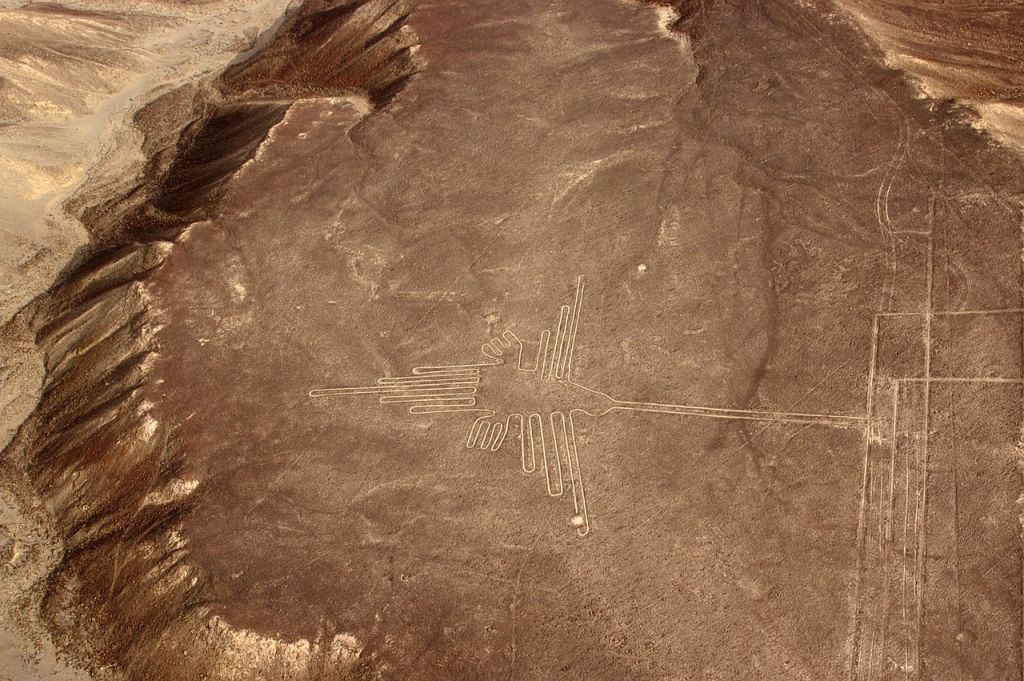
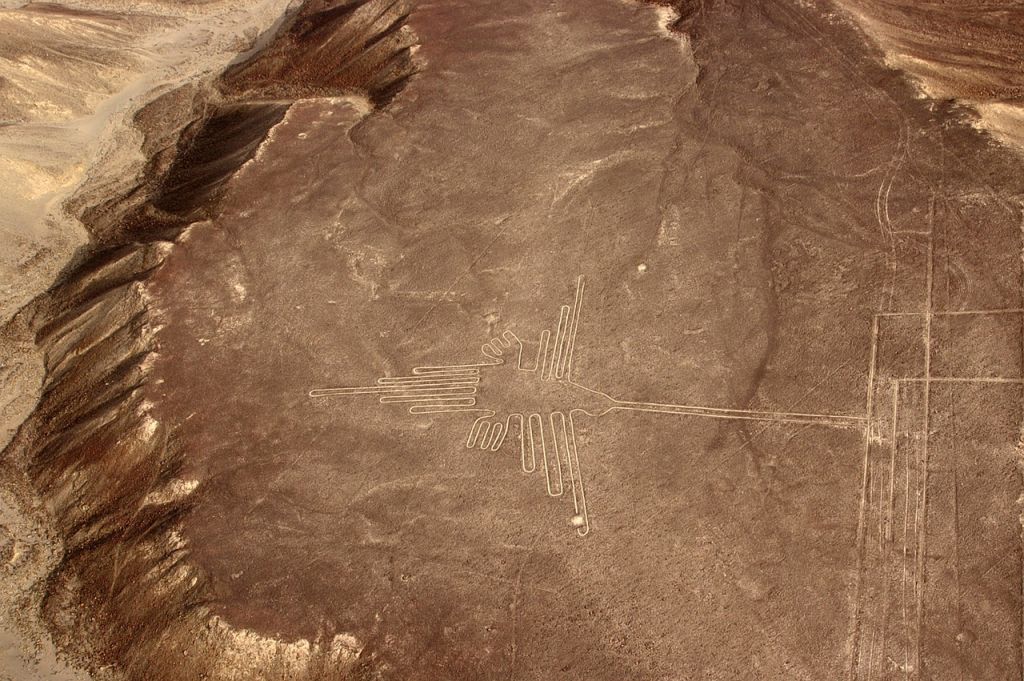
The famous Nazca Lines in southern Peru remain one of the world’s most mysterious archaeological sites. In 1927, archaeologist Toribio Mejía Xesspe was exploring the Nazca Desert when he noticed that road-like lines drawn across the ground formed enormous shapes. Later, in 1939, American archaeologist Dr. Paul Kosok identified geoglyphs shaped like plants and animals.
Further research revealed that this web of lines was connected across a vast area of roughly 500 square kilometers, with nearly 1,000 large and small drawings and geometric patterns carved into the desert surface.
A Vast Network of Lines
Some of the Nazca figures clearly resemble living creatures, while others are strange geometric forms. Their sizes and shapes vary widely, and even today, the exact reason they were made remains uncertain.
Because so many of the geoglyphs are built from long straight lines, they are sometimes discussed as a kind of ley line. In the sense of an enormous man-made linear monument, it may not be an exaggeration to call the Nazca Lines one of the largest ley-line-like sites in the world.
Some of the largest figures exceed 200 meters in length, making it impossible to grasp their full forms from ground level. To see the complete designs, they must be viewed from above.
The Nazca Culture and an Ancient Mystery
The geoglyphs are generally said to have been created between the 2nd and 8th centuries CE, making them relatively recent compared with some other ancient ruins. This period is known as the Nazca culture, part of the developing era of Andean civilization.
When people think of Andean civilization, Machu Picchu—the so-called city in the sky—often comes to mind. While the later stages of these civilizations are comparatively well known, some theories trace their deep roots back more than 10,000 years, with distant ancestral connections to migrations from Asia.
Why ancient people connected to the Andean world left behind such enormous figures is still debated. At the very least, the Nazca Lines appear to have held some kind of important cultural or ritual meaning.
Were They Made for Rain?
The mainstream theory today suggests that the lines may have been created as part of rituals for rain. This idea is based on the desert environment and archaeological clues, but the original purpose has never been proven with certainty.
Another famous theory claims that the Nazca Lines were markers for extraterrestrials. Among the figures is a large human-like form that many people have compared to an alien. Because numerous plant and animal figures over 50 meters long have also been found, New Age and occult discussions have often suggested that the lines may have served as signs for UFOs or beings from space.
In reality, even from about 10 meters above the ground, the full images are difficult to understand. Whether or not aliens were involved, it is easy to see why people imagine that someone—or something—was meant to view these forms from the sky.
Rumors have also linked the Nazca Lines to the so-called alien Anunnaki. Because of their unusual scale and appearance, theories involving extraterrestrial intervention continue to circulate.
Ley Lines Across the Earth
The idea of the Nazca Lines as a massive ley line laid across the Peruvian desert remains one of the site’s most intriguing interpretations. Some believe that ley lines found across the earth are not merely connected to the Inca or Andean worlds, but may carry a broader meaning.
In this view, sacred places and power spots are part of an invisible network of energy stretching across the planet like a web. This concept is sometimes called the World Grid.
According to one interpretation attributed to the Greek philosopher and mathematician Plato, the earth was imagined as a solid made from twelve regular pentagons, with 20 vertices on its surface—a Platonic solid. When this idea is applied to ley lines and ancient ruins, some argue that archaeological sites often seem to overlap with mysterious energy routes known as power spots or dragon veins.
From that perspective, ancient peoples may have understood a global flow of earth energy and placed monuments in locations considered spiritually or energetically important.
Of course, these ideas remain speculative. The Nazca Lines are a protected archaeological treasure, and travelers should view them only through authorized tours, observation towers, or licensed flights. Do not enter restricted areas or walk on the geoglyphs, as the desert surface is extremely fragile and the damage can last for generations.
Japanese Language
南米ペルー にある 有名なナスカの地上絵は現在も謎の多い世界的な遺跡 の1つです。1927年、ナスカ砂漠を探索していた 考古学者のトリビオ・メヒア・へスぺという人物が、地上に描かれた道路のような線が大きな図形になっていることに気付きました。。その後1939年、 動植物の地上絵をアメリカの考古学者であるポール・コソック博士 が発見します。。その後の調査によってこの網のような線は繋がっており、 約500平方キロの広大な範囲に1000近い大小の絵や幾何学模様が刻まれている 事が判明したのです。
。これらの中には、明らかに生物を象ったものから不思議な図形まで大きさも形もバラバラであり、現在でも作られた経緯や目的はハッキリと分かっていませんが、この数多くの 地上絵は直線を多く使われていることからレイライン と見られることがあります。人工的に作られた直線遺跡という意味では最も巨大であり 世界最大のレイライン と言っても過言ではありません。世界最大のレイライン。。ナスカの地上絵の中でも巨大なものは200メートルを超えるようなものもあり、上空からでなければ全体図を把握することは出来ません。
元々、これらの地上絵は紀元2世紀から8世紀にかけて作られたものだと言われていますので、時代的には他の古代遺跡と比べると新しいものです。この地上絵が描かれた時代は 「ナスカ文化」 と呼ばれており、アンデス文明の発展期に辺ります。アンデス文明と言えば、天空の遺跡と言われるマチュピチュを始め文明の終わりは比較的判明しているものの、その本流は10000年以上の超古代に遡り、一説にはアジア系のモンゴロイド達が祖先であると言われています。アジアの流れを汲むアンデス文明の古代人達が何故、このような巨大な図形を残したのかは議論を呼ぶところですが、 少なくとも文明としての意味合いがあることは確実なレイラインの1つ です。
現在の主流の説では、雨乞いのために描かれたとも言われていますが、これらは土地柄や物証による状況証拠であり、本来の目的は未だに明らかになっていません。宇宙人の目印説。ナスカの地上絵には、宇宙人を思わせる巨大な人型の絵が残されています。。その他にも50メートルを超えるような動植物を描いた線が数多く発見されたことから、 UFO(宇宙人)の目印である説がニューエイジ系の話題 では多数上がりました。実際に10メートルくらいの上空から見ても全体像を把握することは出来ないため、宇宙人であるかどうかは別にしても、 上空からこれらの図形を確認しようとした何者 かがいたのかもしれません。
ナスカの地上絵に関しては「宇宙人アヌンナキ」の関与が噂されるなど、その異様な形態から宇宙人関与説が根強く囁かれています。大地に敷かれたレイライン。。南米ペルーの大地に引かれた世界最大のレイラインにはまだまだ深い秘密が残っている と考えられます。インカ文明だけではなく、大地のいたる所に確認出来るレイラインには他にも意味合いがあると言われています。そのパワースポットは地球に網目のように張り巡らされた、エネルギーの動きのようなものであり、ワールドグリッドと呼ばれるものです。
ワールドグリッドという考え方。ギリシャの高名な哲学者であり、数学者であったプラトンの説では 「 地球は十二個の正五角形がつなぎ合わされ、その表面に20の頂点を持つ立体(プラトン立体)である」 と説いていたそうです。。この考え方を古代遺跡の並ぶレイラインに当てはめると、いわゆる パワースポットや龍脈と呼ばれるエネルギーが通る道に不思議と古代遺跡が重なっている と言われています。これらの事から、古代人達は地球規模でのエネルギーの流れを知っており、その知識からエネルギー的に重要な場所に遺跡を並べていたのではないか?
という考え方もあります