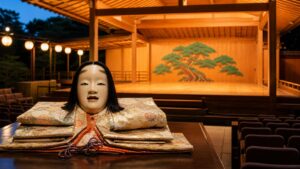
A Snow Woman belongs to the deepest winter, yet one of Japan’s most enduring supernatural stories is returning to the stage in the middle of July. On July 20, 2026, a reading event in central Tokyo is scheduled to present Lafcadio Hearn’s “Yuki-Onna” alongside other tales associated with him. That seasonal reversal is more than a clever way to offer relief from the heat. It points toward a long Japanese habit of meeting summer darkness with stories that produce an imaginative chill.
For readers searching for the Yuki-onna legend, the event offers a timely reason to return to the text that shaped the Snow Woman for many English-language readers. Hearn’s version is not a neutral catalog entry about a fixed supernatural being. It is a carefully structured story about terror, mercy, secrecy, marriage, memory, and the cost of breaking a promise. Reading it closely also reveals an important limit: Hearn recorded one version attributed to one local narrator, not the final definition of every Yuki-onna tradition in Japan.
Why the Snow Woman has appeared in midsummer
The immediate occasion is documented by the event organizer’s official notice. The organization announced an evening reading titled “Midsummer Snow Woman: The World of Lafcadio Hearn’s Ghost Stories” for Monday, July 20, 2026. It is scheduled to run from 4:15 p.m. to 6:00 p.m., with doors opening at 4:00 p.m., in Room C of the Ochanomizu Sola City Conference Center in Chiyoda, Tokyo.
The notice lists Yuki-onna, the tale of the earless biwa performer Hoichi, and a Tottori futon story among the planned readings. Keiko Hashimoto and Emi Fukushima are named as readers. Admission is free, capacity is listed as 140 people on a first-come basis, and registration is handled through a web form. The organizer also warns that the program may change. Anyone planning to attend should therefore check the official notice rather than rely on a summary written before the event.
Those details are facts stated by the organizer. The meaning of the seasonal choice requires interpretation. A Snow Woman in July creates an immediate contrast between physical heat and imagined cold. The audience enters a climate-controlled room, but the story asks them to picture a blizzard, a river in flood, a fragile hut, and fatal breath. The event’s title turns that contrast into its central invitation: cool the body through atmosphere, language, and fear.
The documented source behind Hearn’s Yuki-onna
The most reliable starting point for Lafcadio Hearn’s Yuki-onna is the text of Kwaidan: Stories and Studies of Strange Things, published in 1904 and available through Project Gutenberg’s complete English edition. In his prefatory note, Hearn distinguishes this tale from many pieces he adapted from older books. He says that a farmer from Chofu in Nishitama District, Musashi Province, told him Yuki-onna as a legend of his village. Hearn adds that he did not know whether it had previously been written in Japanese.
This statement is unusually useful because it identifies the chain of transmission as Hearn understood it. A farmer told a local legend; Hearn reshaped it into English literary prose; the story then circulated internationally through Kwaidan. The source does not give the farmer’s name, a transcript of the conversation, or a second version against which Hearn’s wording can be checked. It would therefore be inaccurate to describe every detail in the published story as an unchanged piece of anonymous ancient folklore.
Musashi Province covered most of present-day Tokyo and parts of Saitama and Kanagawa, according to the note attached to the edition. The tale itself places the action in a Musashi village but does not provide a modern street address for the ferryman’s hut. The connection to Chofu comes from Hearn’s prefatory account of the narrator, not from a claim that readers can identify and visit the exact supernatural site today. That distinction matters for both historical accuracy and responsible travel writing.
What actually happens in the Snow Woman story
Hearn opens with two woodcutters, the elderly Mosaku and his eighteen-year-old apprentice Minokichi. Their daily route requires them to cross a wide river by ferry. During a severe snowstorm, they discover that the ferryman has left the boat on the opposite bank, so they shelter in his small hut. The building has no brazier and no place to make a fire. After the men lie down, Minokichi wakes to snow blowing through the open door and sees a woman dressed entirely in white.
The woman bends over Mosaku and breathes a white vapor upon him. She then turns to Minokichi. Instead of killing him, she says that his youth and appearance have moved her to pity. Her mercy is conditional: he must never tell anyone what he has seen. If he speaks, she warns, she will know and kill him. By morning, the storm has passed and Mosaku is dead.
A year later, Minokichi meets a young woman who calls herself O-Yuki. She says that she has lost her parents and is traveling toward Edo in search of service. They walk together, she is welcomed into his home, and they eventually marry. The text describes her as a devoted daughter-in-law and says that she bears ten children. While other women in the village appear to age, O-Yuki retains the same youthful appearance she had when she arrived.
The household survives for years until Minokichi watches his wife sewing by lamplight. Her face reminds him of the supernatural woman in the hut. He tells O-Yuki the secret he promised to keep, still uncertain whether the encounter was a dream or the Woman of the Snow. O-Yuki reveals that she was the being he saw. She says she would kill him for breaking his word if not for their sleeping children. She orders him to care for them, dissolves into white mist, and is never seen again.
Confirmed details and interpretive possibilities
Several points can be stated directly from the text. Mosaku dies after the white woman’s breath reaches him. Minokichi is spared under a condition of silence. O-Yuki and Minokichi form a household and have ten children. Minokichi breaks his promise by recounting the encounter. O-Yuki leaves rather than killing him because of the children. These are narrative events, not reports of a verified historical haunting.
The story’s emotional meaning is less fixed. One reading treats Yuki-onna as a dangerous supernatural force temporarily softened by human attachment. Another sees O-Yuki’s years of family life as evidence that she has genuinely inhabited a human role, making Minokichi’s confession a rupture in trust rather than merely the triggering of a magical rule. A third reading focuses on memory: the past remains dormant inside an ordinary household until resemblance and language bring it back.
None of those interpretations can be proved in the same way as the event’s date or the story’s sequence of actions. The text supports them, but it does not declare a single moral. Even O-Yuki’s departure remains ambiguous. It can be read as punishment, grief, self-preservation, the restoration of a supernatural boundary, or several of those things at once. A careful reader should treat those meanings as arguments grounded in the story, not as facts about Japanese belief.
The promise is more important than the monster
The most memorable image may be the white figure breathing over a sleeping man, but the plot turns on speech. Yuki-onna does not merely spare Minokichi; she gives him a rule governing what may be said about the encounter. Years later, he breaks that rule in a moment of intimacy. He tells the person closest to him because her face seems connected to the secret. The confession is understandable, yet it is still a broken promise.
This creates a severe paradox. Silence makes the marriage possible, but it also means that the marriage begins beside an undisclosed death and a concealed identity. Truth ends the household, but continued secrecy would preserve a life founded on incomplete knowledge. The reader is not offered an easy ethical victory. Minokichi’s words are both a betrayal and an attempt to share the experience that has shaped him since youth.
O-Yuki’s final concern complicates the image of an emotionless spirit. She invokes the children as the reason Minokichi survives and tells him to care for them. The threat remains, but so does parental judgment. Her last speech measures him not only against an old supernatural command but also against his future conduct as a father. That is why Hearn’s Snow Woman still feels more unsettling than a simple account of a lethal apparition.
One Yuki-onna story is not every Yuki-onna legend
Search results often compress folklore into a list of universal traits: white clothing, snow, freezing breath, beauty, and death. Hearn’s story contains several of those elements, but readers should resist turning his version into a rulebook. His own note says the belief appeared in many forms across Japan. That sentence acknowledges variation even as his published narrative became one of the best-known forms in English.
The phrase “Yuki-onna legend” can therefore refer to a broad family of regional and literary traditions, while “Lafcadio Hearn Yuki-onna” refers to a particular text with Mosaku, Minokichi, O-Yuki, a promise, a marriage, ten children, and a final disappearance. Keeping those levels separate prevents two common errors: claiming that Hearn invented the Snow Woman from nothing, or claiming that he simply copied a single timeless national tale without changing it.
Hearn occupied an influential position between Japanese narrators and international readers. His prose gave this local account a durable English form, but the act of literary transmission always involves selection, pacing, description, and emphasis. Respect for the source means crediting the unnamed farmer Hearn mentions, recognizing the limits of the record, and avoiding claims about an untouched original that no surviving transcript establishes.
Why ghost stories feel at home in a Japanese summer
The July reading makes intuitive sense because fear can produce a bodily sense of cold. In Japan, summer programs frequently frame ghost stories as an evening form of cooling entertainment. The official event notice itself promises a chilling and refreshing interval. That wording does not prove one single origin for all summer ghost-story customs, and it should not be expanded into a sweeping claim that every Japanese person observes the same tradition.
What the event does demonstrate is a living curatorial choice. Organizers in 2026 selected winter supernatural fiction for a midsummer audience and presented the contrast as part of the appeal. The Snow Woman Japan remembers through Hearn is thus not confined to a museum case or a cold-weather calendar. She can return through a human voice in a modern conference venue, carried by the same basic mechanism through which Hearn said he first received the story: one person tells, and others listen.
Oral performance also changes what an audience notices. On the page, a reader may pause over geography or footnotes. In a reading, breath, silence, repetition, and the transition from a wife’s voice to the sound of wind can dominate the experience. That observation is an interpretation of performance, not a description of what the July readers will definitely do. The announced program may change, and the event had not occurred when this article was prepared.
How to approach the story and the event responsibly
Readers who want the strongest basis for judgment should first read Hearn’s short story in full rather than rely on a creature profile. Then compare the narrative with Hearn’s prefatory note about its source. Ask which details belong to the plot, which claims come from Hearn about his narrator, and which meanings are supplied by later interpretation. This simple separation makes the story richer because ambiguity no longer has to masquerade as certainty.
For the July 20 event, confirm the schedule, remaining capacity, registration method, and any program changes on the organizer’s page. The listed venue is a public conference center near Ochanomizu and Shin-ochanomizu stations; it is not the village setting of the legend. Visitors should not search private property for a supposed ferryman’s hut or treat present-day residents as participants in a ghost attraction. The source provides no verified location for such behavior.
Parents and sensitive listeners should also make their own judgment about the material. Hearn’s tale includes a sudden death, a threat to kill a young man, and the dissolution of a family. It is restrained rather than graphic, but its emotional force depends on mortality and betrayal. The official notice should be the guide for any audience restrictions or event-specific advice.
What readers can reasonably conclude
The evidence supports a clear conclusion with limited boundaries. Lafcadio Hearn published “Yuki-Onna” in Kwaidan in 1904 and said that he had heard it from a farmer of Chofu as a village legend. His story follows Minokichi from a fatal winter encounter to a marriage with O-Yuki and the loss of that household after he breaks his promise of silence. In July 2026, a Tokyo reading was scheduled to bring that text into a deliberately midsummer setting.
Beyond those facts, the story remains open. Yuki-onna may be read as a monster, a wife, a keeper of forbidden knowledge, a figure of winter, or a boundary between human time and supernatural time. The most persuasive interpretation is not the one that makes the loudest claim. It is the one that accounts for her mercy, her long domestic life, her anger, and her final demand that Minokichi protect their children.
That complexity explains why the Snow Woman still haunts Japan’s cultural imagination. The cold in Hearn’s story does not come only from snow or fatal breath. It comes from recognizing that a loving household can rest on a secret, that confession can be both honest and destructive, and that the person beside the lamp may belong to a past thought safely buried. Midsummer does not weaken that chill. It gives the audience a reason to feel it again.