English Version
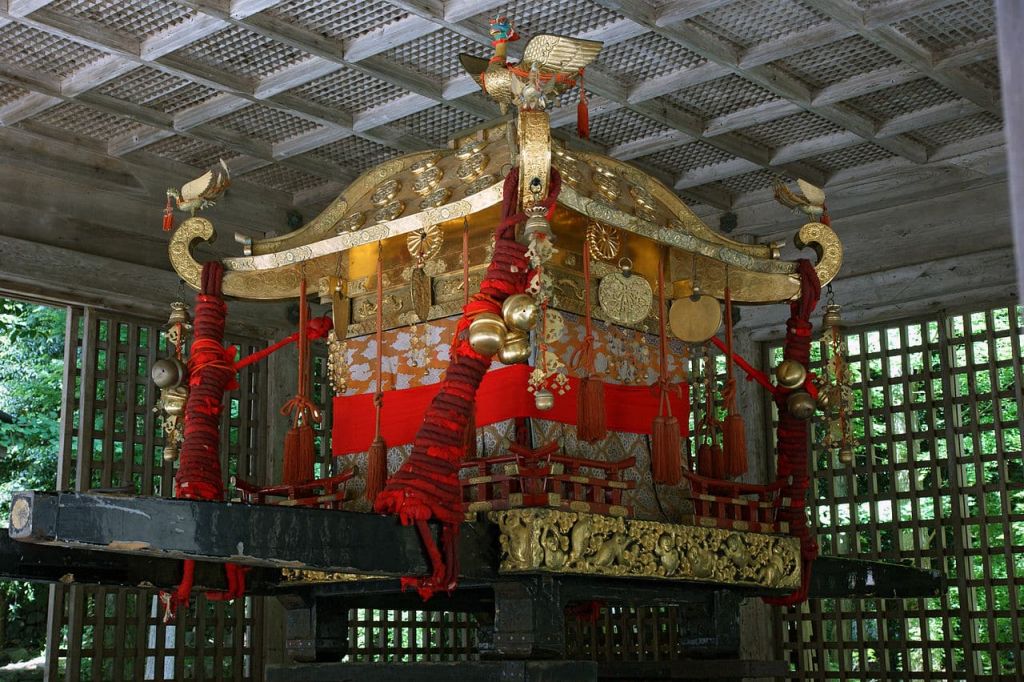
After shrines themselves, one of the most familiar pieces of Japanese festival culture may be the mikoshi, the portable shrine carried through the streets during summer festivals.
Today, mikoshi vary widely by region, but they are generally understood as part of Shinto ritual. A mikoshi is built around a sacred palanquin placed on carrying poles, and that palanquin is said to serve as a temporary resting place for a divine spirit while it moves. Strictly speaking, the term refers to the object carried and moved in this way. The bird often placed on top is usually a phoenix, commonly shown with its wings spread.
Some regions pull their portable shrines rather than carry them, but in its traditional form, the mikoshi is a Shinto ritual tool for moving a divine presence. Depending on the period, it is also said to have carried the emperor, sacred treasures, or objects serving as vessels for spirits.
In the Japan-Jewish common ancestry theory, the mikoshi is often compared with the ancient Israelite Ark of the Covenant. Supporters of the theory point to several similarities between the two.
The Oldest Known Mikoshi Tradition
The earliest origin story commonly cited for the Japanese mikoshi dates to the Nara period, in the year 720, during the reign of Empress Gensho. It is connected to the Hayato Rebellion, an uprising from Kyushu against the Yamato court.
According to the tradition, the imperial court sent an envoy to Usa Hachimangu to pray for the rebellion to be suppressed and the Hayato people defeated. At that time, an oracle was said to have come from the deity Hachiman, and the prototype of the mikoshi was created.
Later, during the reign of Emperor Shomu, known for the construction of Todai-ji, the mikoshi is said to have taken a form closer to what is seen today. By the Heian period, mikoshi were being made in many regions.
What draws attention in this theory is the timing. These cultural developments are often discussed alongside the arrival of continental immigrant groups in ancient Japan. One especially mysterious and powerful clan, the Hata clan, has an uncertain origin. Some theories connect them to Shem, one of Noah’s sons in the Old Testament, and in older racial theories Shem was sometimes described as an ancestor of Asian peoples.
The broader subject of ancient immigrants to Japan deserves its own discussion, but in many legends and speculative histories, the rise of Japanese civilization and the arrival of these groups are closely linked.
Similarities to the Ark of the Covenant
The Old Testament describes the creation of the Ark of the Covenant. After Moses led the Israelites out of Egypt, the Ark was made from acacia wood. It was about 130 centimeters long, with its width and height each about 80 centimeters. Legs were attached to the four lower corners.
The Ark was covered in pure gold, and two poles were attached so it could be carried without being touched directly by human hands.
This detail is often compared to the Japanese mikoshi. A mikoshi is carried by poles, and it is treated as a sacred object that should not simply be handled like ordinary luggage.
There is also the decoration on top. Japanese mikoshi often have a phoenix with outspread wings. The Ark, meanwhile, was topped by a pair of cherubim, heavenly beings traditionally imagined with wings.
The mikoshi is said to have been used to move divine spirits, the emperor, sacred treasures, or vessels for spirits. The Ark was made to carry the sacred objects entrusted to Moses in his covenant with God: the jar of manna, Aaron’s rod, and the stone tablets of the Ten Commandments.
In other words, both objects share the idea of transporting something sacred that human hands should not touch directly. For believers in the Japan-Jewish ancestry theory, the resemblance in both function and form feels too striking to ignore.
Of course, similarity does not prove a direct historical connection. Still, when the Ark is dated by tradition to around 1290 BCE and the Japanese mikoshi appears in records from the Nara period, the comparison has long fueled speculation. The shared emphasis on avoiding direct human contact gives the theory a religious and cultural eeriness.
A similar idea can even be seen in films set in the Heian period. People may speak toward a palanquin, but the person inside often gets in and out by themselves, preserving a sense that the sacred or noble space should not be touched casually.
Kyoto’s Gion Festival and the Zion Festival Claim
Kyoto’s Gion Festival is one of Japan’s most famous tourist festivals, with its major procession associated with July 17. In the Japan-Jewish ancestry theory, this date is sometimes compared to a claimed Jewish custom called the Zion Festival, also said to take place on July 17.
Supporters also point to the decorations of certain Gion Festival floats. The front hanging of Kankoboko, a float associated with the Shijo Karasuma area of Shimogyo Ward, is said to be a late 16th-century tapestry depicting a scene from the Book of Genesis. The rear hanging of Koi-yama, associated with the Muromachi-dori and Rokkaku area of Nakagyo Ward, is said to feature a famous image of King David from ancient Hebrew tradition.
Why would traces that appear to evoke ancient Israel be found in a Japanese festival?
That question is exactly what keeps this theory alive. The more its supporters look, the more they believe similarities between Japanese and Jewish culture begin to surface.
For travelers, Kyoto’s Gion Festival is a real and extremely crowded event. If you visit, check official schedules, follow crowd-control guidance, avoid restricted areas around floats and storage sites, and take summer heat seriously.
Japanese Language
神社に続いて日本人にゆかりのある文化と言えば、夏場のお祭りでおなじみの「お神輿」ではないだろうか?。現在ではお神輿の形状も地域によって様々なものがあるが、基本的にお神輿とは神道に由来する行事の1つであるそうだ。担ぎ棒の上にいわゆる「輿」があり、ここは神霊が移動するための待機場所だと言われている。神輿の形状は地域によって違うが、正確にはこの「輿」を担ぎ上げて移動する物を指すという。また、輿の上部にある鳥は鳳凰であり、両羽を広げている形状が一般的なのだ。
地域によっては引いたりする物も見られるが。本来の神輿とは神道に由来した神霊を移動させるための道具であり、時代によっては天皇や神器、依代などを乗せていたとされている。。この神輿も「日ユ同祖論」では古代ユダヤの聖櫃(アーク)と比較され、共通点が多く見つかる。日本の神輿の起源。。画像引用元: 日吉大社の神輿 。日本の神輿の起源として最古に確認出来るものは720年の奈良時代、元正天皇の時代に起こった九州からヤマト朝廷に対しての反乱である「隼人の乱」だとされている。
朝廷は宇佐八幡宮に勅使を出して鎮圧と隼人の征伐を祈願したという。この時に八幡神から神託が降りて、作られたのが神輿の原型であると言われている。その後、東大寺を建てた聖武天皇時代には今の神輿の原型となる形になり、平安時代に移ると各地で神輿が作られていったそうだ。ここで注目したいのは、こういった文化が起こっているのが、渡来人が来た前後であるという事である。。特に、大きな権力を持ったことで知られる謎の渡来人「秦氏」などはその出自が不明とされているが、旧約聖書に残るノアの方舟で有名なノアの息子の1人、現在の黄色人種の祖先と言われている「セム」の流れであるという説もある。
詳細は渡来人全般で別途紹介するが、 日本の文明の起こりと渡来人の到来は重なることが多い。。古代ユダヤの聖櫃(アーク)との共通点。。画像引用元: 契約の箱 。上記画像はフランスのサントマリー大聖堂にある 契約の箱のレリーフ であるが、旧約聖書にはそもそもアークの作られた経緯なども記されている。モーセがエジプトから脱出してすぐにアカシアの木を使用して作られたアークは、 長さ130センチ、幅と高さがそれぞれ80センチであり、箱の下側四隅に脚が付けられていた。
これらは純金で覆われており、直接手を触れない為に移動用として2本の棒が取り付けられたという。。さらに日本の神輿には鳳凰が両翼を広げていることが多いが、アークの上部には智天使であるケルビムが対になって置かれた。もちろんこの天使にも羽が付けられていたことは想像に難しくない。日本の神輿は神霊、天皇、神器、依代が移動するための物 であったと言われているが、 アークはモーセが神と契約した際に託された三種の神器(マナの壺、アロンの杖、十戒の石版)を収めて持ち運ぶ為 に作られた。
つまり、 人の手では触れてはいけない「物」を移動させるという点で、日本の神輿とアークは同じ性質を持っていると言える。。しかも、これだけ形状も似通っているのである。紀元前1290年頃のアークと日本では奈良時代に始まったとされる神輿がここまでの共通点を持っていることの方が、圧倒的に不自然ではないだろうか?。また、「人の手に触れないために」という意味合いが同じであることもある種の文化的な一致、または宗教的な一致を感じてしまう。平安時代などを描いた映画などでも見られるが、「輿」に声をかけることはあっても、人の乗り降りなどは乗っている人自身がおこなっている事が多い。
日本の祇園祭とユダヤの ZION祭り 。毎年、7月17日に行われている日本屈指の観光祭りである京都の祇園祭(ぎおんまつり)。実は、ユダヤにはZION祭りという風習があり、これも同じく毎年7月17日に行われている。さらに、 京都市の下京区四条鳥丸西入の山鉾 「函谷鉾」 の前掛けは 旧約聖書の創世記の一場面を描いた16世紀末のタペストリー であり、中京区室町通六角下ルの山鉾 「鯉山」 の見送りは 古代ヘブライのダビデ王を描いた有名な図である という。
。何故、日本の祭りに古代イスラエルの痕跡が入っているのであろうか?。知れば知るほど、 日本とユダヤ文化の共通点 が浮かび上がってくる