English Version
When people think of famous temples from ancient Greece, the Parthenon is usually the first name that comes to mind. But the Temple of Artemis at Ephesus, in present-day Turkey, was counted by Philo of Byzantium among the Seven Wonders of the Ancient World. It is said to have been so enormous and beautiful that it pushed the limits of architectural technology at the time.
The temple was far larger than the Parthenon, and Ephesus, where its ruins remain, is believed to have flourished as both a commercial center and a sacred site. Much of the construction cost is said to have been supported by Croesus, the famously wealthy king of nearby Lydia.
Although it is called the Temple of Artemis, and is often assumed to have worshipped the Greek goddess Artemis, some researchers believe the deity honored there was actually a goddess unique to Ephesus.
The Great Temple of Croesus
By around 700 BCE, several temples already seem to have existed at Ephesus. On the site of those earlier sanctuaries, the first massive Temple of Artemis was built with the support of King Croesus of Lydia. This is generally estimated to have happened around 550 BCE, and the structure was also known as the Temple of Croesus.
Its scale was astonishing: about 55 meters wide, 110 meters deep, with columns roughly 20 meters high. However, this first great temple was destroyed by fire in 356 BCE, allegedly set by a man named Herostratus.
Afterward, probably by around 325 BCE, an even larger temple was rebuilt in several stages using the foundations of the Croesus temple. Pliny the Elder is said to have been amazed by its size, which surpassed expectations. Philo of Byzantium, who compiled the Seven Wonders, reportedly praised it in words like these:
> The Temple of Artemis at Ephesus is the one true house of the gods. At a glance, one can see that this is no ordinary place. Here, the heavenly world of the immortal gods has been placed upon the earth. The giants, the sons of Aloeus, tried to climb to heaven by piling up mountains; they built not a temple, but Olympus itself.
Philo is thought to have compiled the Seven Wonders around 225 BCE, so the Temple of Artemis he saw was likely the rebuilt version.
In any case, even in ancient Greece, where architecture had already reached a remarkable level, the Temple of Artemis seems to have stood apart as one of the largest and most impressive sacred buildings of its age.
The Goddess of Ephesus
The Temple of Artemis was one of the older major temples associated with Greek culture, but the goddess worshipped there is often described as Diana of Ephesus.
The object of worship may have been an ancient idol that predated Greek culture. Its original form was said to be wooden, and unlike the Greek Artemis, who was associated with chastity, the Ephesian goddess was depicted with many breast-like forms symbolizing fertility and abundance. Her symbol was the bee.
In simple terms, the image passed down as “Artemis” did not fully match the personality or symbolism of Artemis in Greek mythology.
Because of this, one theory suggests that Diana of Ephesus was originally an ancient Anatolian deity worshipped long before Greek culture became dominant in the region. The temple’s construction techniques and form may have been Greek, but the sacred figure at its heart may not have been a purely Greek goddess at all.
Rediscovery of the Temple
The ruins of the Temple of Artemis at Ephesus were identified by an archaeological team connected to the British Museum, a familiar name in the modern history of the Seven Wonders.
Excavations began around 1863 under the direction of John Wood, a British engineer. After several years of work at Ephesus, the team finally found what appeared to be the temple’s foundations. Even so, like many of the Seven Wonders, the Temple of Artemis itself no longer survives in its original form.
Still, the fact that it continues to be remembered as one of the Seven Wonders may be the strongest proof of how overwhelming its presence once was.
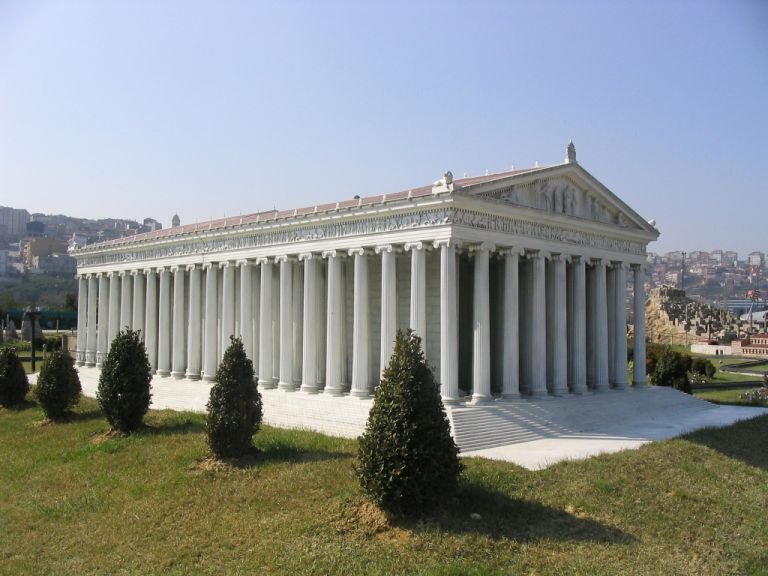
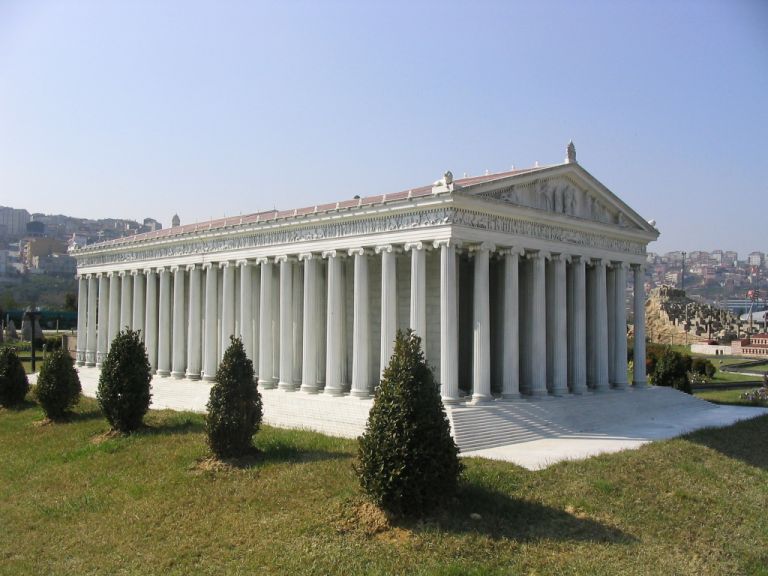
Today, the site of the Temple of Artemis has only one reconstructed column standing, with scattered stones and ruins around it. If you visit Ephesus, treat it as a protected archaeological site: stay on marked paths, respect barriers, and be prepared for uneven ground. There is also a miniature recreation of the Temple of Artemis in Istanbul, which may be worth seeing if your travels take you there.
Japanese Language
古代ギリシャの建築物で有名な神殿と言えば「パルテノン神殿」が頭に浮かびますが、フィロンによって世界の七不思議に数えられた エフェソス(現在のトルコ)にあったアルテミスの神殿は 。当時の建築技術の限界に挑戦したもの であったと言われるほど、巨大かつ美麗なものだったと伝わっています。その大きさもパルテノン神殿を遥かにしのぎ、アルテミスの神殿の遺跡の残っているエフェソスは商業的にも信仰的にも栄えていたとされています。この神殿の建設には隣国の王であったリディア王国のクロイソスという人物が大変な資産家であったことから、建設にかかる費用のほとんどを援助したそうです。
また、 アルテミス神殿と呼ばれることからギリシャ神話の女神アルテミスを祀っていたと思われがちですが、実はエフェソス独特の女神を信仰していた とも言われています。ギリシャ最大級の建築物であったアルテミス神殿。。画像引用元: アルテミス神殿 。紀元前700年頃にはすでにエフェソスにはいくつかの神殿があったそうですが、それらの神殿のあった場所にリディア王国のクロイソス王の援助のもとで、最初の巨大なアルテミス神殿が建設されます。およそ紀元前550頃のことだと推定されており、これは別名クロイソス神殿とも呼ばれていました。
大きさは幅約55メートル、奥行きは110メートルもあり、円柱の高さは約20メートルだとされています。しかし、 最初に作られたこの神殿は紀元前356年にヘラストラスという人物によって放火され焼失 していまいます。その後、これも推定によるところだと紀元前325年頃までにクロイソス神殿の基礎を利用して何度かに渡ってさらに大きい神殿が建てられます。この再建された神殿を見て大プリニウスは想像以上の大きさに感嘆したとも言われています。また世界の七不思議を編纂したビザンチウムのフィロンは以下のように評したそうです。
エフェソスのアルテミス神殿は、神々のただひとつの家である。一目見れば、ここがただの場所ではないことがわかるだろう。ここでは、不死なる神の天上世界が地上に置かれているのである。巨人たち、すなわちアロエウスの子らは、天に登ろうとして山々を積み上げ、神殿ではなくオリンポスを築いたのだから。— フィロン 。引用元: アルテミス神殿 。ビザンチウムのフィロンが世界の七不思議を編纂したのは紀元前225年頃だとされている事から、おそらくフィロンが見たアルテミス神殿も再建されたものだと言われています。
いずれにせよ、当時既に相当な建築技術をもっていたとされる古代ギリシャの中でも群を抜いて大きな神殿であったのではないしょうか。アルテミス神殿で信仰されていたエフェソスのディアーナ。古代ギリシャ文化の中でも比較的古い神殿であったアルテミス神殿は、エフェソスのディアーナと呼ばれる女神を信仰していたと言われています。信仰の対象はギリシア文化以前の古い偶像であった。その元となる偶像は木製で、ギリシアのアルテミスに見られる処女性とは対照的に、豊穣多産を象徴する多数の乳房を持っていた。
そして、この女神の象徴は蜂であった。。引用元: アルテミス神殿 。簡単に言うと、後世にも伝わったアルテミスとされた像の特徴とギリシャ神話上のアルテミスの特徴が全く一致していなかったのです。実は、このエフェソスのディアーナという女神はギリシャ文化より遥か昔から土着信仰されていた古代アナトリアの神であったという説があるのです。古代ギリシャ人達も多神教信仰の中に歴史があったことから、神殿の技術や形態はギリシャ文化であり、信仰対象になったのは少しアジア寄りのギリシャの神ではなかったのかもしれないということです。
アルテミス神殿発見。エフェソスのアルテミス神殿を遺跡として発見したのは、世界の七不思議ではもはやお馴染みになりつつある大英博物館の考古学調査団でした。イギリス人技師であったジョン・ウッドという人物を中心に1863年頃から数年をかけてエフェソスでの発掘が行われ、ようやくその土台らしき遺跡が発見されましたが、このアルテミス神殿も他の多くの世界の七不思議の建造物と同じく、その姿は残っていませんでした。。それでも現在まで語り継がれる「世界の七不思議」となったのは、このアルテミス神殿の当時の存在感を裏付ける証拠だと言ってもよさそうです。
現在のアルテミス神殿の遺跡には復元された柱が1本残っているだけで、他は瓦礫が転がっているばかりになっています。トルコ、イスタンブールにはミニチュアで再現されたアルテミス神殿もあるので、もしも立ち寄る機会があれば見てみたいものです