English Version
Among the many ley lines discussed around the world, one of the most famous—and one of the easiest to visit as a traveler—is the so-called St. Michael’s Ley Line, a straight alignment said to cross southern England from west to east.
It is usually described as beginning at St. Michael’s Mount, a tidal island off the far southwestern coast of England, and continuing through places such as Roche Rock, Glastonbury, and Avebury. These sites are linked in popular legend with the Holy Grail, King Arthur, ancient megaliths, and the kind of “power spot” atmosphere that attracts both spiritual travelers and fans of the mysterious.
One common point of confusion is Stonehenge. In casual discussions, Stonehenge is sometimes mixed together with stone circles in general, but not every famous stone circle lies on the St. Michael’s Ley Line. Avebury is the major megalithic site most often associated with this alignment, while Stonehenge is nearby enough that some people still imagine a broader connection.
St. Michael’s Mount and the Celtic Sacred Landscape
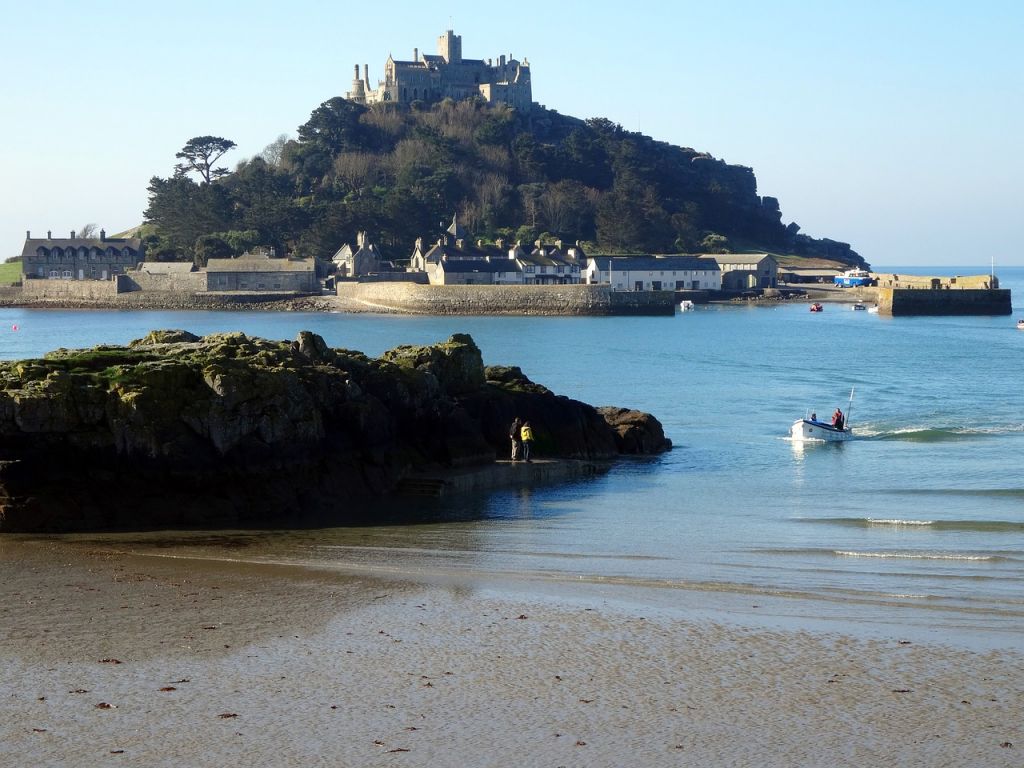
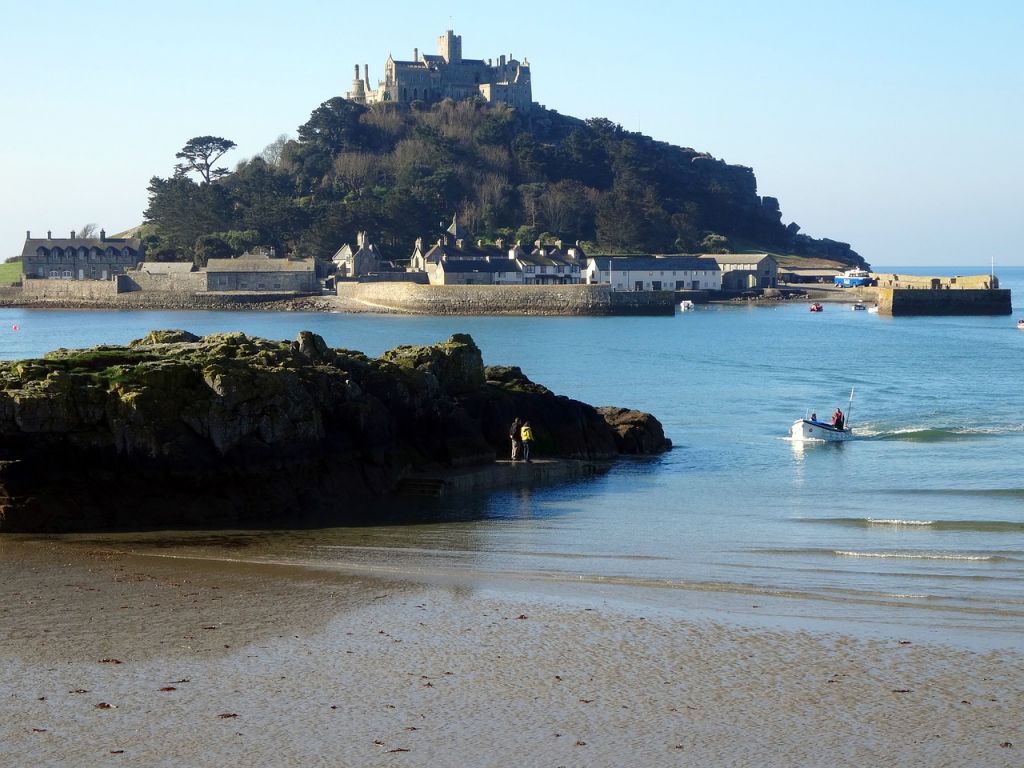
St. Michael’s Mount is often described as a sacred place in Celtic tradition. Located off the coast of Cornwall, it is close enough to be clearly visible from the mainland, and at low tide it can be reached by a causeway.
The island has long been surrounded by legends, and the monastery near the summit is said to date from around the 12th century. Its silhouette often reminds visitors of Mont Saint-Michel in France, and the resemblance is not only visual. The two places are both named for the Archangel Michael, and a rumored deeper connection between them has often been discussed.
Although Mont Saint-Michel is not part of the St. Michael’s Ley Line across southern England, St. Michael’s Mount is said to lie roughly to the north of it. Because of that, some people also regard the line between the two “Michael mountains” as another ley line.
“The White Stone in the Forest”
In Cornish, the local Celtic language of the region, St. Michael’s Mount has been associated with a name often interpreted as “the white stone in the forest.” This has led to speculation that the area around the island may once have been wooded before sea levels rose.
There are more than 40 tidal islands around the British coast—places that appear or disappear depending on the tide. These islands are generally thought to have taken shape through long-term changes in sea level and coastal conditions.
According to reports, wood fragments found near St. Michael’s Mount have been carbon-dated to around 1700 BCE. If that dating is accurate, it supports the possibility that the surrounding landscape may indeed have looked very different in the Bronze Age.
A Monastery for the Archangel Michael
Both Mont Saint-Michel in France and St. Michael’s Mount in England mean “Mount of Saint Michael.” According to one theory, an abbot connected with Mont Saint-Michel may have been involved in establishing the monastery on St. Michael’s Mount.
The present monastic history is usually placed around the 12th century, but the choice of location still invites speculation. Was the island selected only for practical and religious reasons, or did older sacred associations already exist there? The ley line theory leans toward the latter, though it remains a matter of belief rather than proven archaeology.
Megalithic Sites with Unknown Purposes
Britain and Europe contain many ancient megalithic sites and stone circles. On the St. Michael’s Ley Line, the most important of these is Avebury, one of the largest and oldest stone circle complexes in Britain.
Some theories divide the Stonehenge and Avebury landscapes into multiple periods of construction and use, with the earliest traces of activity in the wider region sometimes said to reach back as far as 8000 BCE. Despite extensive research, the original purposes of many of these monuments remain uncertain.
What is generally accepted is that these stone circles show deliberate patterns and were created by human hands. Stonehenge, Avebury, and associated sites are now recognized as UNESCO World Heritage sites, drawing visitors from around the world.
The Mystery of Glastonbury
Glastonbury, located near these ancient landscapes, is another major site often placed along the St. Michael’s Ley Line. The town and its ruins are tied to many stories, including the Holy Grail, Joseph of Arimathea, and the legends of King Arthur.
Many of these tales were passed down through oral tradition and later retold by poets, monks, and storytellers. Some historians argue that they should not be treated as straightforward history. Even so, traditions connected to the region are often said to reach back to around the 4th century, giving Glastonbury an especially layered and mysterious atmosphere.
Was the St. Michael’s Ley Line Man-Made?
Many other old sites are said to exist along or near the line extending from St. Michael’s Mount. Because written sources about the ancient Celts are limited—and because Celtic Britain was later shaped by Roman influence—firm conclusions are difficult.
If we look at the medieval period and later, however, it is easy to understand why people imagine this line as a meaningful sacred route. The repeated appearance of churches, ruins, stone circles, and legendary places along the same general alignment gives the landscape a powerful sense of hidden design, even if archaeology has not confirmed the ley line as an intentional ancient system.
For travelers, these locations are among the more accessible “mystery spots” in Britain. If you visit St. Michael’s Mount, check tide times carefully and use official routes only. At ruins, stone circles, and church sites, respect barriers, private land, and local rules. The legends are best enjoyed safely—and without trespassing.
Japanese Language
世界各地のレイラインの中でも、最も有名かつ観光名所と知られているのが、 イギリス南部を西から東へ横切る【セント・マイケルズ・レイライン】と呼ばれる直線 です。イギリス南部の先端に浮かぶ孤島 「セント・マイケルズ・マウント」 から始まり、 ローチロックやグラストンベリーなど、聖杯伝説やアーサー王に関する謎の残る遺跡 や、 エイブベリーなどの巨石遺跡はパワースポットとしても人気のある観光地 です。イギリスでは有名なパワースポットのストーンヘンジが勘違いされやすいのですが、ストーンヘンジはストーンサークル遺跡の総称であり、いくつかのストーンサークルはセント・マイケルズ・レイラインの上にはありません。
しかし、エイブベリーのすぐ近くにストーンヘンジがあることから、ある種の関連性はあるでしょう。ここでは セント・マイケルズ・レイラインのついての考察 をしていこうと思います。セント・マイケルズ・マウントはケルト神話における聖地。。イギリスの最南西に位置するセント・マイケルズ・マウントは対岸からでも見えるくらいの位置にあります。古代からケルト神話などの伝説の多い 潮間島 ですが、頂上付近の修道院は12世紀頃に建てられたものです。この風景から、フランスのモン・サン・ミッシェルを連想する方も多いですが、実はこの2つには深い繋がりが噂されており、セント・マイケルズ・レイラインからは外れますが、 モン・サン・ミッシェルから真っ直ぐ北へ進んだ位置にあるのが、このセント・マイケルズ・マウント です。
これも1つのレイラインと考えられています。森林の中の白い石 。この場所はコーンウォール語という6世紀頃に使用されていた現地の言葉で「 森林の中の白い石 」と呼ばれており、海面上昇以前に周囲が森であった可能性がしばしば指摘されています。イギリスの海辺には 潮間島と呼ばれる海面の潮位によって、浮き沈みする島が40以上あります。。これらは時代の流れによる潮位の変動によって出来た島であると考えられるのですが、 セント・マイケルズ・マウント近郊から見つかった木片を炭素年代測定したところ、紀元前1700年頃のものである との結果が出たそうです。
つまり、紀元前1700年前頃にはセント・マイケルズ・マウント周辺は森林があった可能性も充分にあります。大天使ミカエルを祭る修道院。フランスの「モン・サン・ミッシェル」とイギリスの「セント・マイケルズ・マウント」は、それぞれを訳すと「 聖ミカエルの山 」を意味します。また、一説によるとモン・サン・ミッシェルの修道長がセント・マイケルズ・マウントに修道院を建てたと言われています。修道院の建設は12世紀のものですが、 セント・マイケルズ・マウントを選んだのには何か理由がある のかも知れません。
目的不明の巨石遺跡。。イギリスやヨーロッパには複数のストーンヘンジと呼ばれる巨石遺跡群が存在しています。セント・マイケルズ・レイラインに重なっているものは「エイブベリーストーン」と呼ばれているものであり、ストーンサークルとしては非常に古いものだとされています。一説ではストーンヘンジはいくつかの年代に分かれており、一番古いものは紀元前8000年にも遡るそうです。ストーンヘンジにはいくつかの研究があり、 何に使われていたのか?どういった目的があったのか?
は未だに判明していませんが、一定の規則性があることから人工物であることは確実だと言われており、ほとんどのストーンヘンジは世界遺産登録されています。グラストンベリーの謎。前述のストーンヘンジと近くにあるグラストンベリーはセント・マイケルズ・レイラインに直線的に配置されている神秘的なスポットの1つです。この街には遺跡も含めて聖杯伝説やアリタマヤのヨセフ、アーサー王伝説など、数多くの逸話が残されています。吟遊詩人によって口伝されてきたこの多くの伝説は「歴史にそったものではない」という意見もありますが、それも発祥は4世紀前後と言われており、謎の多い土地です。
セント・マイケルズ・レイラインは人為的なもの?。セント・マイケルズ・マウントから繋がるこのレイライン上には他にも多くの遺跡の存在が確認されています。古代ケルト人はローマ帝国に大きく影響を受けていたことから、史料などは非常に少ないですが、中世以降で考えれば、充分にレイラインとして機能している可能性は高いでしょう。。また、このレイライン上周辺に多くのストーンサークルが確認出来ることからも、まだまだ解明されていない古代の文明を感じさせてくれますね。
イギリス旅行では比較的、人気の観光地ですので機会があればこれらのパワースポットを見てみるのもオススメです