English Version
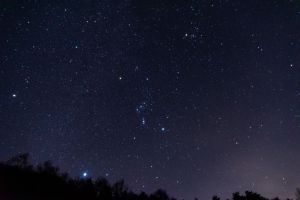
When people think of the classic winter constellations, Orion is usually the first to come to mind. It is a gorgeous constellation: two first-magnitude stars, five second-magnitude stars, and even the Great Orion Nebula. With three stars lined up in a row and such a distinctive shape, it is also one of the easiest constellations to spot.
One of the stars that forms Orion is the first-magnitude star Betelgeuse. It is not only part of Orion, but also one corner of the Winter Triangle, together with Sirius and Procyon. It is the famous red star of the winter sky.
But recently, Betelgeuse has been attracting a lot of attention among astronomy fans.
What Kind of Star Is Betelgeuse?
Betelgeuse is a first-magnitude star in the constellation Orion, located about 642 light-years from Earth.
642 light-years means that even light takes 642 years to travel that distance. The term “light-year” may sound like a unit of time, but it is actually a unit of distance. Light can circle the Earth about seven and a half times in one second. It is said to be the fastest thing in the universe, and even at that speed, it would take 642 years to reach Betelgeuse.
That sounds impossibly far away. But on the scale of the universe, 642 light-years is practically in the neighborhood. In cosmic terms, it is close enough to feel unsettling.
Betelgeuse Is Enormous
Betelgeuse is an incredibly huge star.
If Betelgeuse were placed where our Sun is, it would extend almost as far as the orbit of Jupiter. In other words, if Betelgeuse suddenly occupied the Sun’s position, Earth would be swallowed whole.
It is difficult to comprehend something that large. And while Betelgeuse is certainly massive, there are even larger stars out there. Space can be terrifying.
A Star That Changes Brightness
Betelgeuse is bright enough to see clearly with the naked eye, without binoculars or a telescope. On a clear winter night, you can easily spot it as a large reddish star.
However, Betelgeuse is also a variable star, meaning its brightness changes over time. Observations have shown that its brightness can vary roughly between magnitude 0 and magnitude 1.3, and its changes are especially noticeable compared with many other variable stars.
Is Betelgeuse Getting Dimmer?
Betelgeuse is relatively close to Earth, bright, and enormous. Now, both astronomy fans and astronomers have been talking about how “Betelgeuse is getting dimmer.”
After hearing the news, the author looked up at Betelgeuse and felt the same thing: it seemed as if it used to be brighter. Once one of the most striking stars in Orion, it even appeared dimmer than some of the constellation’s second-magnitude stars.
Betelgeuse is known to change brightness, but it was said that this level of dimming had never been recorded before.
Between October and December 2019, Betelgeuse reportedly dimmed by about 15%. It had previously been considered the ninth-brightest star in the entire night sky, but dropped to around 21st place.
Why did that happen?
Of course, no one can travel to Betelgeuse and check directly, so the exact cause is not fully known. But one reason the star is getting so much attention is the possibility of a supernova.
Is Betelgeuse About to Explode?
A supernova is the spectacular explosion that occurs when certain stars reach the end of their lives.
Massive stars like Betelgeuse are believed to end in a supernova. If Betelgeuse were to explode, it is said that it could become brighter than the full Moon and might even be visible during the daytime.
After that brilliant explosion, its light would fade over several years, and eventually Betelgeuse would disappear from the sky.
Supernovae have been observed in distant parts of the universe, and they are not exactly rare. But a supernova from an object only 642 light-years away would be extremely unusual. That is why so many astronomy fans and researchers are watching Betelgeuse closely.
When Will Betelgeuse Go Supernova?
It is considered highly likely that Betelgeuse will eventually explode as a supernova. The real question is when.
It could be tomorrow. It could be ten years from now. It could be a hundred years from now.
And because Betelgeuse is 642 light-years away, the light we see in the sky tonight is actually the star as it was 642 years ago. If we could instantly teleport to Betelgeuse and observe it directly, it might already have exploded.
But no one knows for sure. The lifetime of a star and the human sense of time are on completely different scales. There is nothing we can do but watch and wait.
Could a Gamma-Ray Burst Endanger Humanity?
If a supernova occurred relatively close to Earth, it is natural to wonder whether it could affect us.
If a gamma-ray burst from a supernova were to hit Earth directly, it could be catastrophic for life on the planet. Gamma rays striking Earth head-on could damage the ozone layer, and in the worst-case scenario, the atmosphere itself could be severely affected.
If that happened, harmful cosmic radiation from space would pour down onto the surface. At that point, humanity would be in extreme danger.
However, observations suggest that the angle of Betelgeuse’s possible gamma-ray burst and Earth’s position are not aligned, so Earth is generally thought to be safe from a direct hit. That said, this assumes the angle does not shift in a dangerous way when the supernova occurs.
If gamma rays from Betelgeuse were somehow aimed directly at Earth, it is hard to imagine we would survive. All we can do is hope that does not happen.
Final Thoughts
Betelgeuse, the first-magnitude star in Orion, is a gigantic star now attracting attention because it may one day go supernova.
If it explodes, it could shine about 100 times brighter than the full Moon and become visible even in daylight. Then, after several years, it would fade and vanish from the night sky.
If a gamma-ray burst from the explosion were to strike Earth directly, our atmosphere could be damaged, and humanity would likely be unable to survive. Researchers say the angle appears to be off, so we should be safe from that scenario.
Still, no one knows exactly what will happen, or when Betelgeuse will finally explode.
Japanese Language
冬の星座の代表格といえば 「オリオン座」 です。1等星が2つ、2等星が5つ、そして、オリオン大星雲も含まれるとってもゴージャスな星座です。星が3つ並んでいて、形にも特徴があるので見つけやすいですよね。このオリオン座の一角をなす星が1等星のベテルギウスです。オリオン座だけでなく、シリウスとプロキオンで冬の大三角形をつくる赤い星です。。画像: ぱくたそ 。このベテルギウスが今、天文ファンの間で注目されているのをご存知でしょうか?。ベテルギウスってどんな星?
。ベテルギウスは オリオン座にある1等星で地球から約642光年の位置 にあります。642光年…ということは、光の速さで642年かかる距離ということ…。光年と言われると、なんだか時間の単位みたいに思えますが、距離の単位です。光は1秒で地球を7周半します。宇宙でもっとも早いのは光と言われていますが、その光で進んでも642年かかる距離ですから、滅茶苦茶遠い星だと思いますよね。でも、 宇宙の単位で考えると642光年は超ご近所!もうすぐそこ!って言っても良いくらいの距離 です。
それだけ宇宙が大きいというわけですが、ベテルギウスは宇宙的に見れば地球から割と近いんだってことです。ベテルギウスはとにかくでっかい!。。画像: Pixabay 。ベテルギウスは、めちゃくちゃ大きな星 です。ベテルギウスを太陽のある位置に置いたとすると、 木星の軌道の近くまで達するほどの超巨大な恒星 です。つまり、太陽の位置にベテルギウスが居座ったら地球は飲み込まれてしまうってこと!。とんでもなく大きいんです。ちょっとそれデカすぎるって。
確かに大きな星だけど…もっとおおきな星もあるんだよー。宇宙・・・こわすぎるんだけど…。ベテルギウスは明るさが変わる星。ベテルギウスは1等星で、 明るい星なので双眼鏡や望遠鏡がなくても肉眼ではっきりと見る ことができます。晴れている冬の夜には赤く大きな星がはっきり と見えます。とっても明るい星なんですが、 ベテルギウスは明るさが変わる「変光」する星 でもあります。0等星から-1.3等星まで明るさが変わることが観測で解っていて、他の変光する星より顕著に特徴が現れる星です。
ベテルギウスが暗くなってる?!。。地球から割と近くて、明るくて、大きな星!ベテルギウスですが、 今「ベテルギウスが暗くなってる」と天文ファンや天文学者の間で話題 になっています。このニュースを聞いて、私もベテルギウスを見上げてみたのですが、確かに「もっと明るかったような気がします」というか、オリオン座の中でかなり明るい星だったのに、 他の2等星より暗くなってるようにも思えました。。ベテルギウスは明るさが変わる星ですが、こんなに暗くなったことは観測史上初だそうです。
。2019年の10月から12月の間に15%も暗くなったそうで、今までは全天で9番目に明るい星だったのに、21番目にまでランクダウンしたんです。参考資料: Wikipedia 。それはなぜなのか…。もちろんベテルギウスに行って見てみることはできないので、はっきりしたことは解っていないのです。その理由がベテルギウスが今、注目されている理由の 「超新星爆発」 です。ベテルギウスが超新星爆発寸前?!。超新星爆発とは、星が最後の時を迎えるときに大爆発して派手にお亡くなりになる現象 です。
ベテルギウスのような質量が重い星の最後は超新星爆発だとされていて、 超新星爆発が起きるとベテルギウスは満月より明るくなって「昼間でもみえる」ようになるんだとか…。。。画像: Pixabay 。そんな派手な大爆発をして、数年かけて明るさがなくなって、最後には見えなくなる…。そんな天体ショーが起こるかもしれない んです。超新星爆発は遠くの天体では確認されているもので、決して珍しいものではないんですが642光年という至近距離の天体が超新星爆発を起こすのはとっても珍しい…。
だから、天文ファンや学者が「ベテルギウス注目」しているんです。ベテルギウスはいつ超新星爆発するの?。ベテルギウスが超新星爆発を起こすのはほぼ確実です。ただし、 問題はそれがいつ起こるのか…。。それは明日かもしれないし、10年後かもしれないし…。100年後かもしれません。そもそも、 光の速さ642光年の距離ということは、今、空を見上げて輝いているベテルギウスの姿は642年前のものということ です。だから、もし今、 ベテルギウスまで瞬間移動して観測できたとしたら、もう超新星爆発しちゃってるかもしれません。
。ただ、それがいつなのかは解りません。星の一生の長さと、私たち人間が持っている時間があまりに桁違いすぎるのです。こればかりはどうしようもありません。超新星爆発のガンマ線バーストで人類のピンチ?。。画像: Pixa bay 。地球から比較的近いところで超新星爆発が起きたら… 地球に何か悪影響がないのかも不安 です。超新星爆発の際に放出されるガンマ線バーストが地球を直撃したら…多分、地球上の生物のほとんどが死滅 します。というのも、 ガンマ線をモロに食らったらオゾン層が破壊されて、最悪の場合、大気がなくなってしまう んです。
そうなると宇宙から降り注ぐ有害な宇宙線がモロに地上に降ってきます。こうなったら、人類はほぼ確実に詰みます。ですが、 超新星爆発のガンマ線バーストの角度と地球の位置がずれているので、大丈夫だろう…。という観測結果 が出ています。ただし、超新星爆発の時にこの角度がずれなければ…の話。もし、角度がズレてガンマ線が地球に直撃したら…多分、私たちは生きてはいられないでしょう。直撃しないことを祈るしかありません。参考資料: Wikipedia 。まとめ。
オリオン座の1等星ベテルギウス…超新星爆発するかもしれないと、今、注目されている巨大な恒星です。超新星爆発すれば、明るさは満月の100倍になり昼間でも見えるようになるそうです。そして、数年後に空から消えてしまいます。超新星爆発の時に放出されるガンマ線が地球に直撃すれば、大気が壊されて私たちは恐らく生きていられません。ガンマ線バーストに関しては角度がズレているので大丈夫とは言われていますが…。どうなるか、いつ超新星爆発するのかは誰にも解りません