English Version
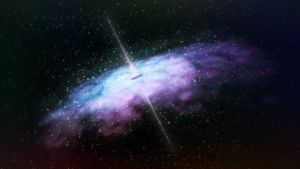
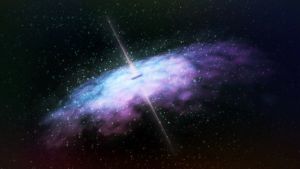
Many people have a vague idea that a black hole is an object somewhere in space with terrifying gravity. The name can make it sound like a literal hole torn open in the universe, pulling everything inside. But a black hole is probably not a “hole” at all.
Its true nature is thought to be an astronomical object with an enormous amount of mass—and gravity so extreme that it defies our everyday sense of reality.
On April 10, 2019, news spread around the world that scientists had succeeded in producing the first-ever image of a black hole, even though it was created from combined observational data.
You may remember the image: a blurry orange ring of light with a pitch-black center. The black hole shown in that image was said to be about 100 billion kilometers across, large enough to swallow the solar system. It is unsettling to think that objects on that scale really exist somewhere in the universe.
How Do Black Holes Form?
Black holes are believed to be the remnants left behind after extremely massive stars explode as supernovae.
But not just any star can become one. A star needs a huge amount of mass—often said to be around 30 times the mass of the Sun—to collapse into a black hole.
The Sun, for example, does not have enough mass to become a black hole. Even Betelgeuse, the famous star often discussed as a possible future supernova candidate, is expected to become a neutron star rather than a black hole.
So what is “mass,” exactly? In simple terms, you can think of it as a kind of weight. Size and mass are not the same thing. An object could be the same size as Earth but have more mass than the Sun.
And while our Sun is certainly not a small or insignificant star, many confirmed stars in the universe are actually less massive than the Sun. Only certain extremely massive stars are able to become black holes. In that sense, black holes are born from a very select group of stars.
Astronomers also believe that giant black holes may exist at the centers of galaxies. For example, the galaxy M106 in the constellation Canes Venatici is said to possibly contain a black hole about 36 million times the mass of the Sun.
If true, that scale is almost impossible to fully imagine.
What Is the Event Horizon?
Around a black hole, there is a boundary where gravity becomes so powerful that even light can no longer escape.
As you may know, light is the fastest thing in the universe. But near a black hole, gravity can overpower even that speed. Once light can no longer get away, the boundary it crosses is called the event horizon.
The event horizon is also the limit of information. In other words, it marks the boundary of what can be observed from the outside.
Anything that passes beyond the event horizon can never return. From there, it can only fall inward. That is true even for light.
The energy involved is far beyond anything we experience on Earth. The black hole image released in 2019 was so valuable because it showed the region around this mysterious boundary.
How Can Mass Warp Space and Time?
Even if you have heard the term “event horizon,” it can be hard to understand what it really means.
In modern physics, space and time are thought to be warped by gravity and mass. When an object approaches a region where gravity becomes close to overpowering the speed of light, an outside observer would see time appear to slow down.
This is part of what people mean when they talk about the warping of space-time in the theory of relativity.
There are many objects in the universe with strong gravity. But as far as we currently know, black holes are the only ones with gravity so intense that light cannot escape.
In daily life on Earth, we do not live as if time and space can bend. For us, space-time distortion is almost impossible to notice. But on the scale of the universe, the concept of “time” does not work in the simple way we usually imagine.
That is why cosmic distances are often described not in hours or years, but in units such as light-years, which are units of distance. In a sense, the universe is ruled by the arrival of light.
When you look up at the night sky, even the light from nearby objects left minutes ago. Light from faraway stars may show you what they looked like tens of thousands of years in the past.
But when light is bent by intense gravity, the way it reaches us changes. And when light is swallowed by a black hole and crosses the event horizon, it can never come back out.
That is the distortion of space-time: when the pulling force becomes too strong, both space and time bend dramatically.
A simple image might be a tightly stretched sheet of rubber with a basketball placed on it. The heavier the object, the more the surface bends.
Living peacefully on Earth, it is difficult to sense this. But on the scale of the universe, the “time” that controls our everyday lives may not be as absolute as it feels.
Final Thoughts
Many of us have heard of black holes in passing, but their power is almost beyond comprehension.
In one simulation imagining what would happen if even a small black hole entered the solar system, the orbits of the planets were quickly altered, throwing the solar system into chaos.
A black hole’s gravity is so strong that even light cannot escape. The event horizon is the point of no return.
When you think about the sheer scale of the universe, doesn’t it start to feel a little frightening?
Japanese Language
ブラックホールはとにかく重力がすごい天体で、宇宙にある…ということはなんとなく知っているという人も多いのではないでしょうか。ブラックホールと言われると、宇宙空間に穴が開いていて吸い込まれるようなイメージを持ってしまいがちですが、ブラックホールはおそらく穴ではありません。ブラックホールの正体はものすごく質量があって(重い)重力が半端ない天体 のことです。2019年4月10日に合成ながらも世界で初めてブラックホールの撮影に成功したニュースは世界を駆け巡りました。
オレンジ色のぼんやりした光の中に真っ黒な部分があるあの画像…。撮影されたブラックホールの 直径は約1000億km と、太陽系を飲み込むほどの巨大ブラックホールです。恐ろしい規模のブラックホールが宇宙には存在しているのですね…。ブラックホールはどうやってできる?。。画像: Pixabay 。ブラックホールは、質量が重い恒星が超新星爆発を起こした後に残る残額だと考えられています。ブラックホールになるためには、かなりの質量が必要。質量が太陽の約30倍は必要 と言われています。
太陽やもうすぐ超新星爆発を起こすんじゃないかと話題のベテルギウスはブラックホールになるには質量が足りず、中性子星という天体になると予想されています。ねえ、質量ってなに??。うーん、解り易く言うなら重さかな。重さ…。例えば、質量が重いとね・・・。地球の同じサイズだけど太陽より質量が重いってこともありえるんだよ。へーーーそれすごいね!大きさじゃなくて、重さってことかー。ちなみに…ですか、我らが太陽は決して質量が小さい星というわけではありません。
もちろん宇宙には太陽よりずっと質量が重い恒星がたくさんあります。ですが、今、確認されている恒星の多くは太陽より質量が小さい恒星の方が多いのです。。画像: Pixabay 。その太陽よりももっと重い星だけがブラックホールになれる… つまり選ばれた恒星だけがブラックホールになれる んです。銀河の中心には巨大なブラックホールがあると考えられていますが、りょうけん座にあるM106という銀河の中心には、太陽の 3,600万倍 ものブラックホールがあるのではないかと言われています。
ものすごい質量…。これが事実なら圧巻としか言いようがありません。参考資料: Wikipedia 。事象の地平面ってなに?。。画像: Pixabay 。さて、ブラックホールの重力でゆがめられて、光さえも逃げられなくなる境界線があります。ご存知のとおり、光は宇宙で最も速いのですが、その速さに重力が勝ってしまうんです。だから、光が抜け出せない!この境界のことを “事象の地平面” といいます。事象の地平面は情報伝達の限界…つまり、観測できる限界でもあります。
この事象の地平面を超えたものは絶対にその外には出られません。あとは、中に落ち込んでいくのみです。それは光であっても同じこと…。地球に住んでいる私たちの常識をはるかに超えたエネルギーがあるんです。2019年に撮影されたブラックホールの画像は、事象の地平面も捉えられたとても貴重のものです。質量が空間と時間を歪めるってどういうことか。。画像: Pixabay 。しかし事象の地平面といわれても、なんだか、よく解らない言葉ですよね。実は、空間や時間は重力と質量で歪むと考えられています。
そして、 光の速度に重力が近づいていく物体を外から観察すると時間の流れがゆっくりに見える・・・。相対性理論で言われている時空の歪みもこれのことです。宇宙には重力が強い天体はたくさんありますが、 光が逃れられないほどの重力があるのは、今のところブラックホールだけ です。私たちは、時間や空間が歪むものだと思って生活をしていません。実際に、地球上ににいて、時空が歪むことなどほとんどありません。ですが、宇宙空間には、厳密には時間というは存在しません。
だから、単位は時間ではなく「〇光年」という距離の単位です。つまり、 宇宙空間では光が届くことで時間が支配されているともいえます 。その証拠に 、 今、夜空を見上げて見ている光は近いものでも数分前、遠いと何万年も前の星の姿です。。ですが、強い引力で光ゆがめられると、光が届くスピードが変わります。そして、ブラックホールに光が飲み込まれて事象の地平面に落ちると光はそこから出ることができなくなります。これが、時空の歪み…。つまり、引き寄せる力が強すぎると時間も空間もぐんにゃりと曲がってしまうんです。
ちょうど、細いゴムをピーンと張って、それにバスケットボールを乗せたようなイメージでしょうか。。地球の上でゆったりと過ごしているとなかなかわからないものですが、私たちを支配している”時間”という概念は宇宙のスケールではまったく通用しないものということです。まとめ。なんとなく知っている…聞いたことがあるブラックホールですが、ブラックホールが持っているパワーはものすごいものがあります。あるシュミレーションで小型のブラックホールが太陽系に突入したら…というものがあったのですが、ごく小規模のブラックホールでも太陽系の惑星の軌道をあっと言う間に変えて、太陽系をぐちゃぐちゃにしてしまいます。
光も逃れられない引力を持つブラックホールと事象の地平面…。宇宙の壮大なスケールを考えるとちょっと怖くなってきませんか?